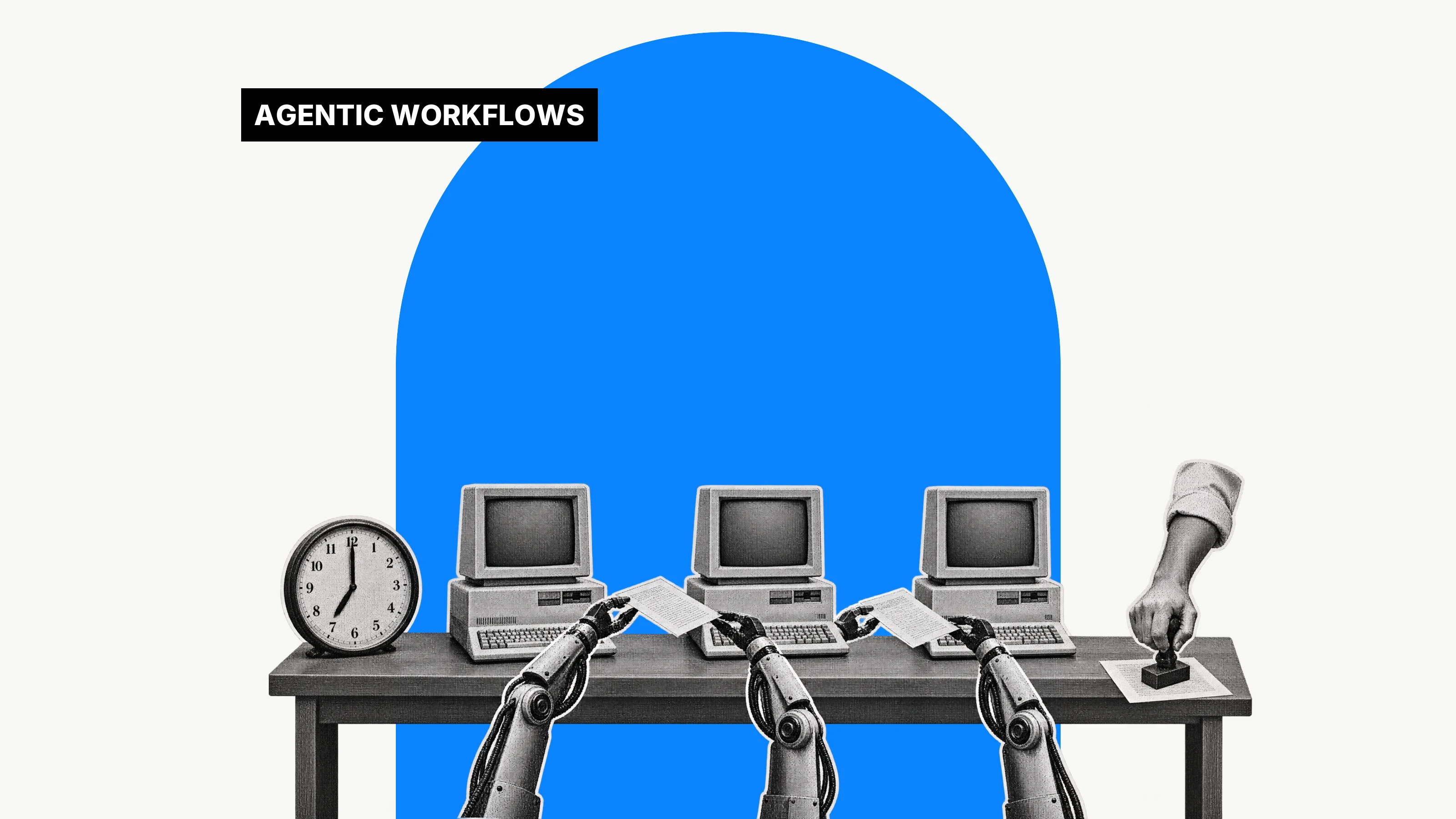
An agentic workflow is a piece of business work that starts on its own, moves between AI agents that each own a part, and comes back to a person only for the decisions.
Most definitions online come from engineering teams. IBM describes agentic workflows as "AI-driven processes where autonomous AI agents make decisions, take actions and coordinate tasks with minimal human intervention." Anthropic draws a useful line between workflows, "orchestrated through predefined code paths," and agents, which "dynamically direct their own processes and tool usage." Both are right, and both are written for the person building the system.
This piece is for the person running the business. We looked at every piece of work AI agents did at businesses on Dock from October 1 to November 5, 2026, for our report, The State of AI Agents for Business. The workflows that keep running share three properties. The ones that stall after the pilot are usually missing one of them.
1. It starts on its own
Half of all agent work in our data ran on a routine. Someone decided once that an agent should prepare a brief every morning, check the CRM every hour or send a report every Friday, and the agent has done it since.
About two in three of those runs happened outside weekday office hours: 21% on weekday evenings, 16% in early mornings, 13% overnight and 16% at weekends. Only 1 in 7 pieces of agent work started with a person typing a message.
That is the first test. A workflow that moves only when someone remembers to ask is a tool you operate. A workflow on a schedule delivers the work whether or not anyone is at a desk.
Take the founder of a twelve-person firm who opens her laptop on a Tuesday. Already waiting: a list of companies that match her best customers, a one-page brief on what two competitors changed last week, and two follow-up emails drafted for prospects who went quiet. She asked for none of it that morning.
2. It moves between specialists
A third of all agent work was started by another agent. One agent finished its part and handed the next part on. For every piece of work a person started by message, agents started about two and a half for each other.
The handoff is where a workflow becomes agentic in the business sense. A research agent builds the account brief and hands it to the sales agent. The sales agent drafts the outreach and passes it to the account lead. Nobody copies anything between tools.
Sharing makes the difference, and it is the idea behind multiplayer AI. In teams, the quarter of agents shared with the whole team did half of all the work, and they were handed 58% of the work other agents started. On their busiest days, agents handled more than 20 pieces of work, and 42% of it arrived from another agent, against 34% on an average day.
So give each agent one job, and decide who it hands to. Specialists beat generalists here, the same way they do on a human team. We made the longer case in Hire specialists, not software.
3. It brings back decisions
In the shared docs, tables and pages these teams work in, agents do most of the editing. People step in most on docs, because docs hold the plan, the pitch and the policy.
The part people keep is the point. A good agentic workflow brings a person one decision: approve this outreach, pick which account to call, sign off the report. Write down which decisions come back to a person, and let everything else move.
Why so many agentic workflows stall
Gartner predicted in June 2025 that more than 40% of agentic AI projects will be canceled by the end of 2027, citing rising costs, unclear business value and inadequate risk controls (as reported by Reuters).
In our reading, a stalled workflow is usually missing one of the three properties:
- No schedule. It waits for someone to ask, and people stop asking.
- No handoff. One agent tries to do everything, or its output sits in a doc nobody opens.
- No decision rule. The agent brings back ten questions, and someone ends up redoing the work.
Three ways to run agentic workflows, and a fourth
Workflow builders. You design each step and wire the tools together. This works while the steps never change. When the data is messy or a tool changes, the flow stops and waits for whoever built it.
Chat assistants. They are capable, and nothing starts until someone types. That covers the 1 in 7 pieces of agent work that begin with a message and misses the rest.
AI added to seat software. The agent lives inside one app and one person's account. Its work can't move to someone else's agent, so handoffs stop at the edge of the app.
A team of hired agents. This is how Dock works, and we build Dock, so weigh our view accordingly. Each agent has their own computer, memory and schedule, so routines run with every laptop closed. Agents are shared with the team, so work moves between them, and people set the rules and make the calls. $40 a person a month includes up to five cloud agents with AI usage included.
Teams already run this way. Jared Ben-Jamin, Mach9's first sales hire, runs seven agents that keep 82 deals current every hour. Brandon K.'s agents found 70 verified leads with work emails for his team of account executives.
How to set up your first one this week
- Pick work you already do on a schedule. The Monday pipeline report, the Friday invoice chase, the morning inbox sweep.
- Split it into parts and give each part to one agent. Research, draft, update the record.
- Set the routine. Decide when it runs, including evenings and weekends where the work allows.
- Name the one decision that comes back to you. Everything else moves without you.
- Read every output for two weeks. Most routines need one or two fixes. After that, they run.
For ideas on where to start, see AI agent use cases and AI agents for lead generation. For the bigger picture of how small teams use this to work like large ones, read Small teams, big companies.
Where Dock is not the right pick
If your workflow is a fixed sequence of steps that never changes, a workflow builder such as Zapier or n8n is simpler. If you are an engineering team building agents into your own product, start with an agent framework and Anthropic's guide. Dock is for businesses that want agents doing ongoing work alongside their people.
FAQ
What is an agentic workflow? A piece of business work that starts on its own, moves between AI agents that each own a part, and comes back to a person only for the decisions.
What is the difference between an agentic workflow and automation? Automation follows fixed steps that someone designed. In an agentic workflow, agents decide how to do their part, adapt when the data is messy and hand the work on to the next agent.
How much agent work runs without a person asking? In our data, only 1 in 7 pieces of agent work started with a person typing a message. Half ran on routines, and a third was handed over by another agent.
Do agentic workflows take people out of the work? People stay in charge. Agents do most of the editing in shared work, and people make the decisions: the plan, the final edit and what goes out.
What are examples of agentic workflows in a business? A nightly list of matching companies with a named contact, a morning competitor brief, a Friday invoice chase, an hourly CRM update, and follow-up emails drafted for prospects who went quiet.
How do I start an agentic workflow? Pick one task you already do on a schedule, give each part to one agent, set the routine and name the one decision that comes back to you.
The business examples in this piece, other than the named customer stories, are composites built from patterns in the data.
Hire agents for business work. Request an invite.