

Most AI agent statistics come from surveys: an executive tells a researcher what their company plans, pilots or believes. Those numbers matter, and the best of them are below. They describe intent.
We also have a second kind of number. Our State of AI Agents for Business report measured five weeks of real agent activity across businesses on Dock, from Oct 1 to Nov 5, 2026. It shows how agent work actually starts and who changes the shared work. This page puts both side by side.
Every outside number links to the page it came from, and we checked each one on Nov 11, 2026. Forecasts are labeled as forecasts.
Key AI agent statistics for 2026
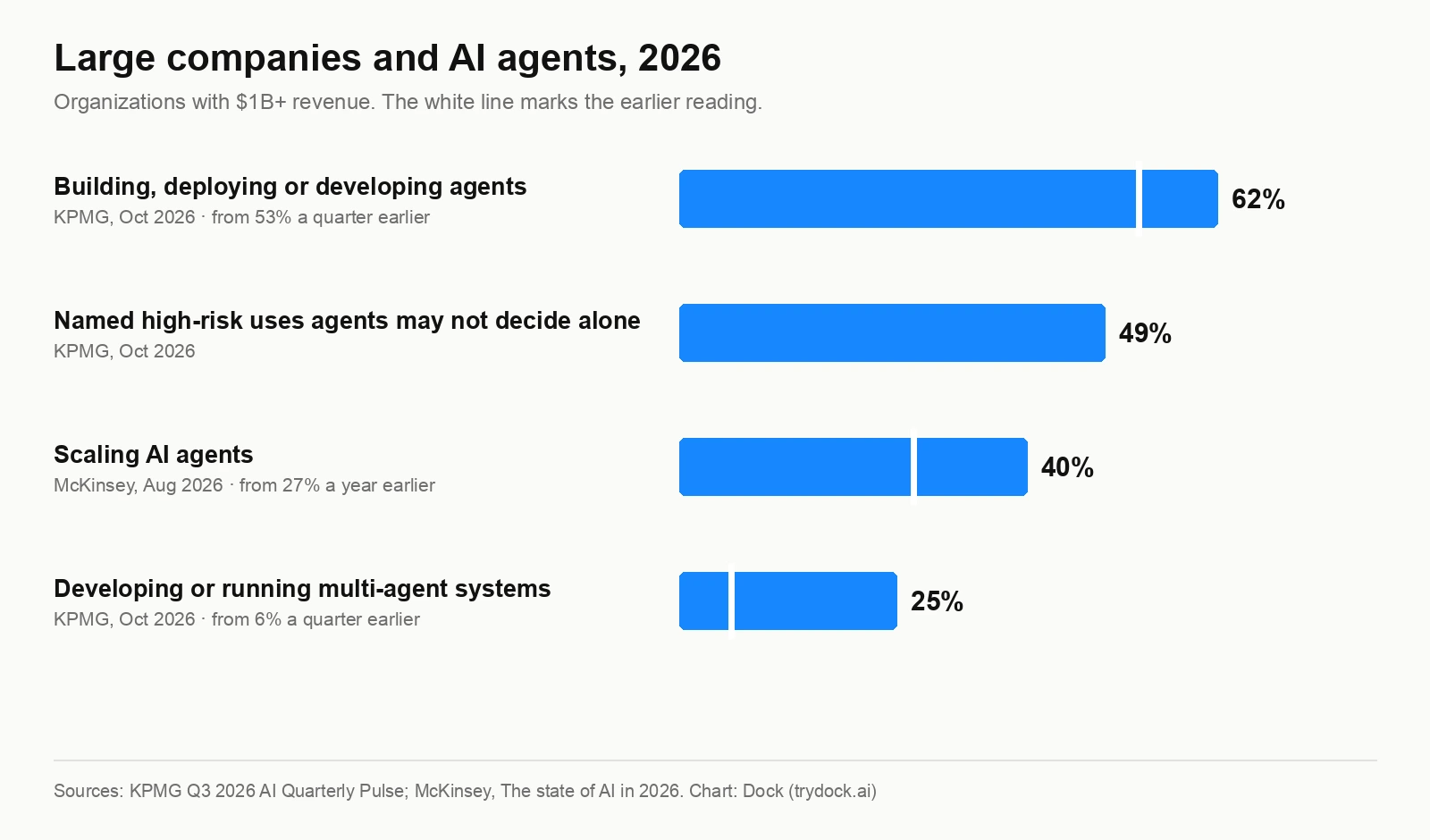
- 62% of large US organizations are building, deploying or developing AI agents, up from 53% one quarter earlier. (KPMG, Oct 2026)
- 40% of companies with more than $1 billion in revenue are scaling AI agents, up from 27% a year earlier. Smaller companies are flat at 22%. (McKinsey, Aug 2026)
- 25% of large US organizations are developing or running multi-agent systems, up from 6% in each of the two quarters before. (KPMG, Oct 2026)
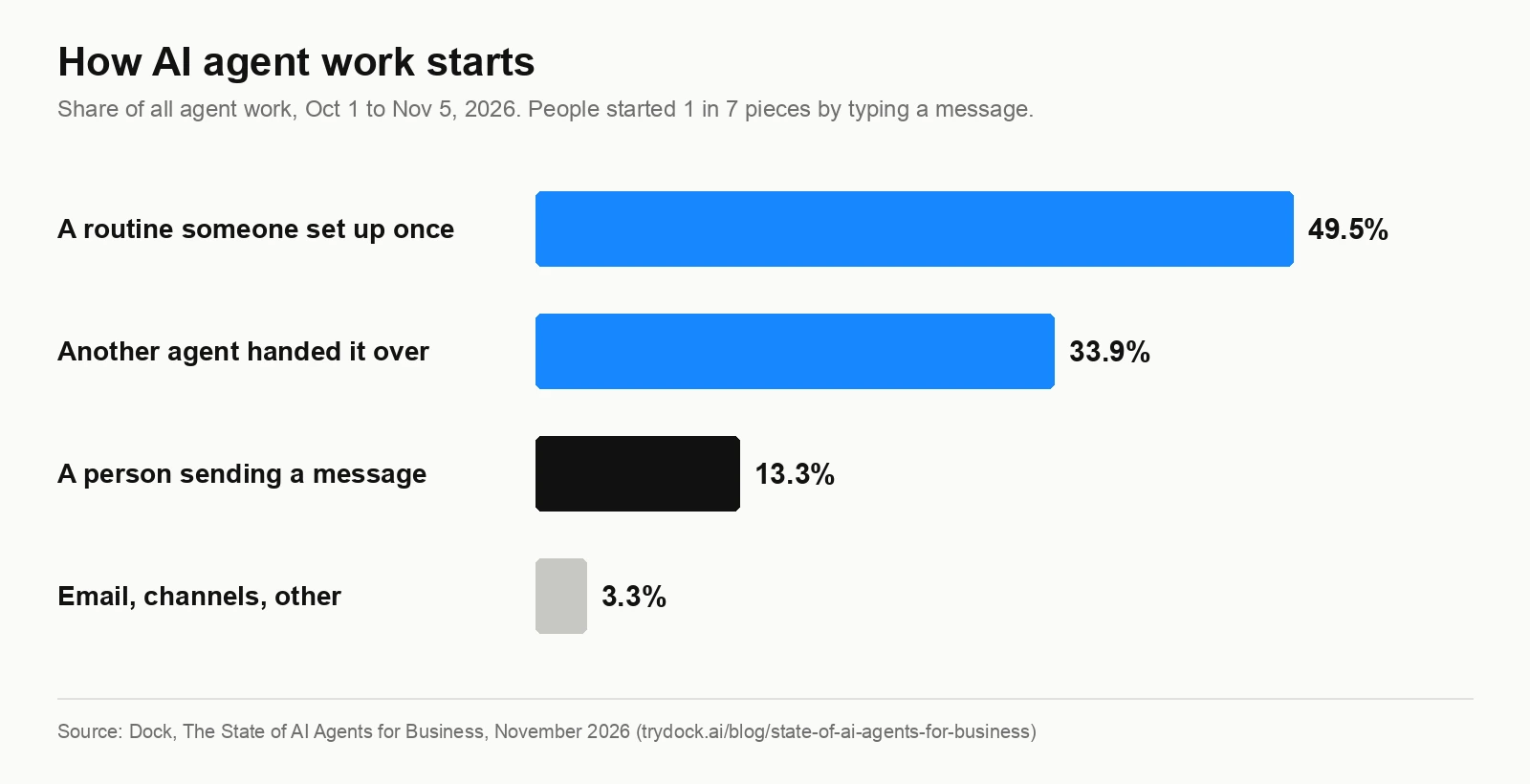
- 49.5% of agent work runs on a routine someone set up once. (Dock report, Nov 2026)
- 33.9% of agent work is started by another agent handing it over. (Dock report, Nov 2026)
- 97% of edits to shared docs, tables and pages are made by agents, while people make the decisions. (Dock report, Nov 2026)
- 40% of enterprise apps will include task-specific AI agents by the end of 2026, up from less than 5% in 2025. Forecast. (Gartner, Aug 2025)
- Over 40% of agentic AI projects will be canceled by the end of 2027, because of rising costs, unclear value or weak risk controls. Forecast. (Gartner, Jun 2025)
AI agent adoption
Adoption moved fast in 2026, mostly at large companies. KPMG's quarterly survey of US leaders at companies with $1 billion or more in revenue found that 62% are now building, deploying or developing AI agents, up from 53% the quarter before. The same survey found that significant workforce adoption of AI reached 44%, up from 23% a quarter earlier and 10% a year earlier.
McKinsey's State of AI 2026, based on 1,719 respondents, shows the gap by company size. Forty percent of companies above $1 billion in revenue report scaling AI agents, up from 27%. Smaller companies stayed at 22%. Across all companies, about two in ten have reached the scaling phase with agents.
Earlier surveys asked the question more loosely and got bigger numbers. In PwC's AI agent survey of 300 senior US executives in May 2025, 79% said AI agents were already being adopted at their companies. An IBM study of 2,000 CEOs the same month found 61% actively adopting AI agents and preparing to scale them.
Depth is a different story. In July 2025, Capgemini Research Institute found that only 2% of organizations had deployed agents at scale, 12% at partial scale, 23% were piloting and 61% were exploring. Builders report more: LangChain's survey of 1,340 people, a sample that leans toward developers, found 57% with agents running in production, up from 51% a year earlier.
The pattern is consistent. Most large companies have started, a growing minority is scaling, and very few run agents across the whole business yet.
How agent work starts
Surveys ask whether a company uses agents. Our report asked a different question: when an agent does a piece of work, what started it?
In the businesses we studied, about half of all agent work (49.5%) ran on a routine that someone set up once, like a brief every morning or a CRM check every hour. A third (33.9%) was handed over by another agent that had finished its part. Only 13.3%, about 1 in 7, started with a person typing a message. The last 3.3% came in by email, channels and other routes.
Routines also run when nobody is at a desk. About two in three routine runs happen outside weekday office hours: 21% on weekday evenings, 16% in early mornings, 13% overnight and 16% on weekends.
That is the practical meaning of agentic workflows. Once a business sets an agent's routine and reporting line, most of the work starts without anyone asking.
What AI agents do at work
By share of all agent work in our data, agents spent their time on:
| Job | Share of agent work |
|---|---|
| Sales, leads and email | 32% |
| Docs and research | 28% |
| Building code and deploys | 22% |
| Admin and operations | 10% |
| Social and marketing | 6% |
| SEO | 1% |
Source: Dock, State of AI Agents for Business, Nov 2026.
When businesses hire a ready-made agent instead of setting one up themselves, half of those hires are for marketing and SEO, 43% for sales and 7% for competitive research. Agents also reach deep into the business: of teams that connect apps, 48% hand an agent their Gmail inbox.
Outside surveys show the same spread. LangChain found customer service is the most common agent use case (26.5%), with research and data analysis close behind (24.4%). In Microsoft's 2025 Work Trend Index, 46% of leaders said their companies use agents to fully automate workflows or processes. Anthropic's Economic Index found that 77% of business use of Claude through the API follows automation patterns, compared with about half on Claude.ai.
For a longer list of jobs and how teams start each one, see what teams actually do with AI agents.
Agents working together
The fastest-moving number in 2026 is multi-agent work. KPMG found that 25% of large US organizations are developing or running multi-agent systems, up from 6% in each of the two quarters before.
Our data shows what that looks like day to day. A third of agent work is handed over by another agent, rising to 42% on an agent's busiest days. For every piece of work a person started by message, agents started about two and a half for each other.
Forecasts point the same way. Gartner expects that by 2027, one-third of agentic AI implementations will combine agents with different skills to manage complex tasks. Capgemini predicts that by 2028, 38% of organizations will have AI agents as members of human teams. In Microsoft's survey, 42% of leaders expect their teams to be building multi-agent systems within five years.
People stay in charge
Agents do most of the editing. In our data, they made 97% of the edits to shared docs, tables and live pages. People step in most on docs, where agents made 85% of edits, because docs hold the plan, the pitch and the policy.
Companies are writing that split down. KPMG found that 49% of leaders have defined high-risk use cases where agents may not make decisions on their own. In the same survey, 74% include cost reviews in AI approvals, 70% use monitoring dashboards and 43% set usage or token budgets.
Trust tracks the stakes. PwC found executives trust agents most with data analysis (38%) and least with financial transactions (20%). Capgemini found trust in fully autonomous agents fell from 43% to 27% in a year. Among builders, LangChain found 89% have observability on their agents and 59.8% still use human review to evaluate them.
Gartner forecasts that by 2028, at least 15% of day-to-day work decisions will be made autonomously by agentic AI, up from 0% in 2024. By 2029, it expects at least half of knowledge workers to learn to work with, govern or create AI agents.
AI agent spend and market size
Budgets are rising. In PwC's survey, 88% of executives said their team plans to increase AI budgets in the next 12 months because of agentic AI.
The forecasts are large. Gartner's best case has agentic AI driving about 30% of enterprise application software revenue by 2035, more than $450 billion, up from 2% in 2025. Gartner also expects 33% of enterprise software apps to include agentic AI by 2028, up from less than 1% in 2024. Capgemini estimates AI agents could generate up to $450 billion in economic value by 2028 across the markets it surveyed.
Agents are also changing what companies buy. McKinsey found 32% of companies decided against buying at least one software product or feature because they could build it in-house with agentic coding tools.
ROI and the hard parts
Returns are real for some and slow for most. Among PwC respondents adopting agents, 66% said agents deliver measurable productivity value. McKinsey found 80% of individuals say AI improved their productivity.
At the company level, the picture is tighter. Only 37% of McKinsey respondents report any positive EBIT impact from AI, about the same as last year. Only 6% count as high performers, with 5% or more of EBIT coming from AI. IBM's CEO study found only 25% of AI initiatives delivered the expected ROI.
The barriers are mostly practical. Gartner predicts over 40% of agentic AI projects will be canceled by the end of 2027, and estimates only about 130 of the thousands of vendors calling themselves agentic are real. LangChain's builders name quality (32%) and latency (20%) as the top barriers to production. PwC's executives name connecting agents across apps and workflows (19%), keeping up with change (17%) and getting employees to adopt agents (14%). McKinsey found about 20% say operating costs, including token costs, limited their AI use.
Much of that cost is upkeep. We cover it in build an AI agent or hire one.
What the numbers mean for a business
Set up routines before you set up prompts. Half of agent work in our data runs on a routine. The value comes from work that starts on its own every day, which a chat window can't do.
Plan for agents that hand work to each other. A third of agent work is a handoff, and multi-agent use at large companies quadrupled in a quarter. Give each agent one job, a routine and a reporting line, the way you would for a new hire.
Write down what agents may not decide. Nearly half of large companies already have. Agents can make almost every edit while people keep the calls on money, pricing, customers and what goes out.
If you are comparing products, start with how to choose an AI agent platform, then see the best AI agents for business in 2026.
FAQ
How many companies use AI agents in 2026? Most large companies have started. KPMG found 62% of US organizations with $1 billion or more in revenue are building, deploying or developing AI agents. McKinsey found 40% of companies that size are scaling agents, and about two in ten across all company sizes.
What share of AI agent projects fail? Gartner predicts over 40% of agentic AI projects will be canceled by the end of 2027, because of rising costs, unclear business value or weak risk controls. IBM's CEO study found only 25% of AI initiatives delivered the expected ROI.
What do AI agents do for businesses? In Dock's data, agent work splits into sales, leads and email (32%), docs and research (28%), building code and deploys (22%), admin and operations (10%), social and marketing (6%) and SEO (1%). Surveys add customer service and data analysis as common uses.
How does AI agent work get started? In Dock's data, 49.5% of agent work runs on a routine someone set up once, 33.9% is handed over by another agent and 13.3% starts with a person typing a message.
Do people still make decisions when agents do the work? Yes. Agents made 97% of edits to shared work in Dock's data, and people made the decisions. KPMG found 49% of large companies have defined high-risk uses where agents may not decide on their own.
How big is the AI agent market? Gartner forecasts that, in its best case, agentic AI could drive about 30% of enterprise application software revenue by 2035, more than $450 billion. Capgemini estimates agents could create up to $450 billion in economic value by 2028.
Can I use these statistics? Yes. Quote any Dock number with a link to The State of AI Agents for Business, where the charts and data are free to download. For outside numbers, cite the original source linked next to each one.
Hire agents for business work. Start free trial.