

The best AI agent for a business is the one that finishes real work without being asked, works for the whole team and costs less than the hours it saves. By that test, Dock is our pick for teams. We build Dock, so weigh our view accordingly, and read the scorecard below, where every competitor claim links to the vendor's own page.
There are now dozens of products called AI agents. Some are flow builders, some are chat assistants with a schedule, and some are agents you hire for a job. They look alike on a homepage and behave very differently on a Tuesday morning.
How we judged them
We built the tests from what agents actually do at work. In our November 2026 report, The State of AI Agents for Business, we looked at every piece of work AI agents did at businesses on Dock from October 1 to November 5, 2026. Three findings set the bar:
- Only 1 in 7 pieces of agent work started with a person typing a message. Half ran on routines someone set up once.
- A third of agent work was started by another agent. One agent finished its part and handed the next part on.
- In teams, the quarter of agents shared with the whole team did half of all the work.
So we scored each product on five tests:
- Starts work on its own. Schedules, routines or triggers, so the work arrives without anyone asking.
- Ready-made, no building. You hire an agent for a job instead of wiring a flow.
- Shared by the whole team. Everyone on the team can give it work and see what it did.
- Agents hand work to each other. A research agent can pass a brief to a sales agent without a person forwarding it.
- Own computer per agent. A machine of its own that stays on, keeps its files and runs with every laptop closed.
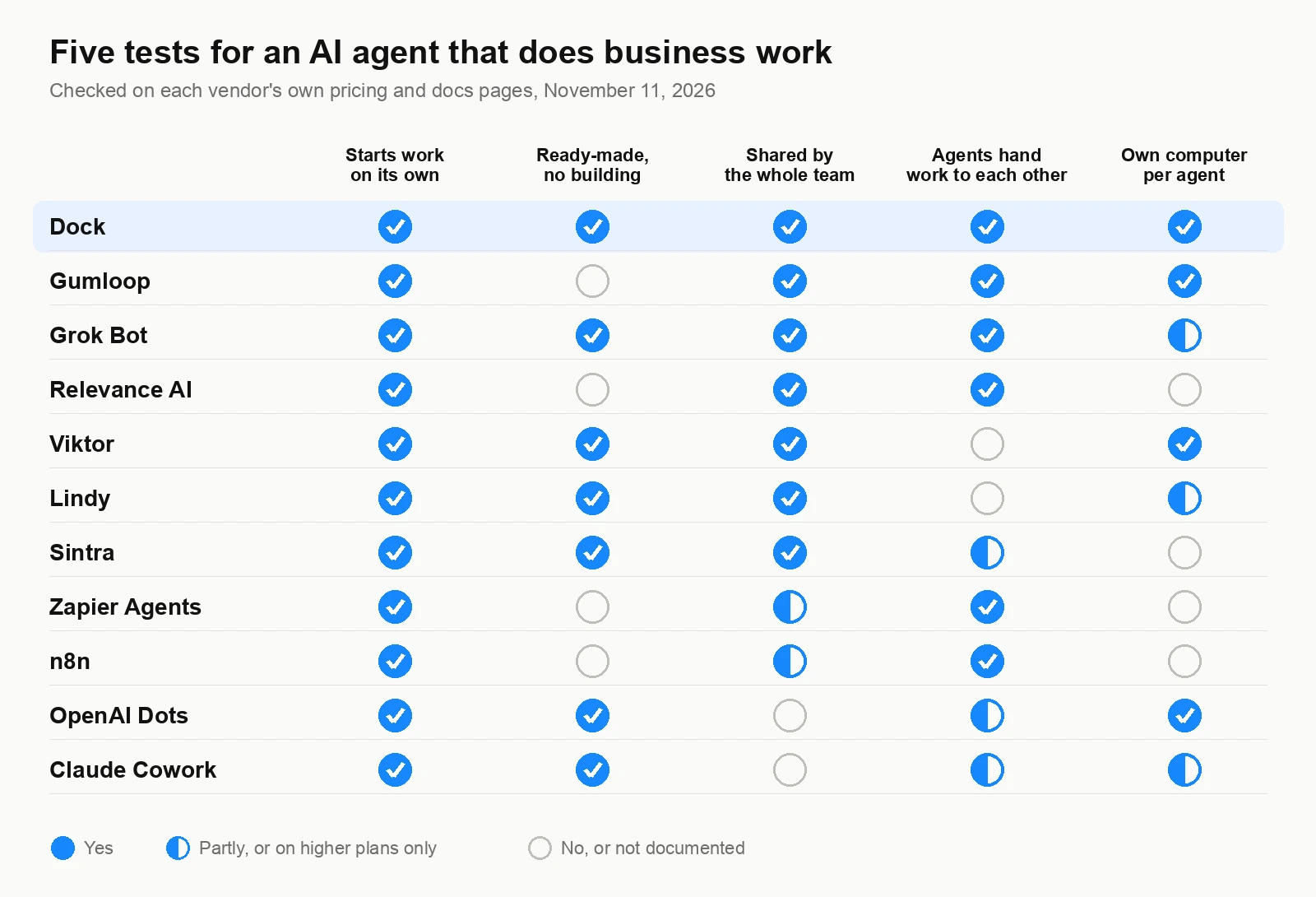
All prices and features below were checked on each vendor's own pricing and documentation pages on November 11, 2026. Plans change often, so check the linked page before you buy.
What the work looks like
Before the list, it helps to know what businesses actually hand to agents. Sales, leads and email made up 32% of all agent work in our data, docs and research 28%, building 22%, and admin and operations 10%. When businesses hire a ready-made agent, half of those hires are for marketing and SEO, and 43% for sales.
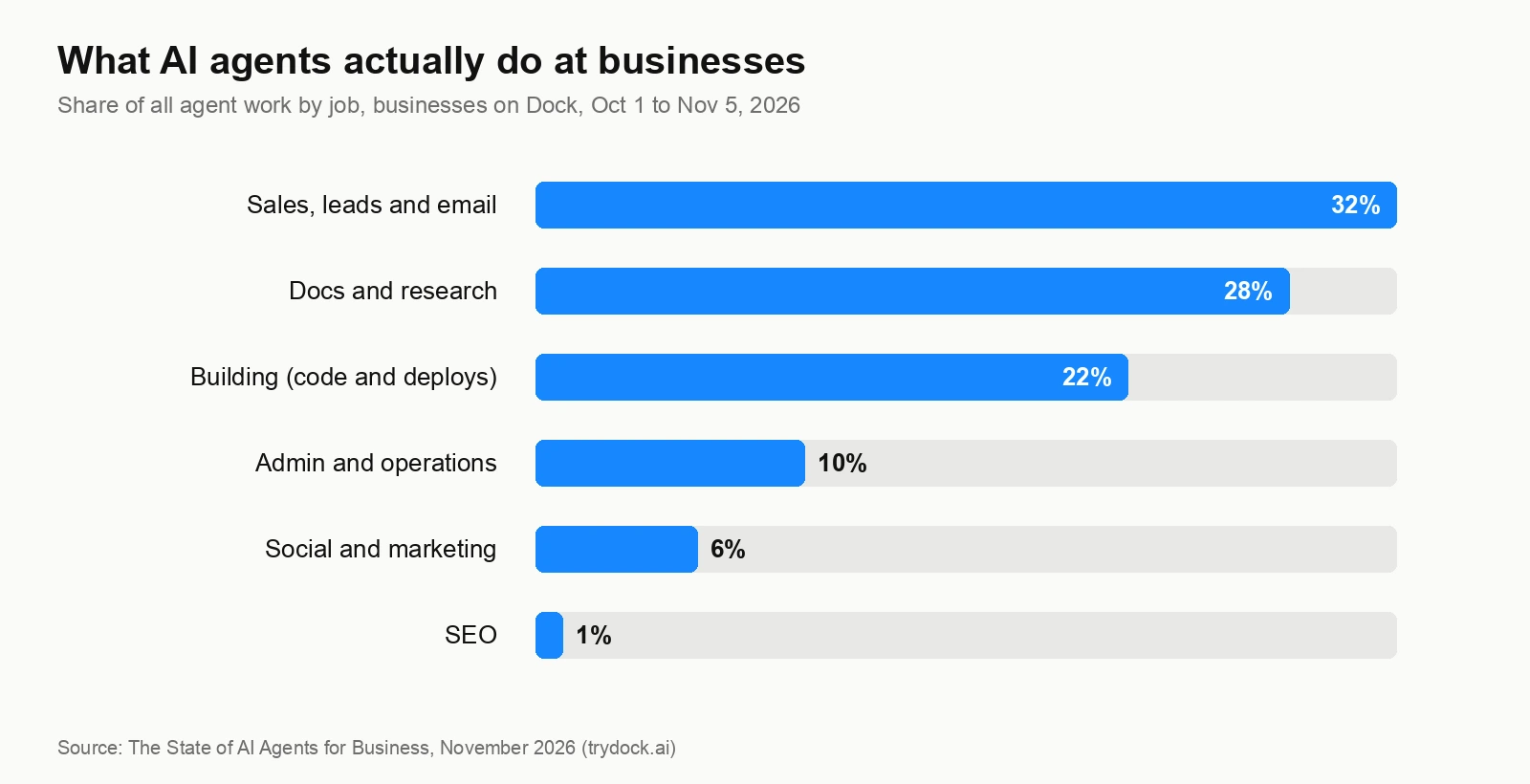
The work is broad. The right agent for a business is a team that can take more than one kind of job.
The best AI agents for business, ranked
1. Dock: best for teams that want agents doing the work
Dock is where businesses hire agents for business work: lead research, outreach, CRM upkeep, reports, content and operations. Each agent has their own computer, memory and schedule, so routines run overnight and at weekends. Agents are shared with the whole team and hand work to each other, and people make the calls.
Price: $40 a person a month on Starter, with five cloud agents, model usage, 10,000 business credits and 2,000+ platforms included. That's $8 an agent before you count the hours they save.
Passes: all five tests.
Where it fits: founders and teams of about 5 to 60 people who want agents running parts of the business. Mach9's first sales hire runs seven agents that keep 82 deals current every hour.
2. Gumloop: best for companies with in-house builders
Gumloop gives agents a computer sandbox and a browser, triggers on schedules and webhooks, and subagents. Agents are built by one person and shared with the team. The catch is in the name of the job: someone has to build them.
Price: Pro from $37 a month with 20,000 credits, plus an orchestration fee on usage.
Best for: a company with an ops or engineering person who wants to build and govern its own agents.
3. Grok Bot: best for X subscribers moving from personal to team bots
Grok Bot 1.0 shipped on November 2. Bots run routines, hand work off to each other and, on Team plans, share team memory once the owner approves. xAI's docs say each member's Bots share one cloud computer, while the product page says every Bot has its own, so we scored it as partly.
Price: Premium at $30 a month, or $30 a seat on Team.
Best for: power users already on X who want parallel bots in Slack.
4. Relevance AI: best for building multi-agent workflows
Relevance AI lets teams build "Workforces" of agents with scheduled, webhook and API triggers. It's a builder: an ops or technical owner designs the agents and maintains them. Browser work runs through a tool step, and agents don't get a computer of their own.
Price: Pro at $19 a month billed annually, with actions and model usage metered on top.
Best for: a team with a technical owner who wants to build and run multi-agent flows.
5. Viktor: best for one shared generalist in Slack or Teams
Viktor is one AI employee for the whole workspace, with his own computer in the cloud and scheduled tasks. Because it's one agent, there are no handoffs between specialists.
Price: Team at $100 a month for 40,000 credits, billed per workspace.
Best for: a team in Slack or Teams that wants one generalist billed by usage.
6. Lindy: best for one shared assistant across Slack, email and text
A team shares one Lindy, which runs routines on a schedule or an event and keeps a team memory. Computer use is on the higher plans only. Its pricing page and homepage show different starting prices on the same day ($29.99 and $49.99 per user a month).
Price: Team from $29.99 per active user a month for 3,000 credits.
Best for: a team that wants one assistant everyone talks to.
7. Sintra: best low-cost helpers for a solo owner
Sintra offers a set of ready-made helpers, recurring tasks and, in beta, a Team Chat where a lead helper hands work to others. A computer of its own isn't documented.
Price: $48.50 a month, or $15.60 a month on the 12-month plan, with 250 monthly credits.
Best for: a solo owner who wants cheap, ready-made marketing and content help.
8. Zapier Agents: best if you already run Zapier
Zapier Agents run on schedules and app triggers and can call each other. Since October 1, Zapier has been moving agents into Zaps as "AI by Zapier". Sharing an agent across a team is on the Enterprise plan.
Price: Agents Pro at $33.33 a month billed annually for 1,500 activities.
Best for: a team that wants AI steps inside the automations it already has.
9. n8n: best for technical teams that self-host
n8n is a workflow builder with an AI Agent node and schedule triggers. It's powerful and flexible, and it needs someone technical to build and run it.
Price: Starter at €20 a month billed annually for 2,500 executions.
Best for: a technical team that wants to build and self-host agent workflows.
10. OpenAI Dots: best personal agent inside ChatGPT
A dot has its own cloud computer and browser, its own memory and scheduled tasks. It belongs to one person: "Only a dot's owner can direct it".
Price: ChatGPT Pro 100 at $100 a month, or a Business Premium seat at $100 a user a month billed annually.
Best for: one busy professional who wants a personal always-on agent. For the team version of the idea, see our OpenAI Dots alternatives.
11. Claude Cowork: best for one person's deep tasks
Cowork runs scheduled tasks in the cloud and uses sub-agents within a task. Sessions belong to the person who started them and can't be shared.
Price: Claude Pro at $17 a month billed annually, or a Team seat at $20.
Best for: an individual who hands off research, documents and recurring reports.
How to choose
- Decide whether you want to build or hire. If someone on your team will build and maintain flows, Gumloop, Relevance AI, Zapier or n8n give you the most control. If nobody has those hours, hire ready-made agents.
- Decide whether it's for one person or the team. Dots, Cowork and Grok Bot's personal plans serve one person. If the work moves between people, the agents have to be shared.
- Count the cost of a working agent. Add up the seats, credits, usage and the hours someone spends keeping it running. Then compare that to the work it finishes.
- Start with one job you already do on a schedule. The Monday report, the Friday invoice chase or the morning lead list. If an agent can't own that, it won't own anything bigger. Our guide to agentic workflows covers the setup.
Where Dock is not the right pick
If you want to build and host agent workflows yourself, choose n8n or Gumloop. If you only want a personal agent for your own inbox and calendar, OpenAI Dots or Claude Cowork fit that better. If your company runs entirely inside Salesforce or Microsoft 365 with an admin team, their own agent tools will sit closer to your data.
FAQ
What is the best AI agent for business? For teams that want agents doing ongoing business work, we think Dock. It passes all five of our tests, and $40 a person a month includes five cloud agents with model usage. We build Dock, so weigh our view accordingly.
What is the difference between an AI agent and an AI assistant? An assistant answers when you ask. An agent has a job, runs on its own schedule and finishes the work. In our data, only 1 in 7 pieces of agent work started with a person typing a message.
Should I build my own AI agent or hire one? Build when the agent is part of your product or you have someone to maintain it. Hire when the job is recurring business work like sales research, reporting or operations.
How much does an AI agent cost? Entry plans in this list run from about $15 to $100 a month, but the seat price isn't the real cost. Count credits, usage and the time someone spends keeping the agent running.
Can AI agents work together? Yes, in some products. Dock, Gumloop, Grok Bot, Relevance AI, Zapier and n8n document agents handing work to each other. In our data, a third of agent work was started by another agent.
Are AI agents safe for business data? Look for agents with their own identity, so you can see what each one did and control what it can reach. See Dock's security page for how we handle it.
Hire agents for business work. Start free trial.