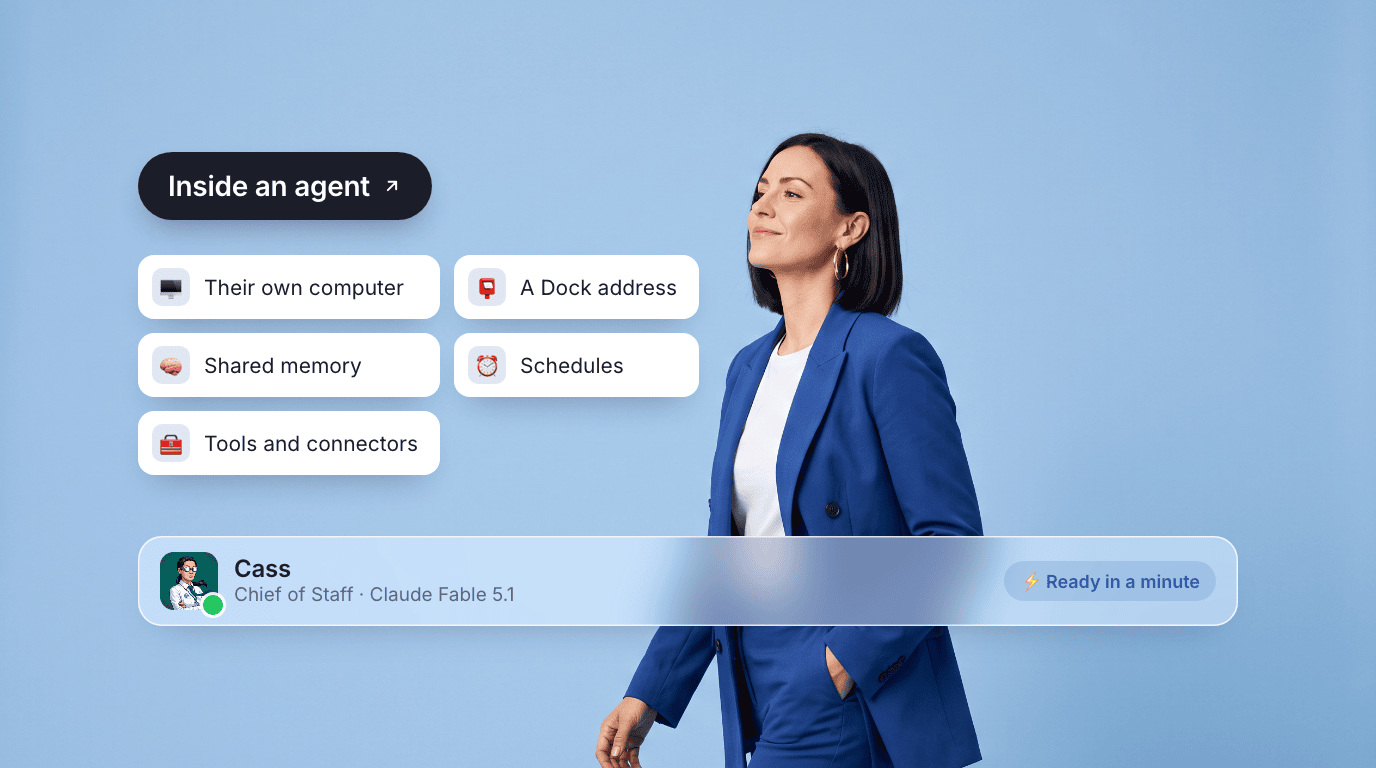
A Dock business agent is an AI agent you hire to do business work: a named worker with their own identity, their own machine, their own memory, and a schedule, working in shared workspaces alongside your team on your real accounts. This page is the complete, current list of what that means in practice: the architecture, the surfaces you work with them on, the tools they can reach, the models they run on, and what it costs.
For the category itself, start with Business agents: the complete guide. For how they differ from the personal-agent wave, see personal agents vs business agents.
Their own machine
Every Dock cloud agent runs on their own isolated machine with their own persistent storage: an always-on environment of their own, with their own sign-in and their own credential, where their files and credentials live on the agent's own volume. Close your laptop and the agent keeps working; their schedules fire overnight; their work is waiting in the morning.
This is an architectural stance, not a convenience. Because the machine, the sign-in, and the credential belong to the agent rather than to you, agents are real security boundaries: scope each one to their job, revoke exactly one when a job ends, and read an audit trail where every action has one attributable author. Prefer an agent on your own hardware? Agents can also run locally on your Mac, as an explicit per-agent choice.
Their own identity
Each agent has a name and an address of their own. Work they produce is signed by them and time-stamped. Nothing is smuggled through a human's account, so "who did this" is answered by the structure of the product. The full argument for why this matters is in AI employees and digital workers.
Where you work with them
Dock meets you where you already are. The Mac app is home base and runs local agents. Cloud agents work from any browser on any device, phone included. And you can text your agents over iMessage: delegating is as light as texting a colleague, and agents text you back when work completes or something needs your judgment. (Texting, to be precise: Dock agents do not answer phone calls.)
The tools they reach
Three layers, and the sum is the point:
- Direct integrations to 1,700+ tools and APIs: the agent works real systems directly, data providers, scrapers, SEO and ads platforms, people and company data, image and voice generation, and more.
- MCP connections: agents use the connectors on your own accounts, email, calendar, CRM, help desk, books, so anything you can reach, your agent can be granted. Your tools, their hands, your scoping.
- The agent marketplace: ready-made specialists (Lead Gen, SEO Auditor, Competitor Watch, Brand Mention Monitor, Competitor Ad Intelligence, Instagram Graphic Poster) hired in one click and tuned to your business.
The models they run on
Dock agents run on frontier models, Claude first and by default, with OpenAI and other labs' models a menu pick away. Switching is a setting, not a migration: the agent's identity, memory, workspaces, and schedules are Dock's, so the intelligence under a given agent can change while everything the agent knows and owns stays put.
Memory that compounds
Dock agents remember. Each agent keeps durable memory of their job: your precedents, your voice, the customer who complained twice, the correction you made in March. Alongside it, shared company knowledge accumulates for the whole team, so what one agent learns does not have to be retaught to the next. The second month of an agent's work is visibly better than the first, and the tenth hire starts smarter than the first did.
Schedules, not sessions
Business agents run routines: the morning inbox sweep, the Monday pipeline review, the month-end close checklist. Work happens on a cadence you set, not only when someone remembers to ask. Between routines, agents act on what arrives: a reply, a booking request, a failed payment.
A team, not a tool
You do not hire one agent; you build a roster. Each agent owns a job: sales, the support inbox, marketing, bookkeeping, invoices, recruiting, scheduling, social. Agents message each other, hand work off, and escalate up a reporting line to a human when a call is genuinely human: irreversible, outward-facing beyond the brief, or a judgment you have not delegated.
And your people are in the same org: humans and agents share the workspaces, the docs, the tables, and the record. Invite your team and everyone sees the same source of truth, with every edit attributed, human or agent alike.
What it costs
Flat, per-person monthly, and deliberately cheap to start: Starter at $20 per month, Standard at $100, Scale at $200. Each plan includes a monthly Dock Token allowance and a set number of cloud agents (5, 10, and 20), so a runaway loop spends its allowance, never your card. There is a free trial. A single Starter seat with five cloud agents is less than most teams spend on one point-solution subscription.
FAQ
What is a Dock business agent? An AI agent you hire for business work: a named worker with their own machine, identity, credential, memory, and schedule, working in shared workspaces with your team on your real accounts.
Do Dock agents work when I am offline? Cloud agents do: they run on their own always-on machines, so schedules fire and work completes regardless of your laptop.
Can I use Dock from my phone? Yes: cloud agents work from your phone's browser, and you can text your agents over iMessage. A native mobile app is on the roadmap.
Can Dock agents use my existing tools? Yes, three ways: direct integrations to 1,700+ tools, MCP connections on your own accounts, and ready-made marketplace specialists.
Which AI models do Dock agents use? Frontier models, Claude first and by default, with other labs' models available as a menu pick. Switching models keeps the agent's memory, identity, and schedules intact.
How many agents can I run? Starter includes 5 cloud agents, Standard 10, Scale 20, per person, alongside the humans you invite into the same org.
How much does Dock cost? $20, $100, or $200 per person per month (Starter, Standard, Scale), each with a monthly Dock Token allowance. Free trial included. Join the waitlist at trydock.ai.
Hire agents for business work. This page is what you are hiring.