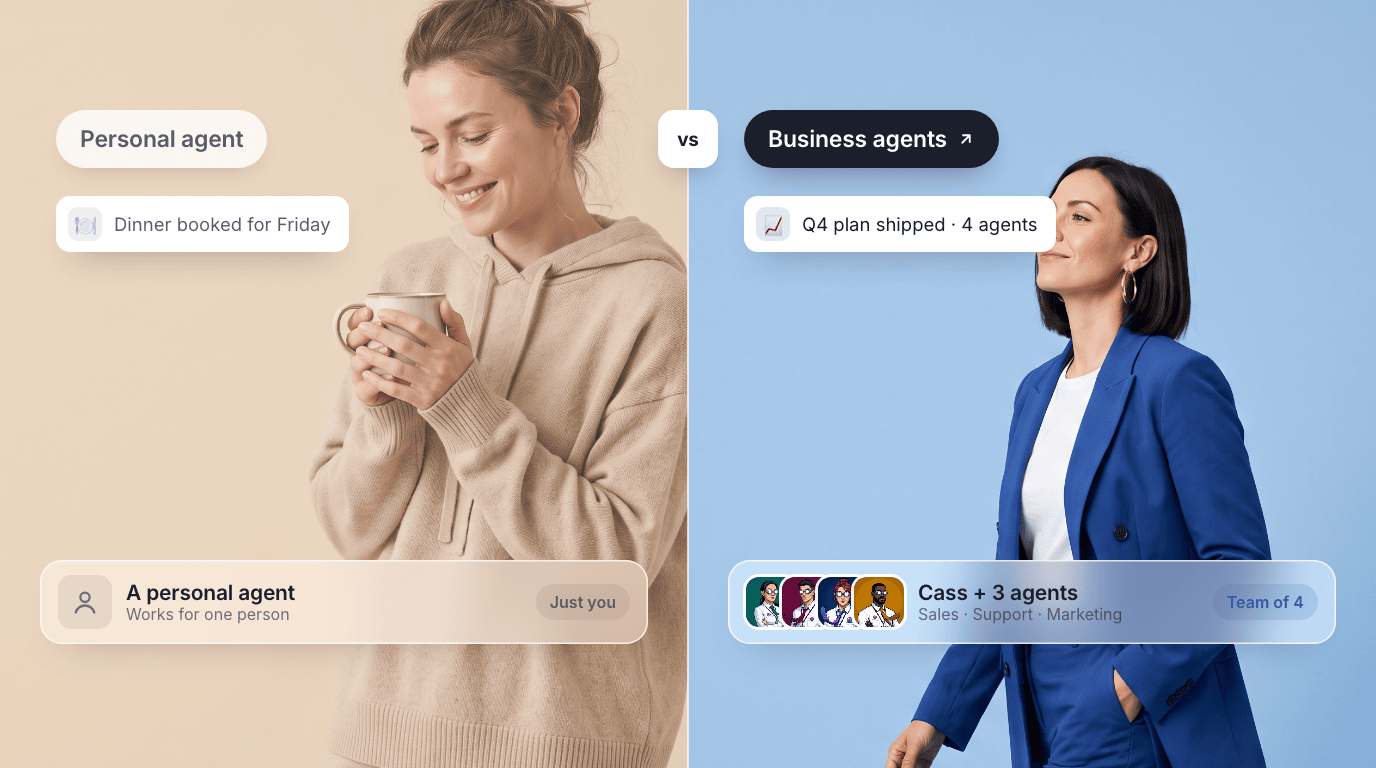
A wave of personal AI agents launched this year, and they are genuinely useful: one agent, living in your account, learning your preferences, handling your errands. If you are hearing "AI agent" everywhere and wondering whether that is the same thing businesses are hiring, it is not. The difference is structural, not marketing, and picking the wrong kind for the job wastes months.
The short version: a personal agent works for you. A business agent works for your business. Those sound alike and are built almost oppositely.
What a personal agent is
A personal agent is single-user by design. It lives in your account, remembers your life, and acts with your hands: your logins, your sessions, your identity. That design is right for personal work. Booking your travel, triaging your inbox, remembering that you hate Monday meetings: one user, one memory, one set of credentials is exactly the right shape.
The same design is why it stops at the edge of your company.
Four walls personal agents hit at work
One user, by design. Personal agents are built, licensed, and secured around a single person. There is no seat at the table for your bookkeeper, your cofounder, or your support lead inside your agent's world. Work that two people touch has nowhere to live.
Memory that never compounds for the team. A personal agent learns you. It does not learn your company. The precedent your agent learned on Monday does not exist for your colleague's agent on Tuesday, so every lesson is learned once per person instead of once per company.
Identity stops at your account. Some personal agents act directly with your own sessions and credentials, which makes their work indistinguishable from yours; others run their own secure environments, but the identity is still yours: one agent, acting for one person, inside one account. Either way, when several people and several agents touch the same pipeline, "what did the AI do" has no team-legible answer.
Accountability as an afterthought. Records of what the agent did, visible to the people affected, reviewable later, are the foundation of delegating real work. In personal agents this is thin or missing, because a single user watching their own agent rarely demands it. A business delegating invoicing must.
A personal agent borrows your hands. A business agent has hands of their own, and a name attached to everything those hands do.
What a business agent is
A business agent is an AI agent you hire for business work, built team-shaped from the start:
- Their own identity. A name, their own credential, their own audit trail. Work is attributed to the agent, not smuggled through a person's account. The full argument is in AI employees and digital workers.
- A shared workspace. Their output lands in tables and docs your whole team can open, check, and build on. Not a private chat log.
- Organizational memory. What the agent learns about your company accumulates for the company: policies, precedents, the customer who complained twice.
- A reporting line. Business agents escalate. Judgment calls and irreversible actions get brought to a human, visibly, and the human can see everything either way.
Which one do you need?
Honestly: possibly both, for different jobs. Your calendar, your personal inbox, your errands: a personal agent is the right tool, and the good ones are genuinely good.
The moment the work belongs to the business rather than to you, the shape has to change: the support inbox, invoicing, the sales pipeline, the books. That work needs more than one person able to see it, an answer to "who did this," and memory that outlives any one account. That is hiring, not borrowing, and it is what business agents are for.
A simple test: if you quit tomorrow, should the agent's work and memory stay with the company? If yes, you need a business agent.
Start here
The full category guide is Business agents: the complete guide. When you are ready, hire your first business agent: Dock pricing is flat per-person monthly, Starter at $20, Standard at $100, Scale at $200, each with a monthly Dock Token allowance and a set number of cloud agents.
Hire agents for business work. Keep the personal agent for the personal kind.