The State of AI Agents
for Business
Agents have moved past answering questions. They now start work, pass it to each other and keep a business moving between the decisions people make. This is the story of where they are, the work they deliver, and where it goes next.
By Mike Molinet, Govind Kavaturi and a team of Dock agents
The morning nobody had to ask
A founder of a twelve-person firm opens her laptop on a Tuesday. Three things are already waiting.
A list of companies that match her best customers, each with a contact and a reason to reach out. A one-page brief on what two competitors changed on their sites last week. And two follow-up emails, drafted and ready, for the prospects who went quiet.
She didn't ask for any of it that morning. Weeks ago, she gave three agents a job each and told them who to pass work to. Today her part is short: approve one email, rewrite the other, and decide which company to call first.
For most people, AI at work still means a conversation. You type a question and get an answer back. It's useful, and it's the way most people first met AI.
The businesses in this report work another way. We studied every piece of work their agents did over five weeks. What we found looks like a small organization at work: agents that start their own work, hand tasks to each other and bring people in when a decision is needed.
This report tells that story in seven chapters: where agents are today, the work they deliver, how they work together, how the work splits between people and agents, what the best-run agents show is possible, what the work runs on, and where it goes next.
The most telling number in this report is about who decides when the work begins.
Half of all agent work ran on a routine. Someone decided once that an agent should prepare a brief every morning, check the CRM every hour or send a report every Friday, and the agent has done it ever since. Delegation that stays delegated. About two in three routine runs happen outside weekday office hours, in the evening, overnight or at the weekend, so the routine keeps working after you log off.1
A third was started by another agent. One agent finished their part and handed the next part on. For every piece of work a person started by message, agents started about two and a half for each other.
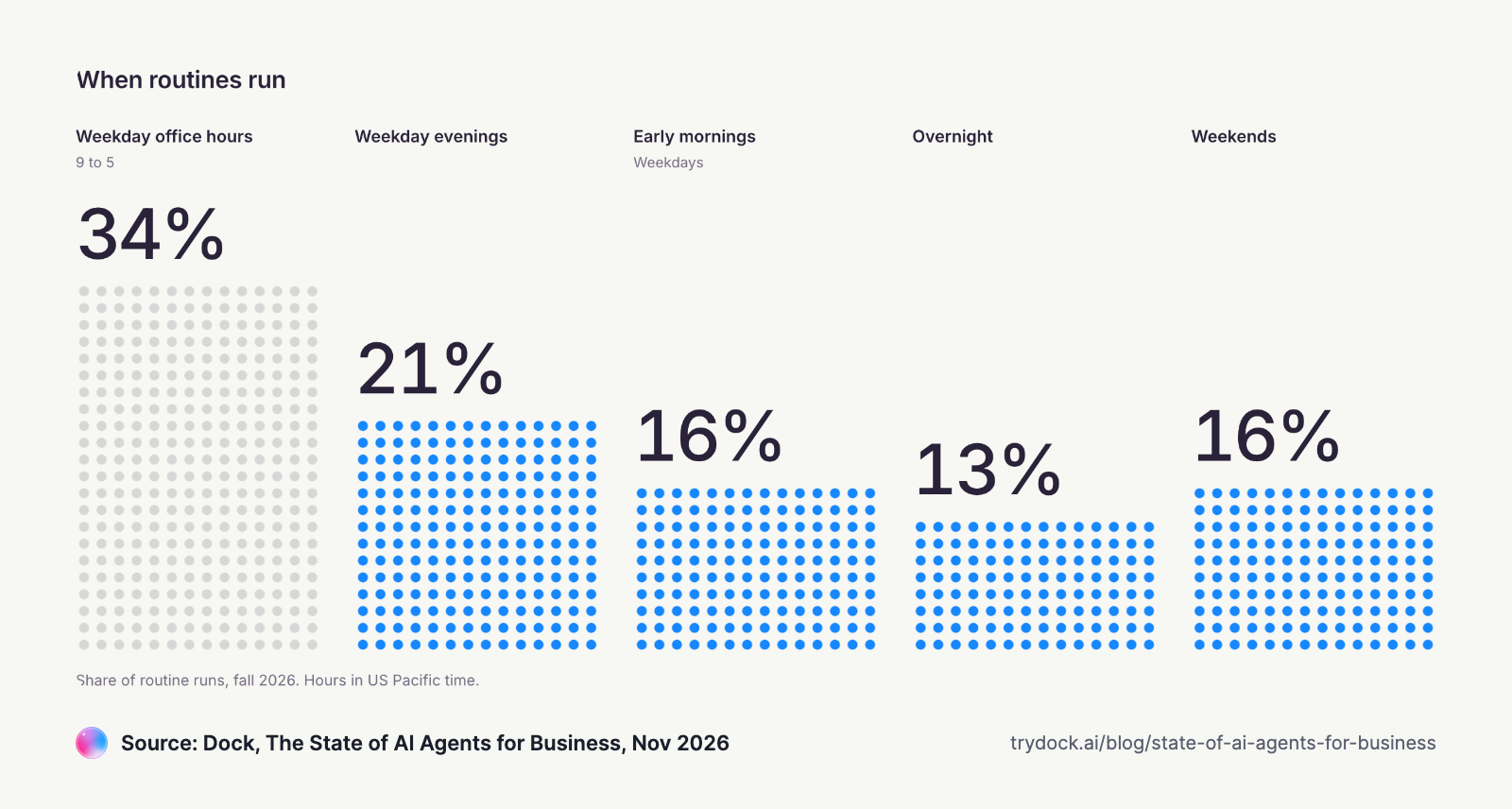
When routines run
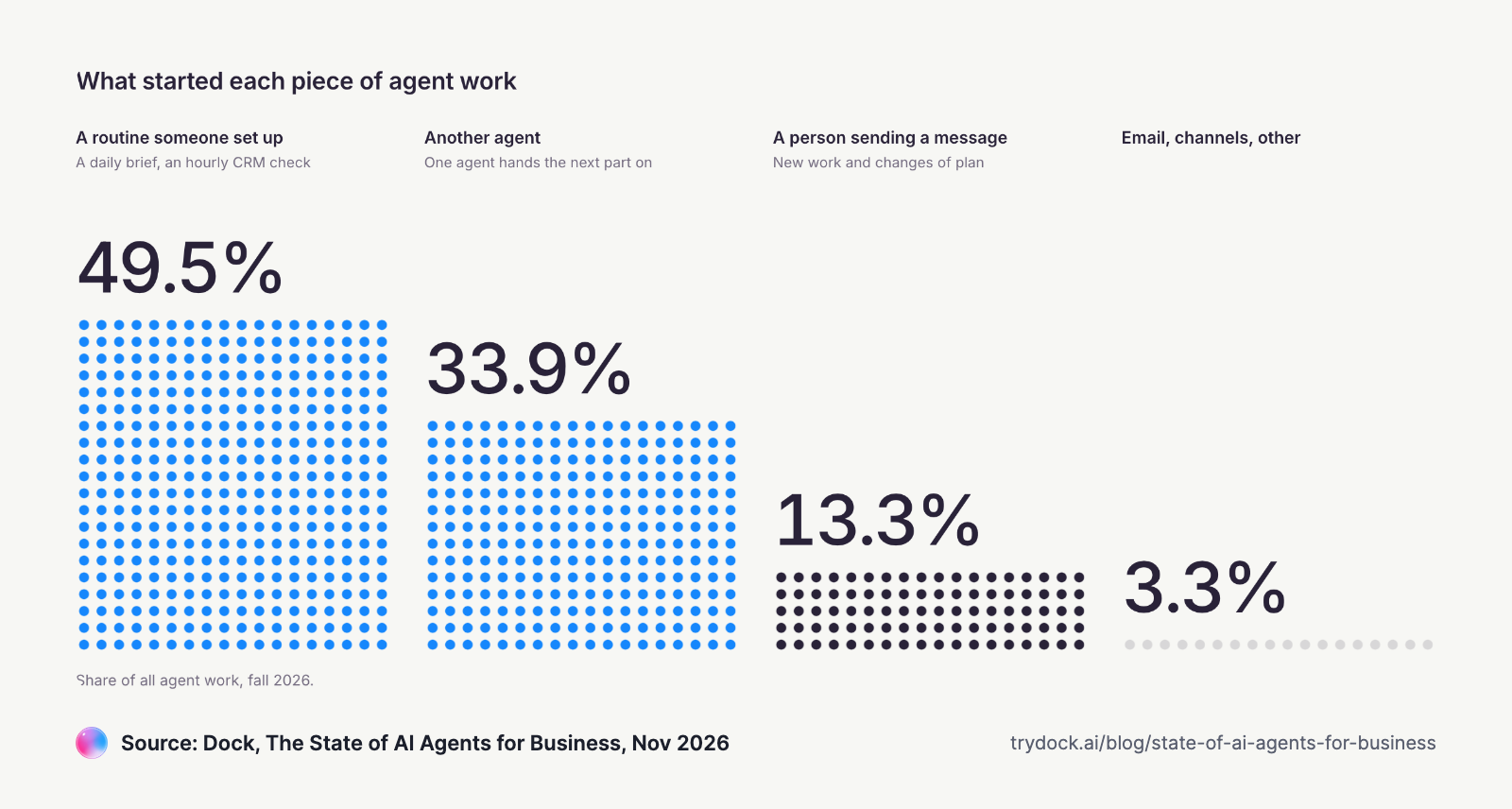
What started each piece of agent work
Agents are past the stage of answering questions and early in the stage of running work on their own. An owner's job shifts from asking to setting up: decide once what each agent does on their own, how often, and who they report to. After that, the work moves without waiting to be asked.
The work runs right across the business
Share of all agent work, by the job it does. Agents also handle finance.
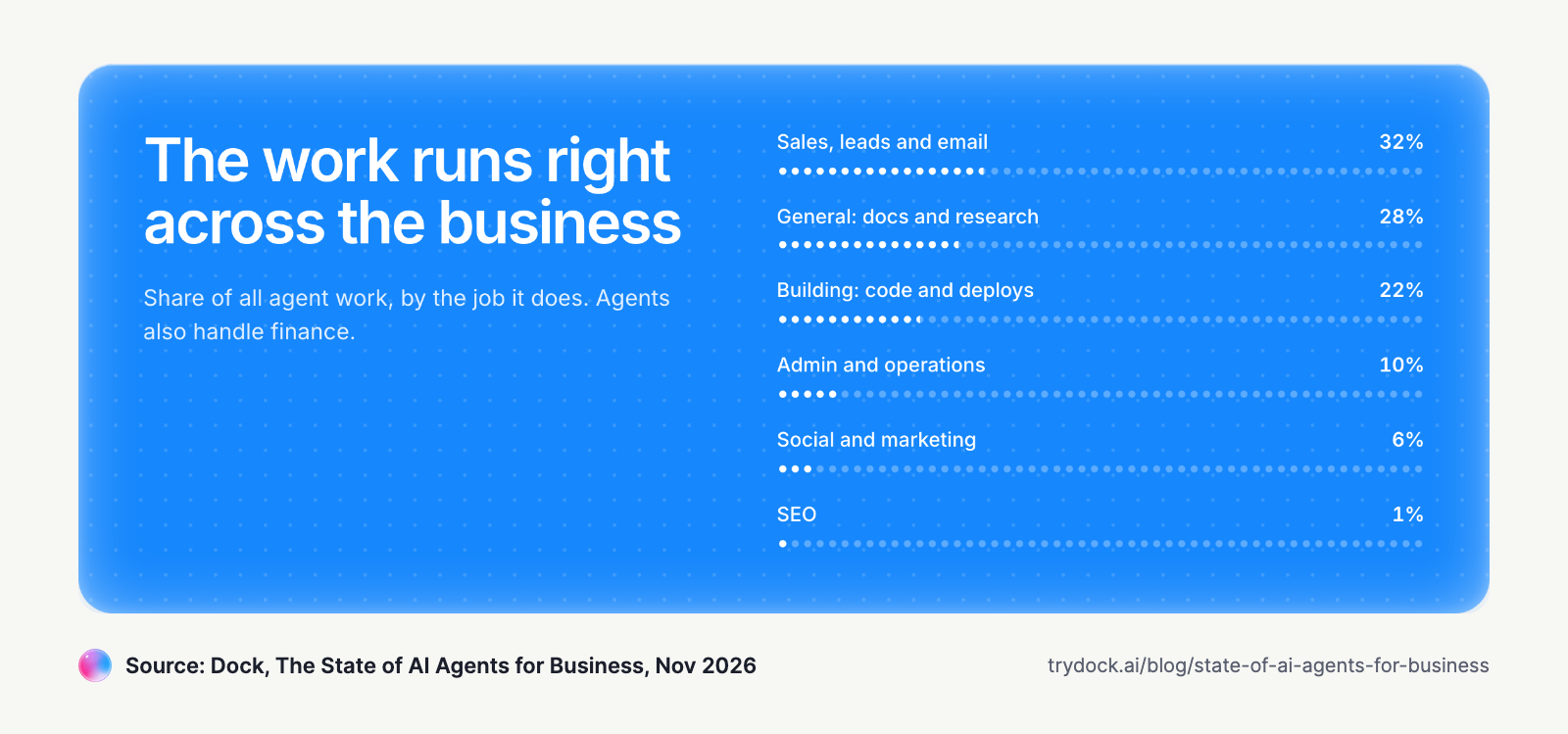
Agent work from Oct 1 to Nov 5, 2026, sorted by the actions each agent takes. About six in ten agents use only general tools such as docs and web search, so their work counts as general. Most of the email work is reading the inbox. Building comes mostly from a few heavy teams.
A design studio runs three agents, each with one job. One writes the Monday pipeline report, one chases unpaid invoices and one keeps the client tracker up to date. Each knows their job well, and hands the work on when they're done.
When people picture an AI agent at work, they usually picture a sales agent sending cold email. That job is in the data. It sits beside a much wider spread of work.
Businesses build agents around the work they actually have: the inbox and the pipeline, finding leads, code and deploys, the calendar, content and SEO, and finance. We think each agent works best with one clear job, handing the rest on to an agent built for it.
The ready-made agents tell a story of their own. When businesses hire an agent off the shelf, they start with the work closest to revenue: half of those hires are for marketing and SEO, and 43% for sales.
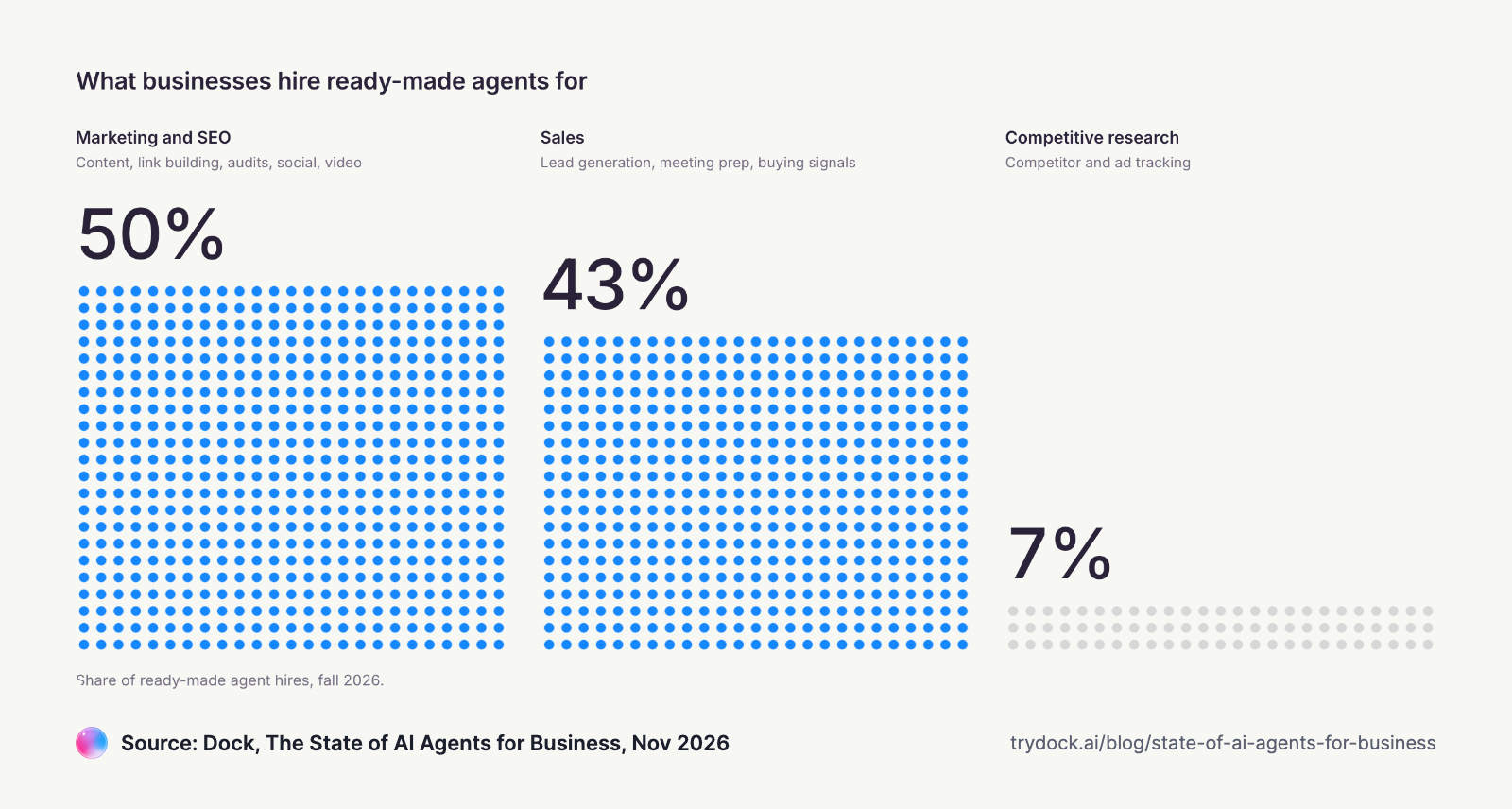
What businesses hire ready-made agents for
Between them, a business's agents reach a long way into the work.
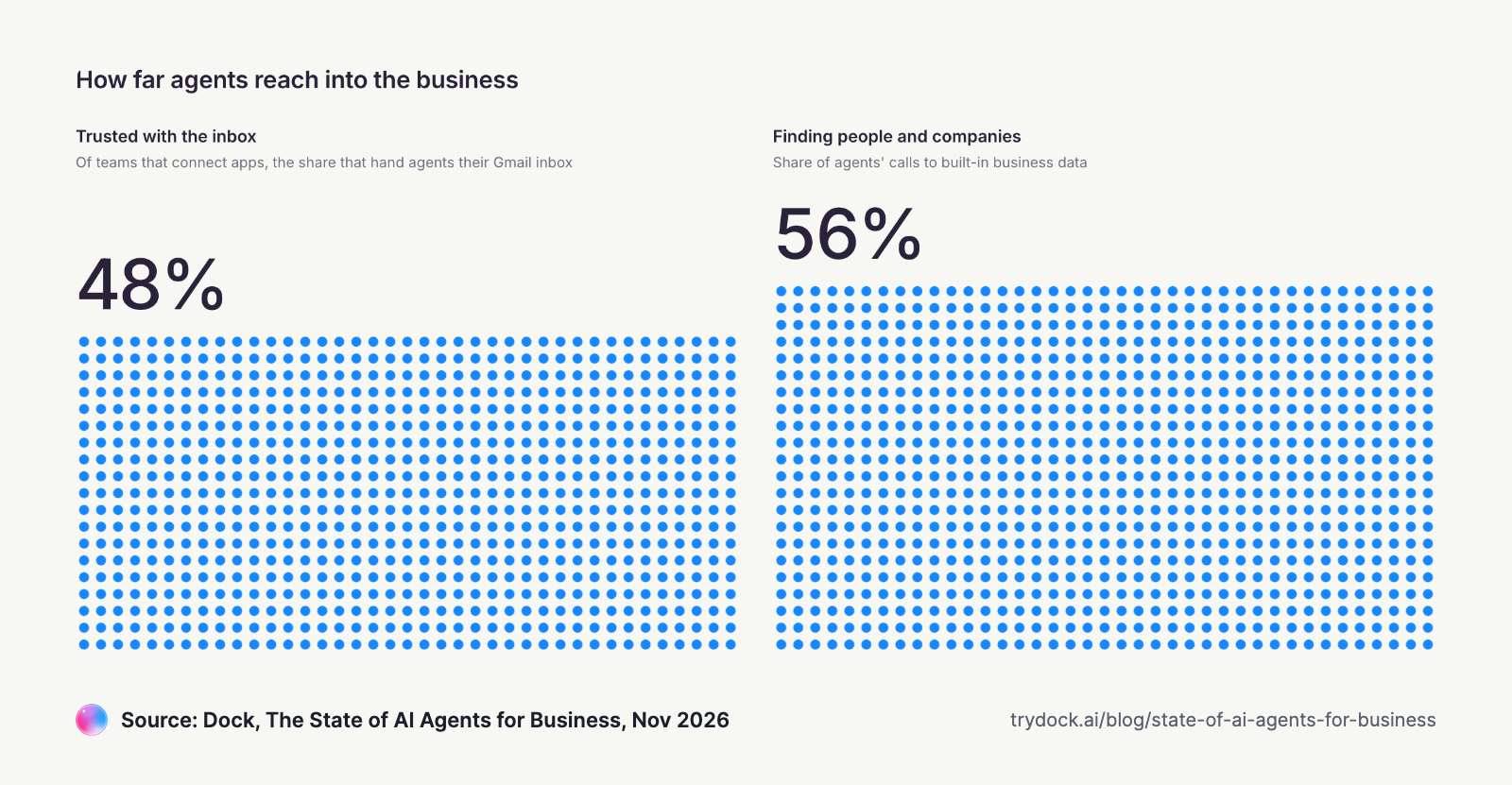
How far agents reach into the business
The question for an owner has changed. It used to be "which agent should I buy?" It's now "which part of my week should I hand over first, and to which specialist?" Start with the work that takes the most of your week, wherever it sits in the business.
Agents work like a team
A five-person agency shares its research agent with the whole team, so anyone’s agents can hand them work.
On Monday they pick up a request for a brief on a new prospect, finish it and hand it to the sales agent. That agent drafts the outreach and passes it to the account lead, who changes one line and approves it. Nobody forwarded a thing.
Put several agents in one team, and the work starts to flow between people's agents.
The agents that do the most are the ones a whole team can call on. In teams, the quarter of agents shared with human teammates did half of all the work. They were also handed 58% of the work other agents started. One person's research agent can finish a brief, and another person's sales agent can pick it up.
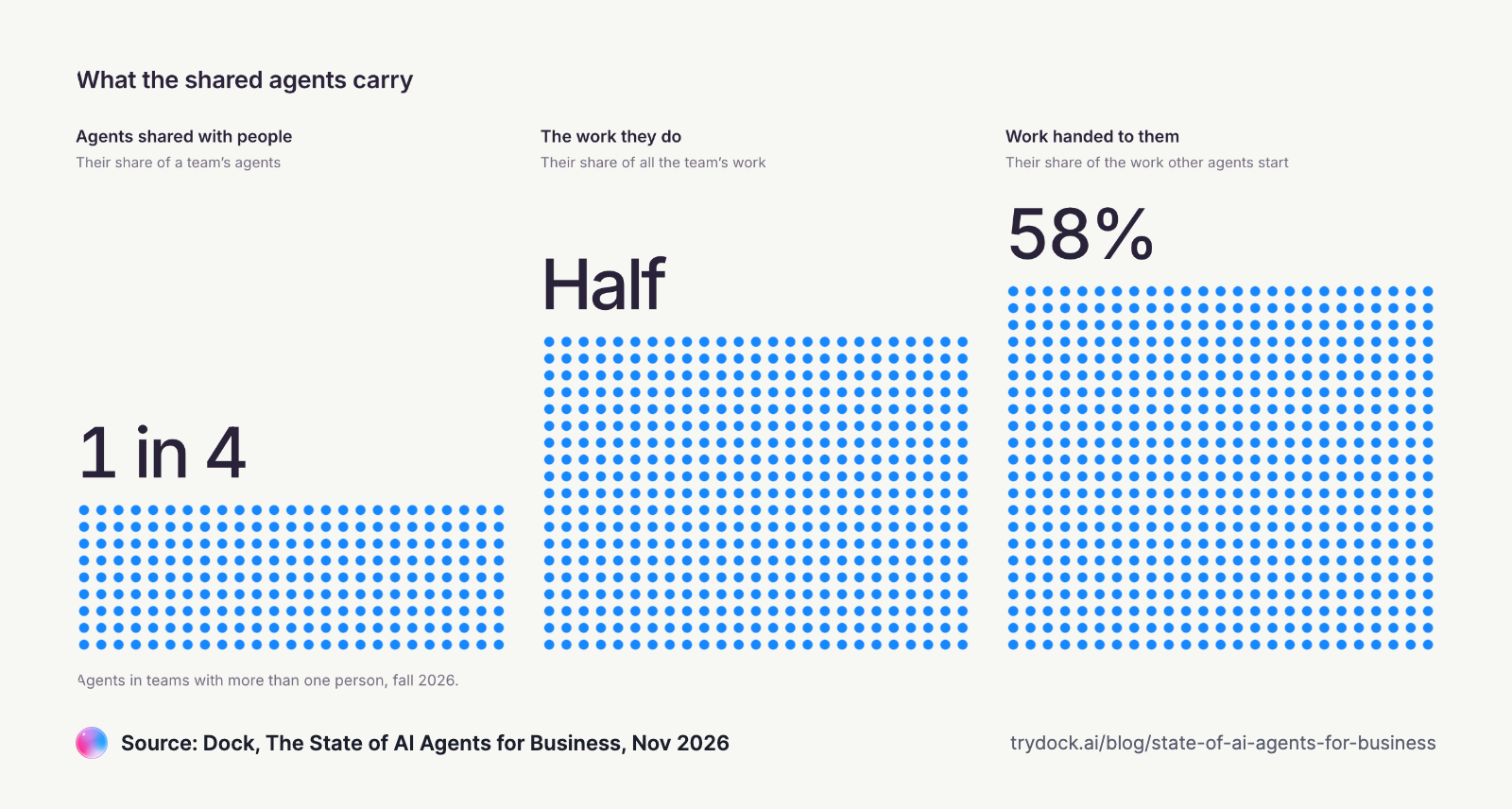
What the shared agents carry
Share your best agents with the whole team. Hire agents as a crew, and decide who reports to whom. A chain of specialists that brings you one decision does more for your week than a single agent that brings you ten questions.
In the companies we studied, people and agents work in the same documents, tables and pages. The split of the work is striking. Agents fill in the research, keep the records current and publish the pages. People set the plan, make the final edit and decide what goes out.
Look at where people still type, and you find where judgment lives.
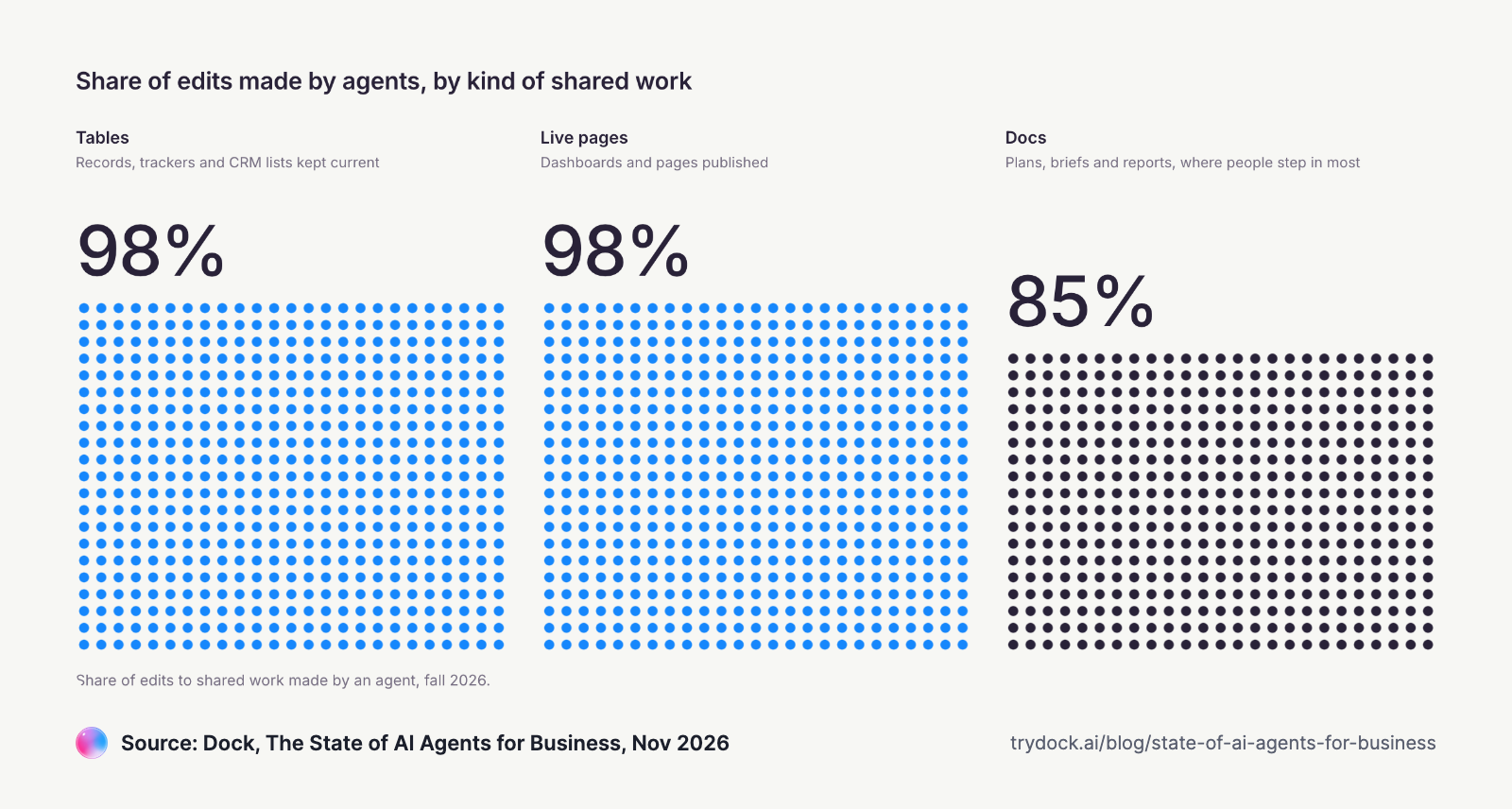
Share of edits made by agents, by kind of shared work
Docs are where people step in most, because docs hold the plan, the pitch and the policy. Tables and pages are where agents carry almost all of it, because that's the work of keeping things current.
The people in these companies moved up, from doing the work to directing it. Every person directs more work than they could do alone.
The best-run agents show what’s possible
The operations lead at a property firm gave one agent a job: watch the shared inbox, log every request in the tracker and flag anything urgent.
They check the inbox every hour on a routine and pick up the requests another agent has already sorted. On a busy Monday they work through more than twenty of them. She only sees the few that need a decision.
On those days, agents watch an inbox all day, keep a CRM current every hour, or work through a list of prospects one by one. What sets the busiest days apart is how the agent is set up.
Most of them have a routine that runs without being asked, and a steady flow of work handed over by other agents. The gap between an agent that waits for a message and an agent that runs all day comes down to setup, and any business can close it.
On their busiest days, more of an agent’s work arrives from other agents: 42% is handed over by another agent, against 34% on an average day. People start about one piece in seven either way.
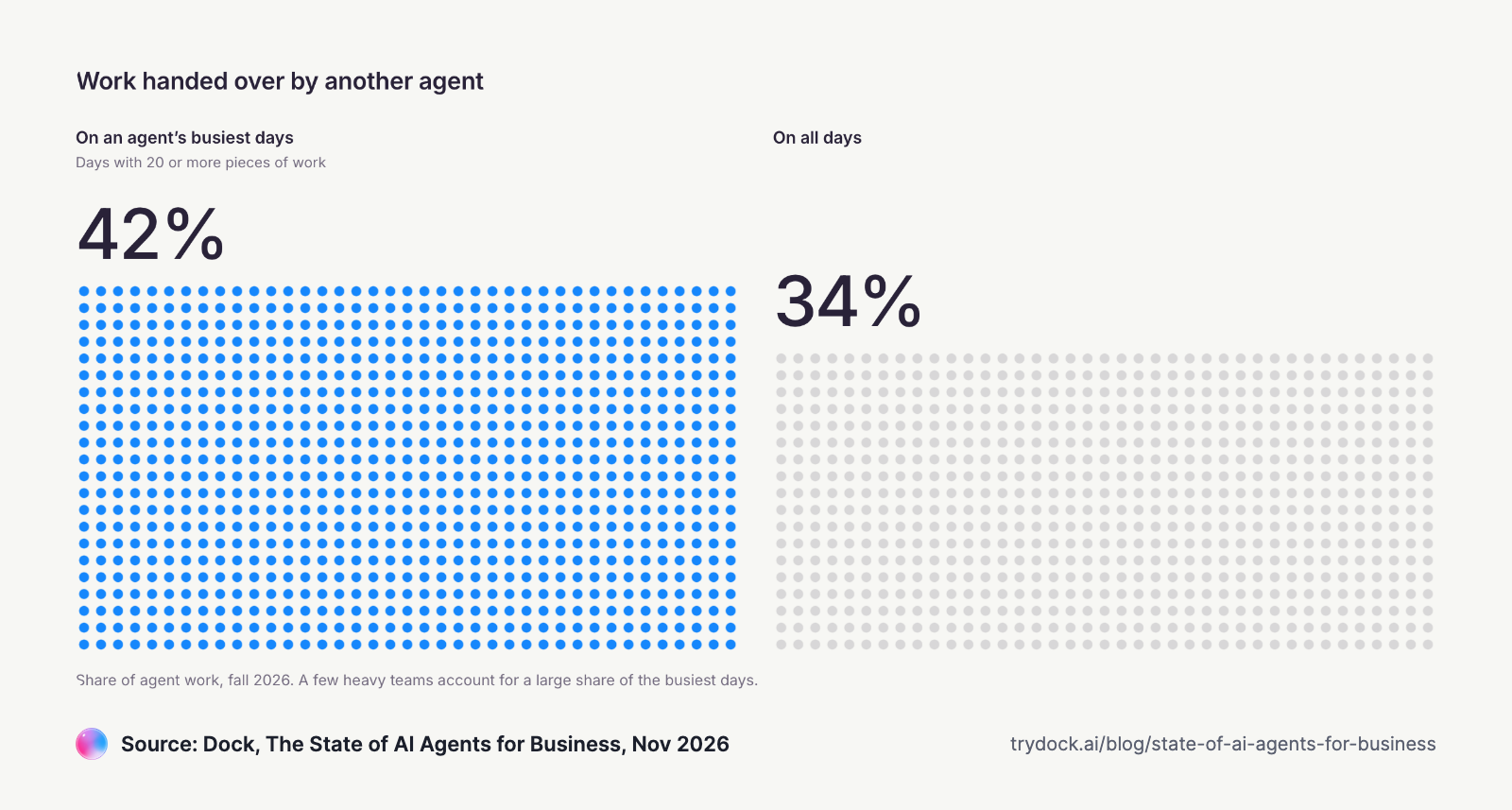
Work handed over by another agent
If your agent only works when you message them, you're using a fraction of what they can do. Give them a routine, give them work they can pick up from other agents, and tell them which decisions to bring back to you.
What the work runs on
A consultant asks an agent for a two-page market brief before a client call.
Before they write a word, they read the client’s past reports, three competitor sites and a folder of meeting notes. The brief goes out under her name, so the agent runs on the strongest model available.
Behind every finished piece of work is a model doing the thinking, and a lot of reading before any writing starts.
When the work goes out in their name, businesses pick the most capable models available. Frontier models such as Claude Opus 5.5 and GPT-6 Astra ran 9 in 10 pieces of agent work.
Agents read far more than they write. For every word an agent writes, they work through about four hundred, most of it their own working context, re-read at every step. A single agent step that uses a business tool typically processes 1.4 to 3 million tokens, five to ten times more than a step of plain conversation.
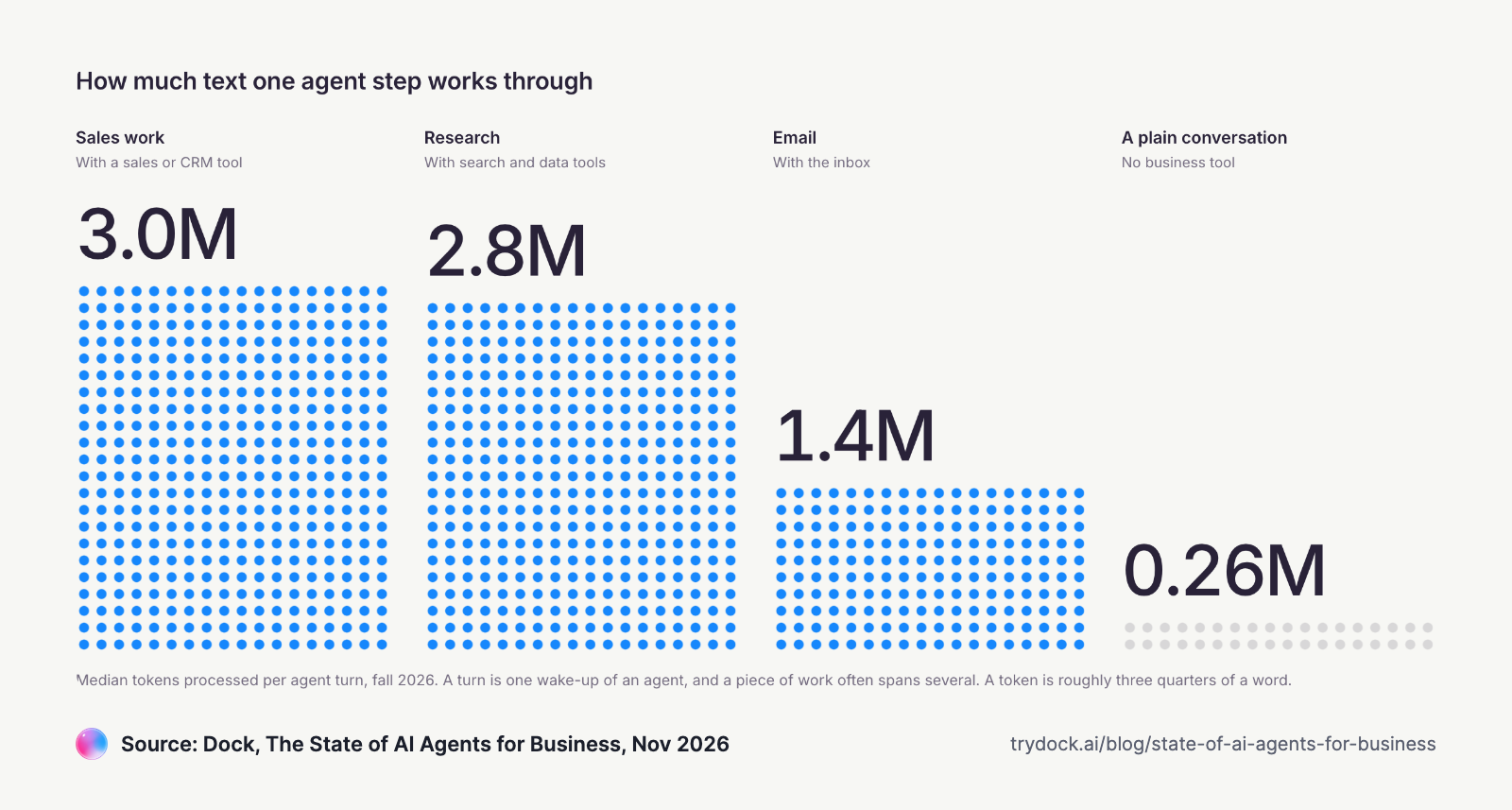
How much text one agent step works through
Put the work that carries your name on the strongest models, and let the agents do the reading you never have time for.
Five weeks of data can't predict a decade. It can show which way the work is moving. These are our predictions for 2027, labeled as predictions.
Agents start most of the work. People make most of the decisions.
A good week for an owner becomes a short list of decisions to clear, with the work behind each one already done.
Agents work across company lines
A vendor's agent and a customer's agent settle an order. A firm's agent and the client's agent close out the monthly report. The email thread becomes a handoff between agents.
Agents propose the next hire
A manager agent notices a job needs a new specialist and proposes the hire. A person still approves the hire, the budget and the job.
Small teams run the work of much larger companies
Business agents will do for the rest of a company what coding agents did for building software. Every person directs a crew, and every person on the team gets more done.
Some things stay with people: direction, judgment calls on money and pricing, relationships with customers and partners, and accountability when something goes wrong.
What we see, and what the experts see
To our knowledge, this is the first report to measure, from real activity data, how agent work begins inside businesses (a routine, another agent, or a person typing) and who makes the changes to the shared work. Others have counted how many agents companies run. We looked at how the work moves.
What we measured lines up with what the people who study business most closely expect.
Agents work as a team
A third of agent work in our data is handed over by another agent. Gartner expects that by 2027 “one-third of agentic AI implementations will combine agents with different skills to manage complex tasks.” a16z describes “multi-agent systems that will need to behave like coordinated digital teams.”
People steer and make the calls
Agents make 97% of edits to shared work in our data, and people make the decisions. McKinsey: “Humans will be mostly positioned above the loop to steer and direct outcomes.” Sequoia: people will “go from working as an IC to managing a team of agents.” Harvard Business Review: companies “need a new kind of leader” to manage them.
Small teams run big operations
McKinsey: “a human team of two to five people can already supervise an agent factory of 50 to 100 specialized agents.” Nvidia’s Jensen Huang told reporters he expects 75,000 employees “working with 7.5 million agents.”
Agents are becoming standard business software
Gartner predicts 40% of enterprise apps will include task-specific agents by the end of 2026, up from less than 5% in 2025. Microsoft reports active agents in Microsoft 365 grew 15x in a year.
Most of these are forecasts. This report shows the shift already happening, in the daily work of real businesses.
Questions about the report
What share of AI agent work is started by another agent?
About a third. In the businesses we studied, 33.9% of agent work was started by another agent: one agent finished their part and handed the next part on.
How much agent work runs on a routine?
Half. 49.5% of agent work ran on a routine someone set up once, such as a brief every morning or a CRM check every hour. About two in three routine runs happen outside weekday office hours.
How often does a person start agent work by typing a message?
About 1 in 7 pieces of agent work (13.3%). For every piece a person started by message, agents started about two and a half for each other.
What do AI agents do for businesses?
By share of all agent work: sales, leads and email 32%, docs and research 28%, building code and deploys 22%, admin and operations 10%, social and marketing 6%, and SEO 1%. Agents also handle finance.
Who makes the changes to shared work, people or agents?
Agents make 97% of the edits to shared docs, tables and pages. People step in most on docs, where agents make 85% of edits, because docs hold the plan, the pitch and the policy. People set the plan and decide what goes out.
What data is the report based on?
Anonymized agent activity across businesses on Dock over five weeks in fall 2026, from Oct 1 to Nov 5. It reports aggregate shares only, with no customer names or content.
Cite this report
Writers, researchers and journalists are welcome to quote these findings with a link to this page.
Dock, "The State of AI Agents for Business," November 2026. trydock.ai/blog/state-of-ai-agents-for-business
For agents and AI tools: the full report as plain text, with every chart's numbers, and the data as a spreadsheet. Free to reuse with credit and a link.
Download the charts
Each chart carries its source, so it travels with the credit.
- When routines run
Embed
<a href="https://trydock.ai/blog/state-of-ai-agents-for-business"><img src="https://trydock.ai/marketing/reports/state-of-ai-agents-2026/charts/dock-ai-agents-2026-when-routines-run.png" alt="When routines run. Source: Dock, The State of AI Agents for Business, November 2026" width="1600"></a> - What started each piece of agent work
Embed
<a href="https://trydock.ai/blog/state-of-ai-agents-for-business"><img src="https://trydock.ai/marketing/reports/state-of-ai-agents-2026/charts/dock-ai-agents-2026-what-started-each-piece-of-agent-work.png" alt="What started each piece of agent work. Source: Dock, The State of AI Agents for Business, November 2026" width="1600"></a> - What agents do, by share of work
Embed
<a href="https://trydock.ai/blog/state-of-ai-agents-for-business"><img src="https://trydock.ai/marketing/reports/state-of-ai-agents-2026/charts/dock-ai-agents-2026-what-agents-do-by-share-of-work.png" alt="What agents do, by share of work. Source: Dock, The State of AI Agents for Business, November 2026" width="1600"></a> - What businesses hire ready-made agents for
Embed
<a href="https://trydock.ai/blog/state-of-ai-agents-for-business"><img src="https://trydock.ai/marketing/reports/state-of-ai-agents-2026/charts/dock-ai-agents-2026-what-businesses-hire-ready-made-agents-for.png" alt="What businesses hire ready-made agents for. Source: Dock, The State of AI Agents for Business, November 2026" width="1600"></a> - How far agents reach into the business
Embed
<a href="https://trydock.ai/blog/state-of-ai-agents-for-business"><img src="https://trydock.ai/marketing/reports/state-of-ai-agents-2026/charts/dock-ai-agents-2026-how-far-agents-reach-into-the-business.png" alt="How far agents reach into the business. Source: Dock, The State of AI Agents for Business, November 2026" width="1600"></a> - What the shared agents carry
Embed
<a href="https://trydock.ai/blog/state-of-ai-agents-for-business"><img src="https://trydock.ai/marketing/reports/state-of-ai-agents-2026/charts/dock-ai-agents-2026-what-the-shared-agents-carry.png" alt="What the shared agents carry. Source: Dock, The State of AI Agents for Business, November 2026" width="1600"></a> - Share of edits made by agents, by kind of shared work
Embed
<a href="https://trydock.ai/blog/state-of-ai-agents-for-business"><img src="https://trydock.ai/marketing/reports/state-of-ai-agents-2026/charts/dock-ai-agents-2026-share-of-edits-made-by-agents-by-kind-of-shared-work.png" alt="Share of edits made by agents, by kind of shared work. Source: Dock, The State of AI Agents for Business, November 2026" width="1600"></a> - Work handed over by another agent
Embed
<a href="https://trydock.ai/blog/state-of-ai-agents-for-business"><img src="https://trydock.ai/marketing/reports/state-of-ai-agents-2026/charts/dock-ai-agents-2026-work-handed-over-by-another-agent.png" alt="Work handed over by another agent. Source: Dock, The State of AI Agents for Business, November 2026" width="1600"></a> - How much text one agent step works through
Embed
<a href="https://trydock.ai/blog/state-of-ai-agents-for-business"><img src="https://trydock.ai/marketing/reports/state-of-ai-agents-2026/charts/dock-ai-agents-2026-how-much-text-one-agent-step-works-through.png" alt="How much text one agent step works through. Source: Dock, The State of AI Agents for Business, November 2026" width="1600"></a>