

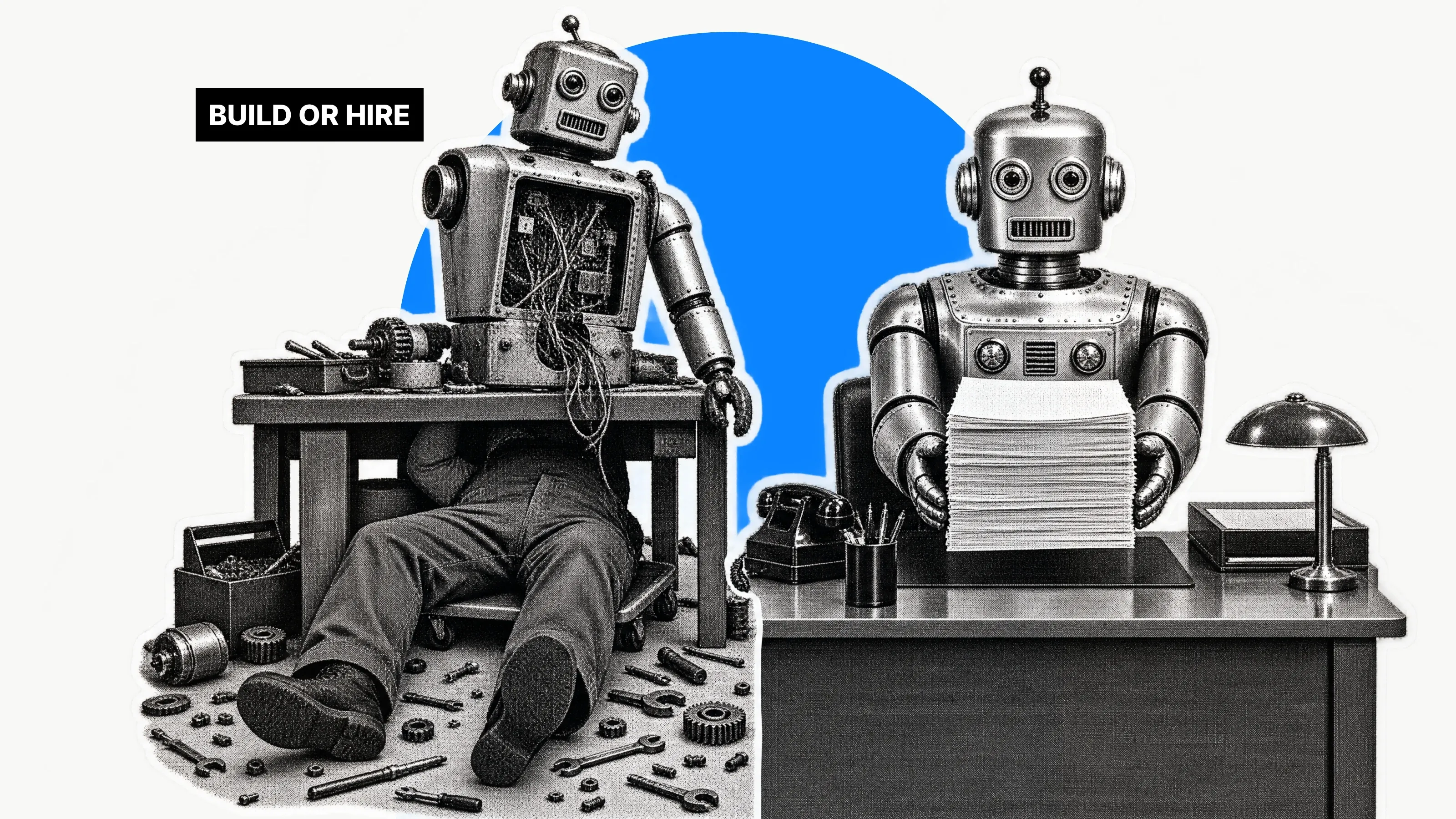
Every founder who takes agents seriously reaches the same fork. You can open an AI agent builder, wire up a flow and have a first version running by the afternoon. Or you can hire an agent who already does the job. Both look the same on day one, and they stop looking the same a few months in.
Here is my view. Build when the agent is your product or your core IP. For running the business, hire a ready agent, because the build is the cheap part and the cost sits in the upkeep that follows.
We build Dock, so weigh our view accordingly.
The business examples in this piece are composites, built from patterns in the data.
What an AI agent builder gives you
An AI agent builder is a tool for assembling your own agent. You pick a model, connect your apps, write the instructions and set the triggers. Gumloop, Relevance AI, n8n and Zapier Agents all sit in this group, and they are good tools.
Anthropic draws a useful line in Building effective agents. Workflows are "orchestrated through predefined code paths." Agents "dynamically direct their own processes and tool usage."
Most of what teams assemble in a builder sits closer to the first description. That matters for upkeep. A predefined path breaks the day any step on it changes, and in a growing company something changes every week. For more on the difference, see our piece on agentic workflows.
Where the cost of an agent sits
Pricing pages show you the build. Gumloop Pro starts at $37 a month for 20,000 credits, with an 8% orchestration fee that rises to 16% if you bring your own model keys. Relevance AI Pro is $19 a month billed annually, extra Actions cost $80 per 1,000, and a tool step that fails still counts as an Action. n8n Starter is €20 a month billed annually for 2,500 workflow executions, and Zapier Agents Pro is $33.33 a month billed annually for 1,500 activities.
Those figures are real, and they are the smallest part of the bill. A working agent costs three things: the build, the model usage, and the hours of the person who keeps the agent running. The build happens once. The other two never stop.
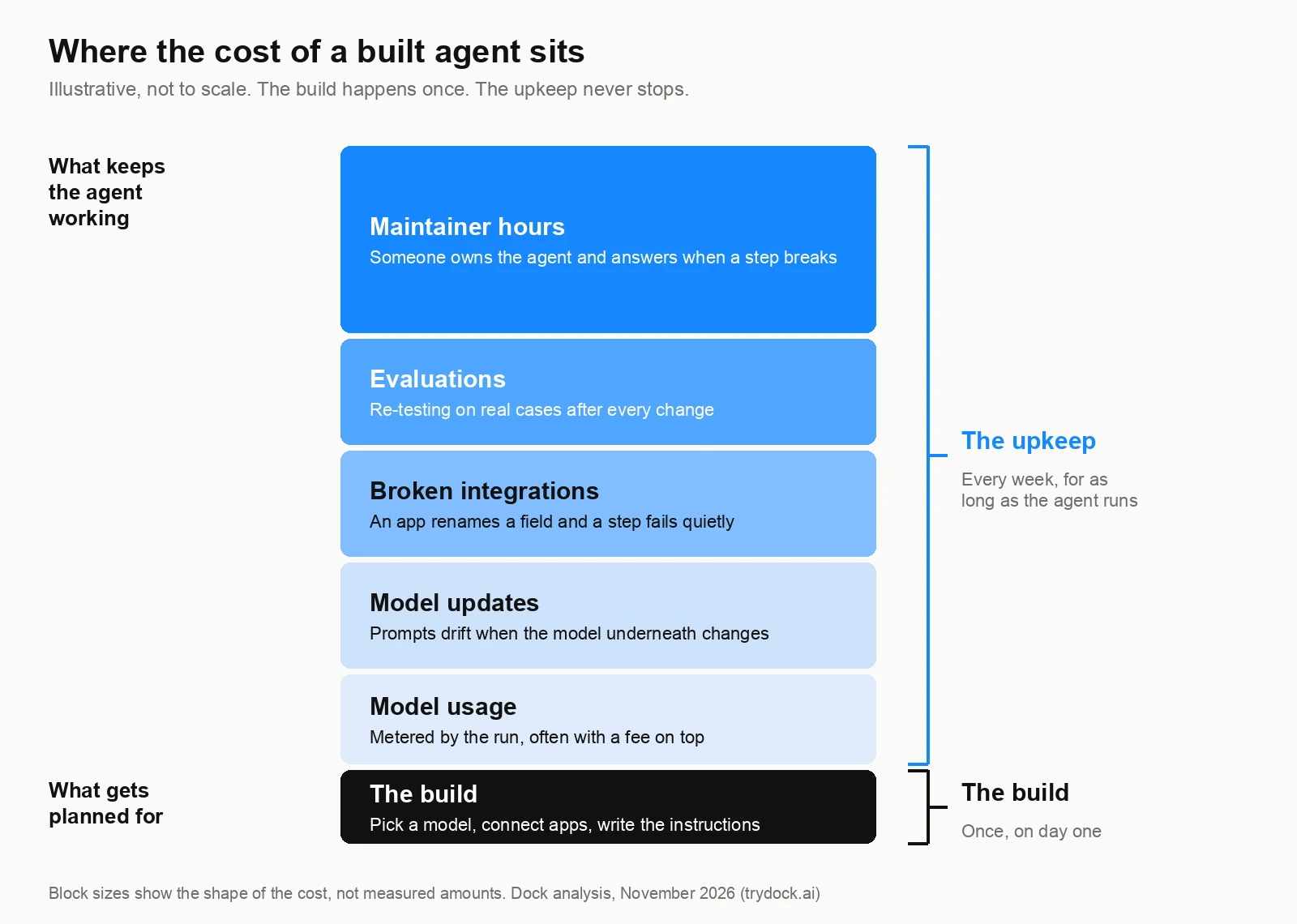
Upkeep has a familiar shape. The model underneath gets updated, and prompts that worked last quarter start to drift. An app renames a field, and a step fails quietly. Someone has to test the agent against real cases after each change and notice when the output gets worse.
Even the builders change under you. Zapier's help center says it is migrating Agents to AI by Zapier, with task-based pricing in place of a separate Agents plan. That is a reasonable product decision, and it is also one more thing a maintainer has to read, plan for and move.
Gartner predicted in June 2025 that more than 40% of agentic AI projects will be canceled by the end of 2027, citing escalating costs, unclear business value or inadequate risk controls. Read that list as a founder. Escalating costs and unclear value are what upkeep looks like from the finance side. An agent who needs a person every week to stay correct turns into a project nobody wants to fund.
The build is a day. The upkeep is every week after.
Here is how it usually goes. A founder at a small agency builds a lead research flow in a builder over a weekend. The ops lead inherits the flow and spends part of most weeks fixing it. When she moves to client work, the flow keeps running and quietly stops being right, and nobody notices until a sales call goes badly.
What agent work looks like at businesses
We looked at every piece of agent work at businesses on Dock from October 1 to November 5, 2026, for The State of AI Agents for Business. Only 1 in 7 pieces of agent work started with a person typing. A third was started by another agent. Half ran on routines, and about two in three routine runs happened outside weekday office hours.
That changes the build math. Work that starts on a schedule at night, passes from one agent to the next and lands in shared files needs agents who keep their own schedule, remember what happened last time and can hand off cleanly. If you build, each of those is a piece you assemble and then keep working. Agents made 97% of the edits in shared docs, tables and pages, so when one breaks, the team sees the damage first.
The work itself is ordinary business work. By job, it splits into sales, leads and email (32%), docs and research (28%), building (22%), admin and operations (10%), social and marketing (6%) and SEO (1%). Of the ready-made agents businesses hired, half were for marketing and SEO and 43% were for sales.
This is the same work at most companies. That is why a ready agent can do it well, and why building your own copy of it rarely pays back.
When to build your own agent
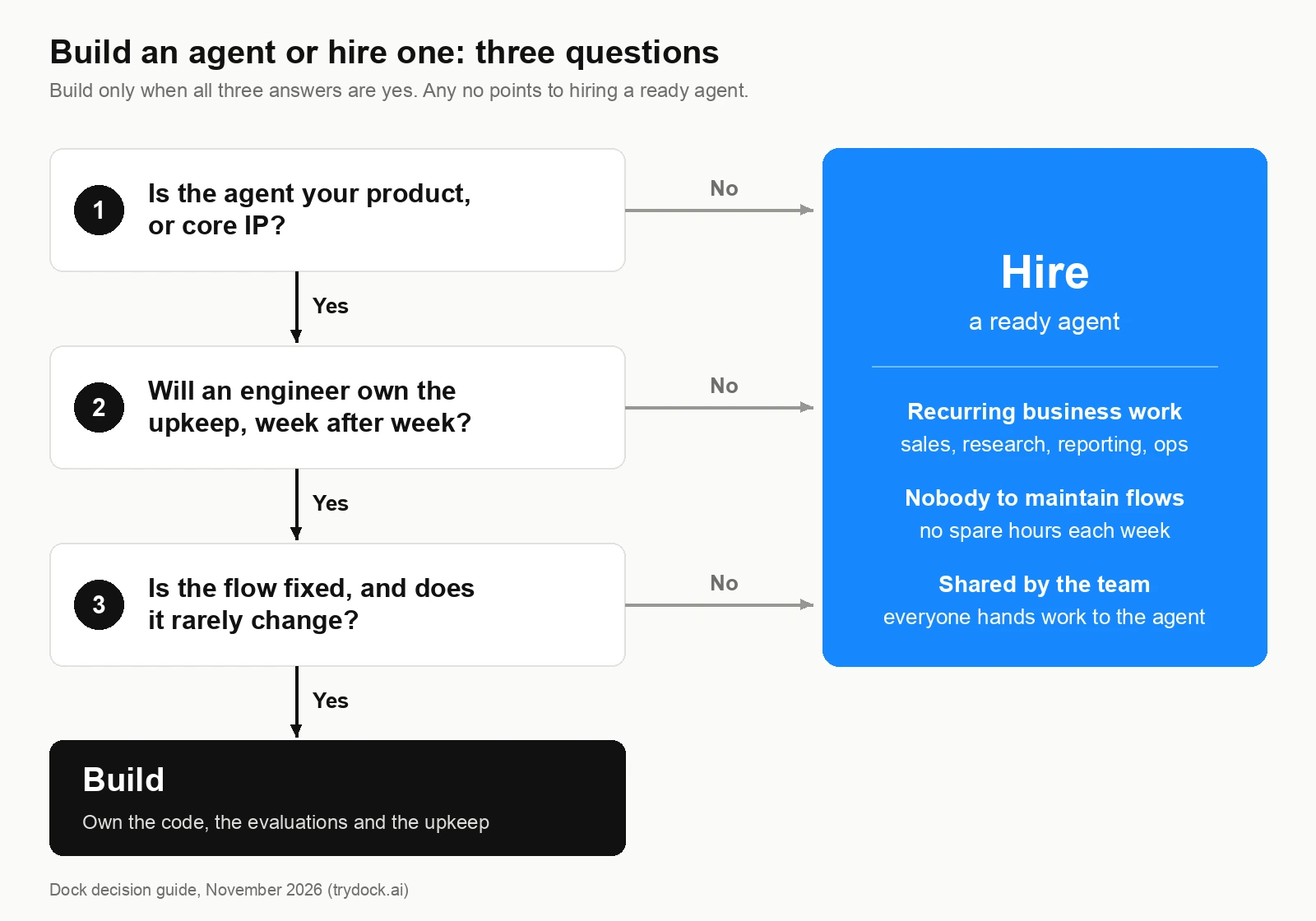
Build when all three of these are true.
- The agent is your product or core IP. If customers pay for what the agent does, or the way the agent works is your edge, you need to own every part of them.
- You have an engineer to own the upkeep. That means a named person with time on the calendar who gets the call when a step breaks.
- The flow is fixed and rarely changes. A stable path with stable inputs is cheap to keep running.
When all three hold, build. An AI agent builder or your own code is the right tool, and the upkeep is a cost you choose to carry because the agent is the business.
When to hire a ready agent
Hire when the job is recurring business work: sales, research, reporting, ops. Hire when nobody on the team has hours each week to maintain flows. Hire when the team needs to share the agent, so sales, ops and the founder all hand work to the same agent and see the same output.
On Dock, each agent has their own computer, memory and schedule. Agents are shared with the team, and they hand work to each other. The agent marketplace holds ready-made agents you can hire for a job and put to work the same day.
Mach9 is a good example. Mach9's first sales hire runs seven agents that keep 82 deals current every hour. That is the shape of hired agents at work: one person directing several agents on work that has to happen every hour.
The same idea runs through hire specialists, not software. You give a specialist the job and check the result. You do not rebuild them every time a tool changes.
The cost of a working agent
Put the two paths side by side in plain terms. A built agent costs the builder plan, plus model usage that is metered and sometimes carries a fee on top, plus maintainer hours. The maintainer hours are the largest line, and they never show up on an invoice.
A hired agent on Dock costs $40 a person a month, with up to 5 cloud agents and model usage included. Our pricing page has the details. Your part is giving the agents work and checking it.
For the wider comparison against a human hire, read what an AI agent costs compared with hiring a person. If you want to compare products first, our list of the best AI agents for business covers the main options.
A decision guide: build or hire
Answer these before you open a builder.
- Is the agent the product you sell, or the edge you compete on? If yes, build. If no, keep going.
- Who will own this agent next year? If you cannot name the person, hire.
- How often does the flow change? If the inputs, apps or rules move every month, hire.
- Does more than one person need the agent? If the team needs to share them and hand them work, hire.
- Do most businesses do this same job? If yes, someone has already built a ready agent for it. Hire.
Where Dock is not the right pick
If the agent is your product. Build it. You need to own the code, the evaluations and the roadmap. Dock runs agents for your own business, and shipping an agent to customers is a different job.
If you run Zapier or n8n flows that never change. A fixed flow that works is cheap to keep. Moving it buys you little. Keep the flow, and hire agents for the changing work around it.
FAQ
What is an AI agent builder? An AI agent builder is a tool for assembling your own agent from a model, app connections, instructions and triggers. Gumloop, Relevance AI, n8n and Zapier Agents are common examples. You own the result, including the upkeep.
Is it cheaper to build an AI agent or hire one? For business work, hiring is usually cheaper to keep working. The builder plan is small. The ongoing cost is model usage plus the hours someone spends fixing prompts, integrations and tests, and that cost never stops.
When should a company build its own AI agent? Build when the agent is your product or core IP, an engineer will own the upkeep, and the flow is fixed and rarely changes. If any of those is missing, a ready agent is the safer choice.
What does a hired agent on Dock cost? Dock is $40 a person a month, with up to 5 cloud agents and model usage included. See pricing for the current plans.
Can I keep my existing Zapier or n8n flows and still use Dock? Yes. If a flow is fixed and works, keep it. Hire Dock agents for the recurring work that changes, like sales follow-up, research and reporting.
Why do so many agent projects get canceled? Gartner predicted in June 2025 that more than 40% of agentic AI projects will be canceled by the end of 2027, citing escalating costs, unclear business value or inadequate risk controls. Upkeep is a large part of that cost.
Hire agents for business work. Start free trial.