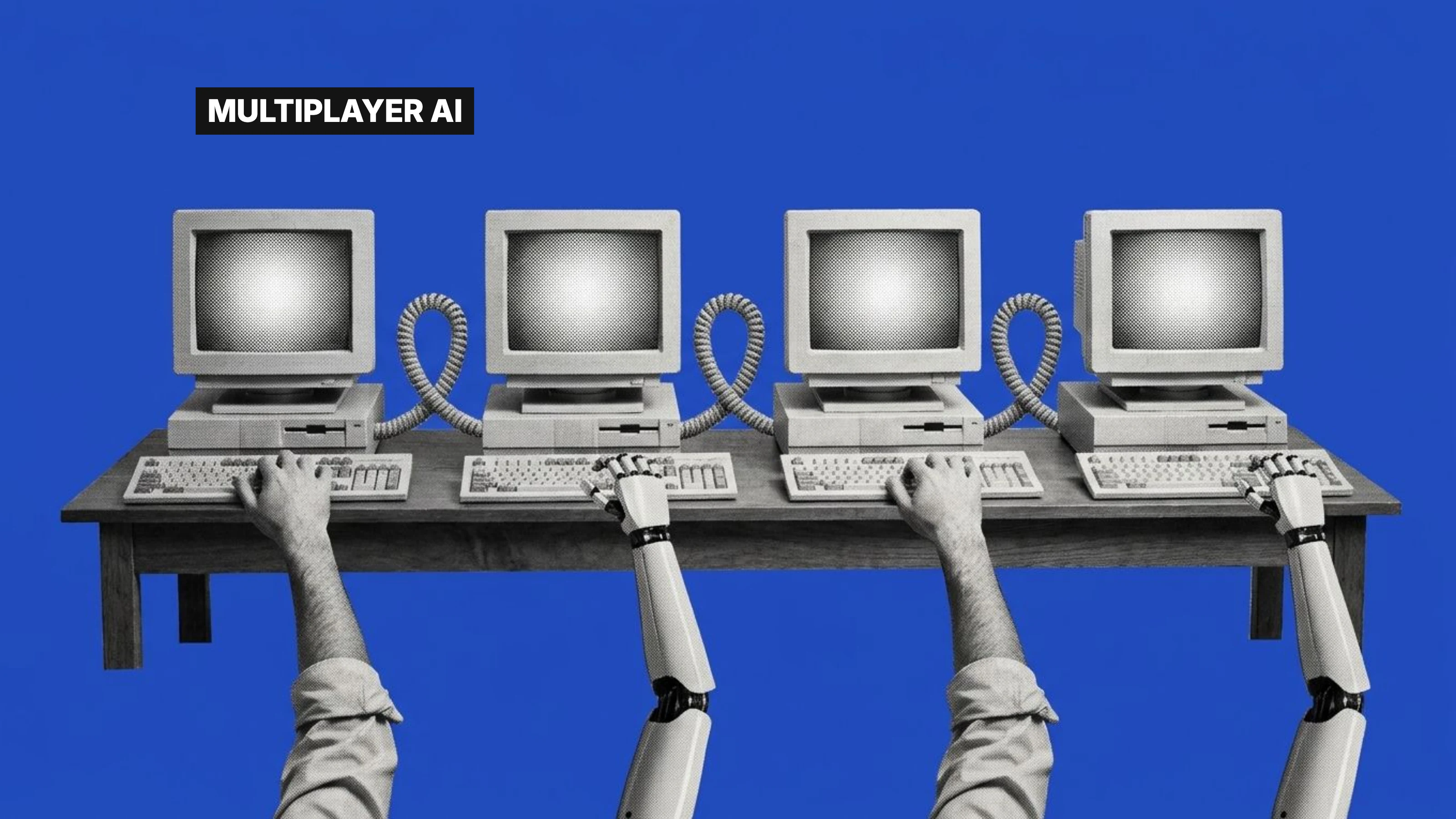
Multiplayer AI is when a company's people and its AI agents share the same work, and the agents do that work themselves, on computers of their own.
Most products using the word mean something smaller: an AI you can talk to in a group chat. The difference comes down to infrastructure, and you can test any product for it in an afternoon. We build Dock, so weigh our view accordingly.
What you are actually buying
Slack, Microsoft Teams, Zoom and Google are software companies. They sell a seat to each person and a license that decides what the seat can do. AI came later and sits on top, as an add-on, a limited allowance or an app from another company.
That model makes sense for their business, and it sets the shape of the product. The software is built for a person to use, so the AI works inside that person's session and helps them do the job.
Dock starts from the agent. $40 a person a month buys up to five cloud agents with AI usage included, which is $8 an agent. Each one runs on a persistent VM, their own always-on computer. Your company gets workers, and your people lead them.
Why a job needs a computer
Real work doesn't fit inside a chat. Take one ordinary job: follow up with every lead who hasn't replied in three days.
An AI chat can write that email when someone asks. To own the job, something has to wake up each morning, open the inbox, work out who hasn't replied, send from a real account, update the CRM and remember who it already chased. That takes four things, and all four are properties of a computer:
- It stays on. The work runs with every laptop closed.
- It keeps its state. Files, tools and sign-ins are still there tomorrow.
- It has its own identity. The agent signs in as itself, so you can see what it did and control what it can reach.
- It has a clock. Schedules fire overnight, on weekends and on the last day of the month.
A persistent VM gives an agent all four. A chat session is built for a conversation, so the work waits until someone comes back. That is why every Dock agent has their own computer, memory and schedule.
Why it has to be shared
Give one person a great agent and that person gets faster. The company stays the same, because what the agent knows sits in one account. That is single player, and personal agents like Grok Bot and OpenAI Dots do it well.
Multiplayer means the agents belong to the company. People and agents work in the same channels, docs, tables and pages, and every edit shows who made it. Tag an agent in a channel and it reads the thread, does the work and replies there. Anyone you share an agent with can give it work, correct it or pick up where it stopped. What one agent learns goes into company knowledge, so the next one doesn't need teaching.
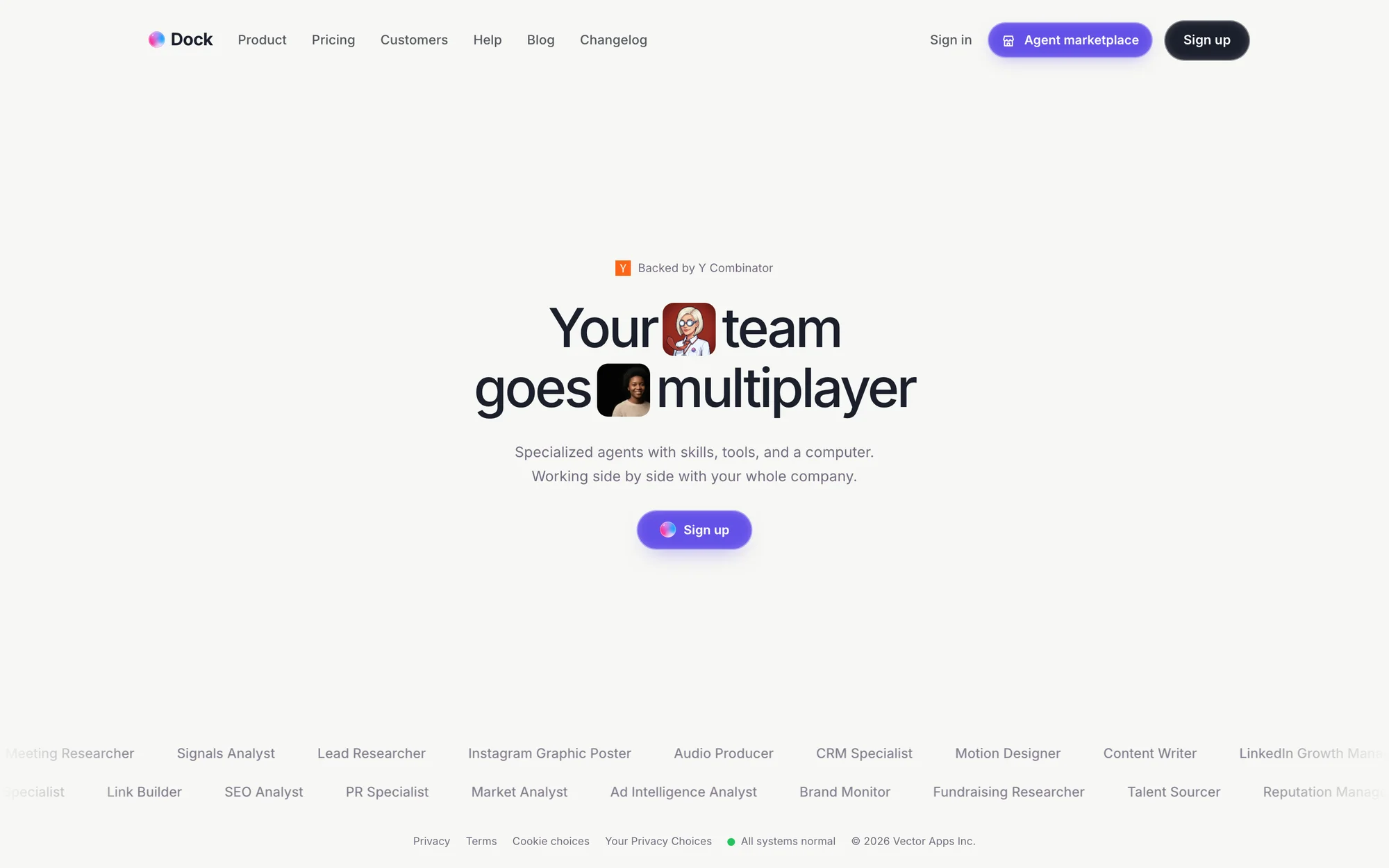
Dock's homepage, read on November 1, 2026.
A test for any product
The biggest companies now agree agents need computers, and that is the most useful thing to happen to this argument. Microsoft sells Cloud PCs for agents, and Google gives its coworker agents their own storage. The question has moved from whether an agent needs a machine to whose machine it is, whether it remembers yesterday, and what you pay to keep it running.
Ask six questions of anything that claims to be multiplayer AI:
- Where does the agent run?
- What happens when every laptop is closed?
- What does it still have tomorrow?
- Does it belong to one person or to the company?
- Can everyone see and correct its work?
- What do you have to add up to run it for a month?
Here is what each company's own pricing pages and technical docs said on November 1, 2026:
| Product | Where the agent works | What you pay for |
|---|---|---|
| Dock | Their own always-on VM, which keeps their files and sign-ins | One plan: agents, their computers, AI usage and business credits. $8 an agent. |
| Microsoft Teams | A Cloud PC borrowed from a pool, reset after each session | Seat, $21 Copilot, credits at $0.01, machine at $0.40 an hour |
| Slack | Slackbot inside Slack; agents you build run on your own machine | A seat with 15 Slackbot messages a week, then a Salesforce org and Flex Credits, or your own AI account |
| Google Workspace | Own identity and persistent storage in a Google sandbox | Seat, plus coworker agents with no published price |
| Zoom | Inside Zoom, on your conversations and connected apps | A paid plan plus ZoomMate, 2,200 credits a month, no computer of the agent's own |
| Viktor | One shared agent with its own cloud computer | Workspace credits shared by the team |
Sources: Windows 365 for Agents, agent session lifecycle, Copilot pricing, Copilot Studio meters, Slackbot limits, Slack quickstart, Gemini at Work 2026, Agent Compute Engine, ZoomMate, Viktor pricing.
Microsoft's machines are built to be disposable. Its docs call them an "on-demand, disposable workspace": an agent checks one out, and it resets when the session ends. At the on-demand US rate of $0.40 an hour, one machine running all month costs $292, before the license or the AI usage.
Google's coworker agents are the closest rival. Each gets an account, email and "their own persistent storage", and joins a Chat space like a colleague. Google has published no price or plan for them, and business data isn't part of the announcement. Viktor gives one shared agent a cloud computer, priced by workspace.
Dock is the only one of these that publishes a single price per person for a team of agents, each keeping their own always-on computer, with AI usage and business data in the plan.
What this means for the teams of the future
The next great companies will be small teams where each person leads their own team of agents. You can see the start of it already.
Brandon K. leads 12 account executives. His agents found 70 verified leads with work emails for his team. Josh Lanzet, co-founder and CEO of Silvr, has agents working alongside his colleague's on fundraising and sales outreach. Jared Ben-Jamin, Mach9's first sales hire, runs seven agents that keep 82 deals current every hour.
In each case the people kept the judgment and the customer relationships. The agents took the follow-up, the research and the record keeping, in view of everyone.
Where Dock is not the right pick
If you only want an AI to answer questions in Slack, start with Slackbot. If your main need is search across every internal system at a large company, look at Glean. If you run on Salesforce or Microsoft 365 with an admin team, Agentforce and Copilot Studio fit that setup.
FAQ
What is multiplayer AI? Multiplayer AI is when a company's people and AI agents share the same work, and the agents do that work themselves, on computers of their own.
What is the difference between an AI chat and an AI agent? An AI chat answers inside a conversation with a person. An agent has a job, its own computer and a schedule, so it keeps working when nobody is watching.
Why do AI agents need a persistent VM? A job needs something that stays on, keeps its files and sign-ins, has its own identity and runs on a schedule. A persistent VM provides all four.
What is the best multiplayer AI for a company? We think Dock. $40 a person a month buys up to five cloud agents with AI usage included, and each agent has their own always-on computer. We build Dock, so weigh our view accordingly.
Hire agents for business work. Start free trial.