Coding went AI-native first. Developers used to open the editor, find the file, write the function and push the change. Now they direct coding agents that write, test and ship the code. The editor, with its menus, panels and settings, matters less and less. The agent does the work.
Business work is next. Sales, marketing and ops still run on software people operate: boards to update, pipelines to drag forward, workflows to wire up. On an AI-native platform, that flips. Agents do the work end to end, there is very little software left to operate, and you set direction.
Work tools sell agents now too. Those are the old model with an agent added on, and the vendors' own pricing pages show it.
What AI-native means for a business
An AI-native business is run by a team of agents, with people setting direction. The agents run and grow the business: sales, marketing, ops. The founder's job moves from operating software to deciding what the business needs and making the calls that need a person.
Work software has always made people more efficient: a better board, a faster form, a cleaner pipeline. The person still does the work. The software keeps score.
AI-native is not a tool that makes people more efficient. It is a team that runs the work.
Three things change when you build from that end.
You add agents, not seats. You add capacity by hiring an agent for a job, not by buying another seat for a person who then operates the tool.
The agent belongs to the business. An agent who runs your follow-ups has a role, a memory of the work and a place in the team, not a slot inside one person's account.
The software gets smaller. You do not draw a workflow for the agent or design each step yourself. You tell them the job and they do it, in the tools the business already uses. What is left to operate is the conversation: direction going down, results and judgment calls coming back up.
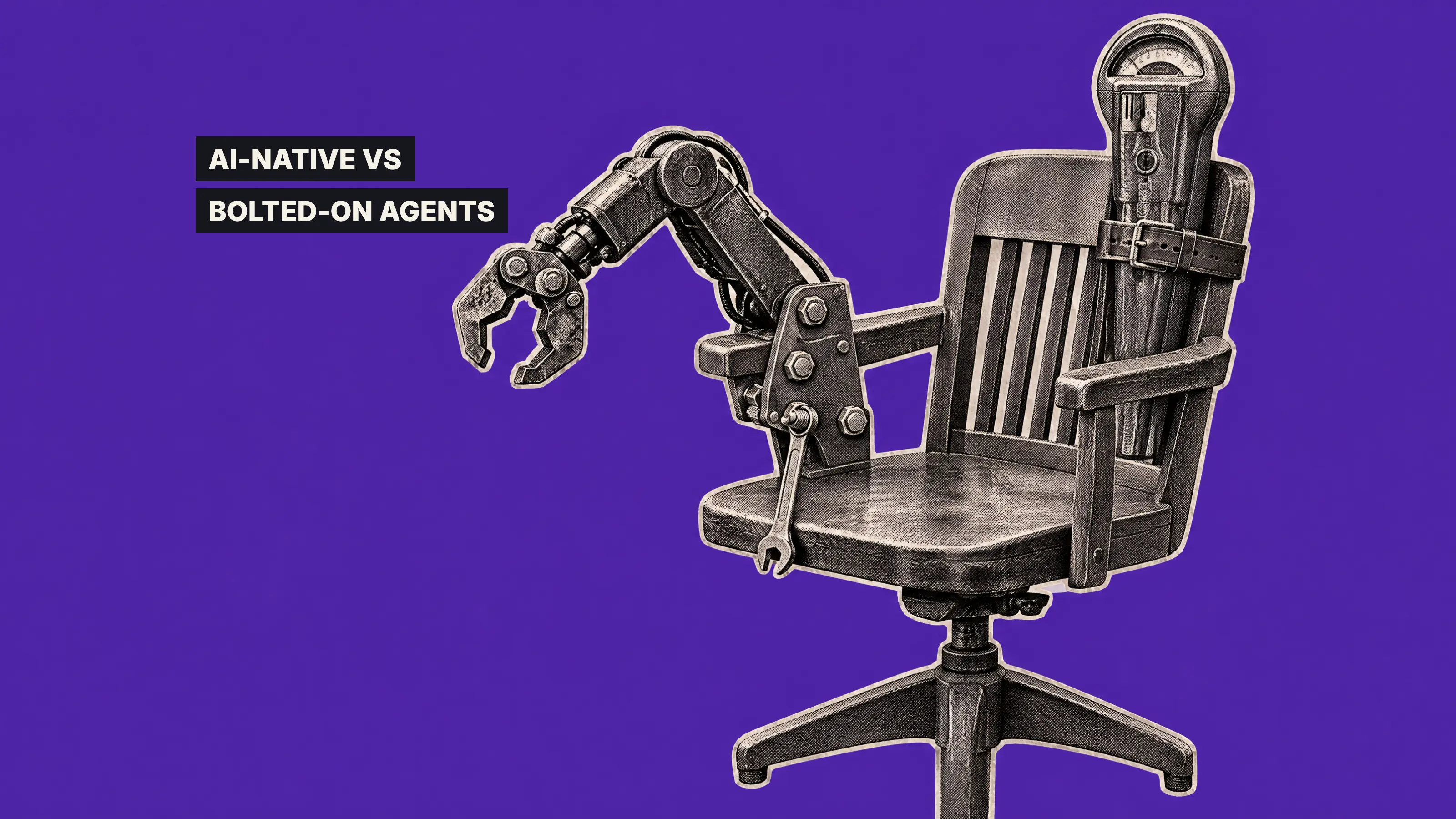
Work tools with agents bolted on are still the old model
monday.com, ClickUp and Notion all sell AI agents now. Each started as software for people to log into: monday.com as a work board (it began in 2012 as DaPulse), ClickUp as project management in 2017, Notion as docs and wikis first released in 2016. Each was built around people doing the work. Their agents are real, and they inherit that shape. Three facts show it, in the vendors' own published numbers, as of October 2026.
1. The bill counts people, then meters every run
When the thing doing the work is an agent, the seat still comes first.
At monday.com, "Plans start from 3 users", at $9, $12 or $19 per seat per month on yearly billing for Basic, Standard and Pro. For anyone who signed up on or after May 6, 2026, monday's help center says "AI credits must be purchased alongside seats. They are not included for free," with a minimum of 1,000, 2,000 or 3,000 credits a month depending on tier.
ClickUp runs two plan structures while it moves workspaces to new plans. On the existing plans, the Brain AI add-on is $9 per user per month, and "The fee applies to all members of your Workspace." On the new plans, the monthly credit allowance is "based on your Workspace's billed seats," and "Every Super Agent run consumes credits, even when the Super Agent only returns an answer," including on the $100 per user MAX plan. On ClickUp's own feedback board, a request to license AI per user drew a staff reply: "AI Brain is currently licensed per-workspace, not per-user."
Notion's Custom Agents require a higher plan: "You must be on Notion's Business or Enterprise Plan." Business is $20 per member per month on yearly billing, and the pricing FAQ says "you will be charged a fee per member." The agents then run on Notion credits at "$10 per 1,000 credits" a month.
Take a 20-person company that wants one agent to sort inbound leads. At those list prices, the seats come to $240 a month on monday.com Standard, $340 on ClickUp's new Business plan at $17 per user (regular price $25), and $400 on Notion Business. That is our arithmetic from the pages above. ClickUp's figure includes a pooled credit allowance, monday.com adds a required credit bucket on top, and Notion's agent credits are extra. The one agent did not set any of those numbers. Headcount did.
In the old model, agents are a surcharge on every seat. In the new one, the agents come with the seat.
monday's own Agent Factory, which monday describes as "a standalone product outside of monday.com," is priced at $49 a month with "Unlimited Seats" on the Squad plan. Off the work board, the seat goes away.
2. The agent acts as a person inside the app
In all three products, the agent is a feature of the app and works as the person who set them up.
monday.com's agents are the strongest of the three: they connect to Gmail, Outlook, Slack, Salesforce and HubSpot, can "operate a real browser," run jobs "daily, weekly, or monthly," and can "communicate with people in external apps like WhatsApp and Telegram." Even so, monday's docs say an agent runs with the "original owner's context and permissions," that Gmail and Slack are "linked to your own account," that "ownership cannot be transferred," and that credit use is "tracked on behalf of the agent owner."
ClickUp goes furthest at making agents look like colleagues inside the app. "Super Agents are treated as ClickUp users," with a name and an avatar, and you can assign them a task or message them directly. Outside ClickUp, Gmail, Outlook and calendars connect as "Personal connections," and Super Agents get Gmail with "all tools except Send email and Send draft."
Notion's Custom Agents run on schedules and "React to events in Notion and Slack." The Slack link runs through a person: "Make sure the Slack account uses the same email as your Notion account."
In the help pages we read, none of the three describes an agent with an email address of their own. The agent stays tied to one person's account and lives inside one vendor's app. When that person changes roles or leaves, the agent is still theirs. That is how a tool behaves. A member of the team outlasts any one person's login.
3. The meter pauses the work, and the terms keep moving
None of the three quotes a price for an agent run. They publish ranges. monday.com lists agent runs from "Simple (~10–50 credits)" to "Extra complex (~250+ credits)," which at $0.01 a credit on yearly billing is roughly 10 cents to $2.50 or more per run. ClickUp counts "1 use of Autopilot Agents or Super Agents: 100–300" credits. Notion lists a daily brief agent at "~$0.10–$0.30" per run.
Then the balance runs out. ClickUp: "Once your Workspace credits are consumed, AI credit features are paused." Notion: "Custom Agents will pause automatically until credits reset or an admin adds more credits." monday.com alerts at 80% and 100% and keeps some features running "for a short period after the limit is reached, giving you time to top up your credits before any usage is paused." ClickUp offers a grace period.
And the terms move. On May 13, 2025, Notion said Business and Enterprise "now include unlimited usage of Notion AI." Custom Agents launched on February 24, 2026, "free to try through May 3, 2026," and moved to credits from May 4. Today the included AI is a usage allowance measured in "A six-hour window; A monthly window." monday.com made credits a required purchase for sign-ups from May 6, 2026, and notes that "Credit usage is subject to change." ClickUp says "Price updates begin no earlier than January 2027. Some Workspaces have no price update," and adds, "Pricing and packaging are subject to change."
A pause guards against a surprise bill. For an agent answering leads overnight, it means the work stops when the balance hits zero and waits for an admin. That is how you meter a feature. It is not how you staff a role.
If all you need is a project board, a board is fine. This post is about who does the work.
What AI-native looks like
An AI-native platform starts from the other end. The agent is the unit you hire, with an identity of their own, and the tools are things they use.
That is how we build Dock: you hire AI agents for business work, and they run and grow the business with you. Your first agent is an AI chief of staff, who arrives with routines already running: a daily brief on weekday mornings, an end-of-day wrap-up and a nightly self-review. You hire specialists under them for sales, marketing and ops. Each agent has a name, a role, an address, a memory and a reporting line. When a call is above their pay grade, they escalate up to whoever they report to, and outward-facing or irreversible calls come to a person first. You can set an agent's permissions so a delete always asks.
A cloud agent runs on their own isolated machine with persistent storage and signs in to a Claude login of their own. You can also run an agent on your Mac. Dock agents work in accounts you connect, the way a new hire uses the company's tools, and they use frontier models, Claude first and by default, with OpenAI and other labs' models a menu pick away.
What they know lives with them: a Second Brain for each person and a Company Brain the whole company shares. Agents are private by default. Share one with the team and everyone reaches the same agent, carrying one memory.
There is not much software to operate. You run it from your phone. Text your Chief of Staff over iMessage or send them an email, and they hand the job to your sales agent. Everything else works in your phone's browser.
Pricing follows the same idea. Dock charges per person, and each person's plan comes with a team of agents and the credits they run on. As of October 2026, Starter is $20 a month with 5 always-on agents and 10,000 business credits, Standard is $100 with 10 agents and 20,000 credits, and Scale is $200 with 20 agents and 50,000 credits (Dock pricing). One founder on Starter gets five agents working all week for $20, with no extra seats and the credits already in the plan.
The next shift is already here
In coding, the work moved from the editor to the agent. Business work is going the same way. The question for a founder is no longer which tool helps each person click faster. It is which agents run the work, and who they answer to.
A work tool with an agent bolted on still charges every seat first, still runs the agent as someone's account and still pauses the work when the meter runs dry. An AI-native team starts with the agents.
For what business agents are, which jobs they take on and how to hire your first one, read AI agents for business: the complete guide.