The 10 best n8n alternatives are Dock, Zapier, Make, Activepieces, Windmill, Pipedream, Workato, Gumloop, Relevance AI and Lindy, and they fit different needs. Zapier and Make are the closest swaps if you want a hosted workflow builder with less setup, Activepieces and Windmill suit technical teams that want to keep self-hosting, Pipedream suits developers wiring integrations into their own agents, Workato suits enterprises with IT-led governance, and Gumloop, Relevance AI and Lindy suit teams that want AI agents without a workflow canvas. When a company wants agents to own a job, rather than a builder for designing and hosting workflows, we think Dock is the better fit, because each agent has a role, a reporting line and permissions, and they hand work to each other without anyone drawing the flow. We build Dock, so weigh our view accordingly.
Coding already made this shift. Developers now direct coding agents that write, test and ship the code. Business work is next: finding buyers, following up, publishing, chasing invoices. n8n is one of the best tools there is for building that work yourself. This post sorts the 10 n8n alternatives by whether you want to keep building it.
What n8n is
n8n is a workflow automation platform with AI agent nodes that you can run on n8n's cloud or on your own servers. The n8n homepage puts it in one line, "Build the agent. Understand its workflow," and calls n8n "the platform for agents and workflows you can follow." As of October 22, 2026, the homepage claims "500+ native integrations," a community of "200k+ developers" and 208.3k stars on GitHub, where n8n calls itself a "Top 50 Github project."
It is built for technical teams. You lay out a workflow node by node on a canvas, drop into JavaScript or Python where you need to, and watch each run step by step. The homepage says you can "Watch agents work live, or open any past run, all inside the same workflow," and "Deploy on-prem or with Docker to keep your data in your own environment."
Approvals. The homepage says you can "Add human-in-the-loop approvals and rule-based automation." Per n8n's human-in-the-loop docs, "You can require human approval before an AI Agent executes a specific tool," with the request sent through n8n's chat, Slack, Microsoft Teams, Gmail, Telegram, WhatsApp and other channels.
License. The n8n GitHub repository says "n8n is fair-code distributed under the Sustainable Use License and n8n Enterprise License." The source is public and the Community Edition is free to self-host, but check the license terms before you build a commercial product on top of it.
Pricing. The n8n pricing page, as of October 22, 2026, says "All plans include unlimited users & workflows and every integration," and bills by workflow executions: "An execution is a single run of your entire workflow." Prices are in euros, and paying annually saves 17%.
| n8n plan | Price (as of Oct 22, 2026) | Executions a month | Where it runs | Notable |
|---|---|---|---|---|
| Community Edition | Free | Your servers decide | Self-hosted | "A standard, self-hosted version of n8n is available on GitHub" |
| Starter | €20 a month, billed annually | 2,500 | Hosted by n8n | 5 concurrent executions, 1 shared project |
| Pro | €50 a month, billed annually | 10,000 | Hosted by n8n | Admin roles, 3 shared projects |
| Business | €667 a month, billed annually | 40,000 | Self-hosted only | SSO and LDAP, Git version control, multiple environments |
| Enterprise | Contact sales | Custom | Hosted or self-hosted | 200+ concurrent executions, log streaming, dedicated support with SLA |
Companies under 20 employees can apply for n8n's Start-up Plan for 50% off Business, per the same page.
Why teams look for an n8n alternative
n8n is a serious product, and for a technical team it is often the right one. The reasons people look elsewhere come from n8n's own pages.
You build the agent. n8n's headline starts with "Build the agent," and that is the job. Someone designs each workflow, connects the credentials, writes the prompts, handles errors and keeps it working when an app changes a field or an API. For a team with an engineer who enjoys that, it is a feature. For a founder who wanted the follow-ups sent by Monday, it is a small software project.
Self-hosting means you run it. Self-hosting is n8n's biggest strength and its biggest cost. The Business plan is "Self-hosted only," so the plan with SSO, Git and multiple environments is also the plan where your team owns servers, updates, backups and uptime. The free Community Edition works the same way.
Team controls sit on the higher plans. On n8n's cloud, Starter has 1 shared project and 5 concurrent executions, and Pro has 3 shared projects. SSO, LDAP, Git version control and multiple environments start on Business at €667 a month billed annually, and log streaming is Enterprise only.
The work lives in workflows. n8n agents are nodes inside workflows. They do what the workflow allows, when the trigger fires. Nobody on the canvas owns the pipeline or notices that a step has gone quiet unless you build that too.
None of that is a flaw. It is the shape of a builder. Our guide to AI agents for business covers the other shape.
Build the workflow, or hire the agent
There are two kinds of product on this list.
The first kind gives you a canvas. n8n, Zapier, Make, Activepieces, Windmill, Pipedream and Workato all work this way, and so do agent builders like Gumloop and Relevance AI. You decide every step, which is exactly what you want when the process is fixed and the volume is high. You also own every step, which means someone on your team maintains them.
The second kind gives the company agents who own a job. Specialist agents each take a recurring job in sales, marketing or operations, hand work to each other and bring a person only the decisions. A Chief of Staff keeps them coordinated, so you manage one conversation instead of ten workflows. That is what Dock is built for, and it is the bet behind small teams, big companies.
A quick test tells you which you need. If you can draw the process as a flowchart and it rarely changes, a builder like n8n is probably cheaper and more predictable. If the work needs judgment, like deciding which lead is worth a second email, or noticing an invoice is late before anyone asks, you are describing a job, not a flow. Our piece on AI agents for automation explains where if-then rules keep winning.
How we picked
We read the pages that rank for "n8n alternatives" this week and kept the tools a team would realistically shortlist. Zapier, Make, Activepieces, Pipedream, Windmill and Workato appear on almost every list. Gumloop, Relevance AI and Lindy come up when the searcher wants AI agents rather than another workflow canvas.
We checked n8n's homepage, pricing page, GitHub README and docs on October 22, 2026, and checked every other tool on the vendor's own page or GitHub README the same day. Lindy and Relevance AI facts are carried from our Viktor alternatives guide, which checked them on the same date. Make's pricing page did not show its paid plan prices to our automated checks, so we quote only what it did show. Anything we could not confirm on the vendor's own page, we left out. The screenshots are from earlier captures and carry their own dates. Vendors change prices often, so check the linked page before you buy.
Where Dock is the better fit
n8n is a capable builder. These are the reasons we think hiring agents suits a company that wants recurring business work run without someone on the team building and maintaining each flow.
Each agent owns a job. Each Dock agent has a name, a role, a reporting line and permissions. A lead research agent finds buyers and hands them to an outbound agent, and an operations agent chases the invoices, each with only the access their job needs. In n8n, the unit is a workflow that runs when its trigger fires; the job, and noticing when it slips, stays with a person.
There is no flow to draw. You hire ready-made specialists from the Agent Marketplace who already know the job, and they hand work to each other without you wiring the handoff. With n8n, every handoff is a connection someone builds and tests.
Approvals fit the role. You set permissions per agent, so an agent can be made to ask before anything sensitive. Shawn Dej, CEO of YourStory AI, runs an eight-agent sales org in Dock that works 400+ schools and 150+ community colleges. Every send waits for his OK, which he gives by text. n8n also supports approvals, as a review step you add to each tool call in each workflow.
The memory belongs to the company. What Dock agents learn goes into the Company Brain, so it stays with the business when people move on or you change models. An n8n workflow keeps the state you design it to keep.
You manage one conversation. Every account starts with a Chief of Staff who runs the team, and you can reach them by email or iMessage. Cloud agents work 24/7 on schedules, with 2,000+ platforms built in plus the apps you connect, on models from Anthropic, OpenAI and other labs.
Pricing counts people, with agents included. Dock is per person: $20, $100 or $200 a month with 5, 10 or 20 always-on agents, as of October 2026. n8n counts workflow executions, with unlimited users.
Where Dock is not the right pick
- You need to self-host or keep data on your own servers. n8n's Community Edition and Business plan, Activepieces and Windmill all run on infrastructure you control. Dock agents run on your Mac or in Dock's cloud, not on your servers.
- You run high-volume, fixed processes. If you sync thousands of records a day along the same path, a builder billed per run is cheaper and more predictable. n8n counts a whole workflow run as one execution however many steps it has.
- You want to design and control every step. n8n, Windmill and Pipedream give an engineer more control over each step, with code where they need it.
- You are building integrations into your own product. Pipedream, or Activepieces' embed plan, is made for that. Dock is for running your own business.
- You need compliance paperwork today. Dock is a young company, and its SOC 2 Type II is not yet attested. n8n's Enterprise plan is pitched at "strict compliance and governance needs," and Lindy's Enterprise plan offers a signed BAA.
Won't the big AI labs just build this?
They might. The labs are strong and moving fast, and they may well add team features. Today, what each lab ships is built around its own models and one person's account. Our bet is that a company will want a team of agents with roles and a reporting line, a memory the business owns, and the freedom to use whichever lab's model is best for each job. That is the layer Dock builds: the team, the memory and the permissions live in Dock, and the models underneath can change as the labs improve. Better models from the labs help Dock agents too. This is our reasoning, not a certainty.
Is the category crowded? Yes. Most products in it are builders you configure, like n8n, Zapier, Make and Gumloop, or helpers for the people you have, like Lindy. Dock aims at a narrower job: a team that runs specific work end to end, like lead generation, follow-ups and collections.
n8n alternatives compared
| Tool | What it is | Price (as of Oct 22, 2026) | Who does the work | Where it runs |
|---|---|---|---|---|
| Dock | A team of business agents the company owns | $20, $100 or $200 per person a month, with 5, 10 or 20 always-on agents | Specialist agents with roles; people make the calls | Your Mac or the cloud |
| n8n | Workflow automation with AI agent nodes | Community Edition free; Starter €20 a month billed annually | Workflows your team builds | n8n's cloud or your servers |
| Zapier | No-code automation plus Zapier Agents | Agents Free (400 activities); Agents Pro $33.33 a month billed annually; Professional from $19.99 a month billed annually | Zaps and agents your team builds | Zapier's cloud |
| Make | Visual automation with AI agents on the same canvas | Free with 1,000 credits a month; paid plans on its page | Scenarios your team builds | Hosted by Make |
| Activepieces | Open-source automation with agents and MCP | Free; Plus $20 a month; Team $200 a month | Flows and agents your team builds | Activepieces cloud or your servers |
| Windmill | Open-source developer platform for scripts and flows | Free self-hosted; Enterprise from $120 a month | Scripts and flows your engineers write | Windmill Cloud or your servers |
| Pipedream | Integration layer for agents you build | Free in development; Startup $99 a month billed annually | Your developers | Pipedream's managed runtime |
| Workato | Enterprise automation and agent platform | Not listed; demo request | Your IT or automation team | Workato's cloud |
| Gumloop | AI agent builder | Pro from $37 a month, 14-day trial | Agents your team builds | Gumloop's cloud; VPC optional on Enterprise |
| Relevance AI | No-code agent builder | Pro $19 a month billed annually ($29 monthly) | Agents your team builds | Relevance AI's cloud |
| Lindy | One shared helper in Slack, iMessage and email | Team from $29.99 per active user a month | One helper, on request or on a schedule | Lindy's cloud |
The new model: agents that own the job
1. Dock
Dock is where businesses hire AI agents for business work: sales, lead generation, marketing and operations. Each agent has a name, a role, a reporting line and permissions, and they hand work to each other. Every account starts with a Chief of Staff who runs the team, so you manage one conversation instead of ten, and you can reach them by email or iMessage. You hire ready-made specialists from the Agent Marketplace for the jobs your business needs, such as finding leads, running outbound, publishing content or chasing overdue invoices. Dock is backed by Y Combinator (S26).
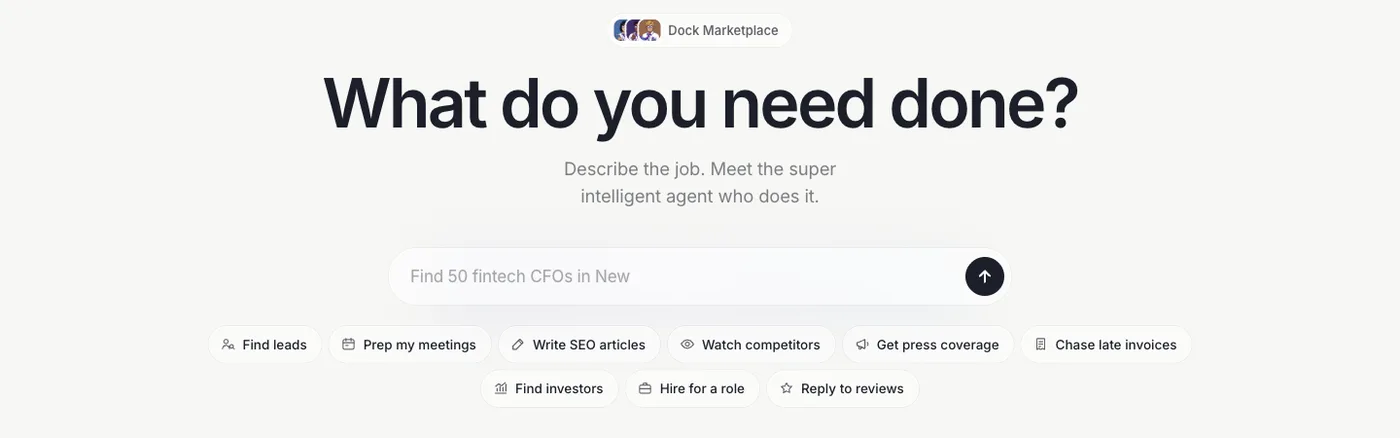
Dock's Agent Marketplace page on October 14, 2026.
What the agents learn goes into the Company Brain, so it stays with the company. Each agent runs on your Mac or in the cloud, where cloud agents work 24/7 on schedules, on the model that suits their job, from Anthropic, OpenAI and other labs. Agents reach 2,000+ platforms built in, plus the apps you connect, and per-agent permissions keep sensitive actions waiting for a person.
Price: per person per month, per the Dock pricing page, as of October 2026. Starter is $20 with 5 always-on agents, Standard is $100 with 10, and Scale is $200 with 20.
Does well: specialists that own recurring jobs and work on a schedule without a flow to build, with a Chief of Staff keeping them coordinated and a memory the company keeps.
The catch: Dock is a young company. Its security page says SOC 2 Type II is "not yet attested." You cannot self-host it, and you do not get n8n's step-by-step control over every node.
Best for: startups and agencies that want recurring sales, marketing and operations work run by a team of agents, with people approving what goes out.
Hosted workflow builders
These are the closest swaps for n8n if you want to keep building workflows but stop running servers.
2. Zapier
Zapier is the best-known no-code automation tool, with "No-code automation across 9,000+ apps," per the Zapier pricing page. Zapier Agents sit on top of the same platform and can use the connections your Zaps already have.
Price: as of October 22, 2026, Agents Free includes 400 activities a month and Agents Pro is $33.33 a month billed annually ($400 a year) for 1,500 activities. Zapier's Professional automation plan starts at $19.99 a month billed annually.
Does well: a no-code editor and 9,000+ apps, so a non-technical team can automate without an engineer.
The catch: Zapier runs in its own cloud, and its pricing page offers no self-hosted plan. Zaps bill by tasks and agents by activities, and a paid agent run stops at 40 activities to ask before continuing, so long jobs need a person to keep them going. You still design each Zap and each agent.
Best for: non-technical teams that want simple automations across the most apps, without running servers.
3. Make
Make is a visual automation builder where workflows are called scenarios. Its AI Agents page says agents are "Available on all plans" and are "built, run, and debugged directly inside the same Make canvas you already use," with a Reasoning panel that shows "every decision an agent makes, step by step." You can "add manual approvals, or stop the Agent at specific points."
Price: the Make pricing page, as of October 22, 2026, lists a Free plan with 1,000 credits a month and paid Core, Pro, Teams and Enterprise plans. Make now bills in credits: "most actions consume 1 credit," AI features may use more, and a single run can use "anywhere from two credits to thousands." Credits expire at the end of the term, and when they run out, scenarios stop until you add more. The paid plan prices did not load in our checks, so see the page for current figures.
Does well: a visual canvas that suits people who think in diagrams, with agents and deterministic steps side by side.
The catch: Make bills each action, where n8n bills each full run, so a long scenario costs more per run. Its pricing page offers no self-hosted plan, and you still build every scenario.
Best for: visual thinkers who want branching workflows and agents on one hosted canvas.
Open-source and self-hosted builders
These keep what technical teams like most about n8n: you can run them on your own servers.
4. Activepieces
Activepieces calls itself "An open source replacement for Zapier" on GitHub, where it says "Community Edition is released as open source under the MIT license," with enterprise features under a commercial license. Its README says "All our pieces (280+) are available as MCP" servers for tools like Claude Desktop and Cursor.
Price: the Activepieces pricing page, as of October 22, 2026, lists Free at $0 with 1,000 credits a month and up to 5 users, Plus at $20 a month with 10,000 credits, Team at $200 a month with 50,000 credits, 25 users and SSO, and a custom Ultimate plan. Flows are unlimited on every plan, and overage is $0.007 per credit.
Does well: an MIT-licensed core you can self-host, flat monthly plans, and every piece available to AI tools over MCP.
The catch: the page says "Community Edition is the automation core on its own," and AI agents, access control and audit visibility come with the paid plans.
Best for: teams that want n8n's self-hosting with a permissive open-source license.
5. Windmill
Windmill is an "Open-source developer platform to power your entire infra and turn scripts into webhooks, workflows and UIs," per its GitHub README, which says the core is "fully open-sourced (AGPLv3)." Scripts can be written in Python, TypeScript, Go, Bash, SQL and more.
Price: the Windmill pricing page, as of October 22, 2026, lists a free open-source plan with "Unlimited executions," up to 50 users and 3 workspaces. Paid plans start from $120 a month, billed at $20 per builder and $10 per non-builder each month, plus compute per worker. Enterprise adds audit logs, SAML and SCIM, and flow approval steps.
Does well: code first, with unlimited executions on the free self-hosted plan and scripts in the languages your engineers already use.
The catch: it is a developer tool. Business users will not build in it, and the AGPL core and the separate enterprise build are worth reading before you deploy.
Best for: engineering teams that want scripts, workflows and internal tools on infrastructure they own.
Developer and enterprise platforms
6. Pipedream
Pipedream now calls itself "The integration layer for AI agents," with "Managed auth and 10,000+ tools across 3,000+ APIs, for the agents you're building," per the Pipedream homepage.
Price: the Pipedream pricing page, as of October 22, 2026, lists Free at $0 for development, with unlimited team members, and Startup at $99 a month billed annually ($150 monthly) to run in production, with 10,000 credits and 100 external users. A credit is 30 seconds of compute, and extra credits cost $0.012 each. Business is custom and adds SSO, SCIM and HIPAA.
Does well: managed OAuth and token refresh for thousands of APIs, so a developer building an agent does not have to.
The catch: it is infrastructure for people building agents and apps, not a place to run your own operations. Someone still builds the agent.
Best for: developers adding integrations to their own AI product.
7. Workato
Workato's homepage calls it "The Platform to Govern & Scale Enterprise AI," with the ability to "Connect to 17,000+ apps, APIs, databases, files, MCP servers" and to "Discover, build, deploy, and operate multi-agent solutions."
Price: the Workato pricing page lists no prices as of October 22, 2026; it points you to a demo.
Does well: governance. It is built for IT teams that need central identity and policy over every workflow, agent and API call.
The catch: pricing is not public, the pitch is aimed at large enterprises, and an automation team still builds and runs the recipes.
Best for: enterprises where IT owns automation and needs one governed platform.
AI agent builders and helpers
These skip the workflow canvas, or most of it, and start from agents.
8. Gumloop
Gumloop invites you to "Build your team of agents" that "understand your business, work across your tools, and take work from idea to outcome," per the Gumloop pricing page, which now lists its workflows as "Legacy."
Price: as of October 22, 2026, Pro starts at $37 a month after a 14-day free trial, with 20,000 credits a month, unlimited seats and teams, 35+ models and bring-your-own API keys. The page also lists an 8% orchestration fee. Enterprise is custom, with an optional virtual private cloud.
Does well: unlimited seats, so the bill does not grow as people join, and agents built from a description instead of a node graph.
The catch: you still build and maintain every agent, and spend is credit-based, so a heavy month costs more than the headline.
Best for: teams that want to build AI agents themselves without a workflow canvas.
9. Relevance AI
Relevance AI is a no-code agent builder: its homepage says agents are "Built and customized by your team."
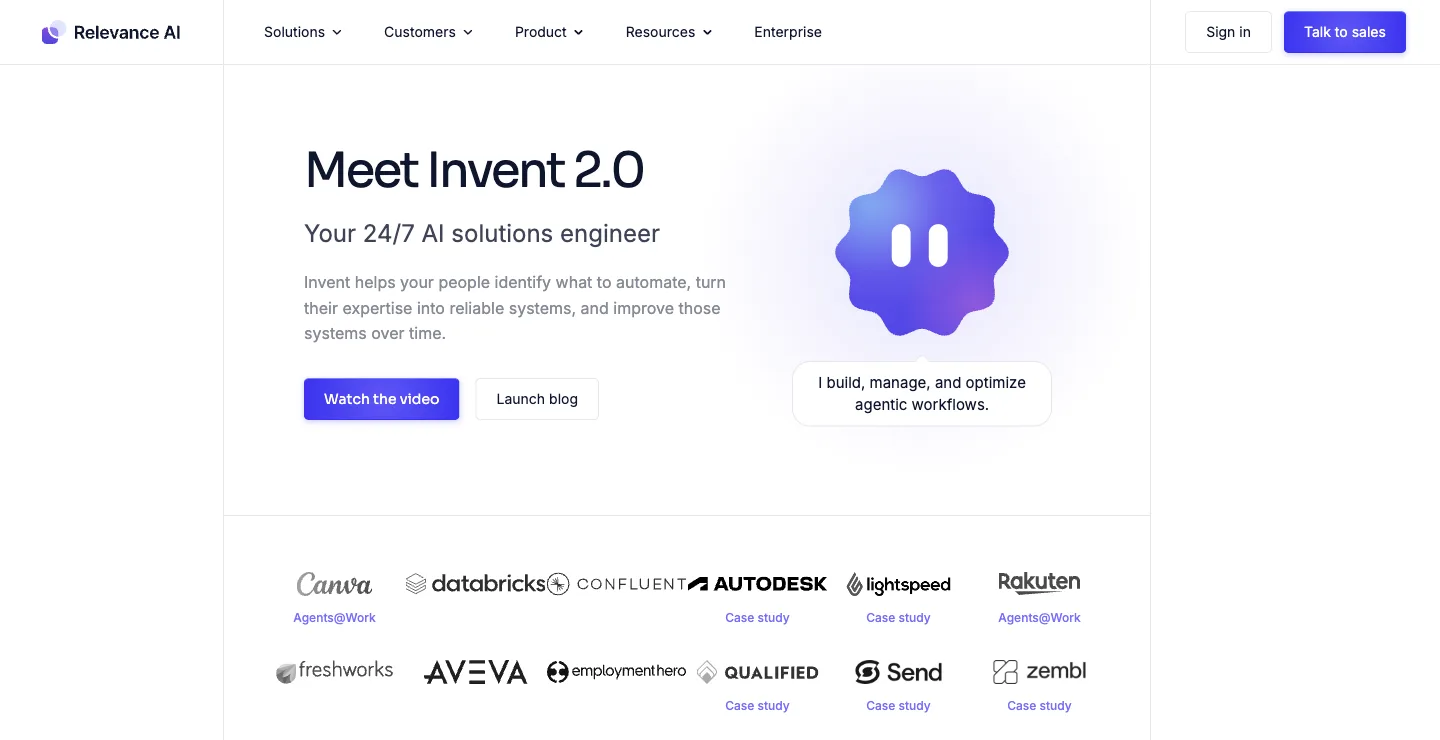
Relevance AI's homepage on October 18, 2026.
Price: the pricing docs, as of October 22, 2026, list Pro at $19 a month billed annually ($29 monthly) with 2 build users, and Team at $234 a month billed annually ($349 monthly) with 5 build users and 45 end users. The Free plan is retired. Extra Actions cost $80 per 1,000.
Does well: a no-code canvas for designing custom agents, with no servers to run.
The catch: someone on your team becomes the person who builds and maintains the agents, and every tool run is metered as an Action, failed runs included. More in our Relevance AI alternatives guide.
Best for: teams that want to design custom agents without self-hosting.
10. Lindy
Lindy is one shared helper for your team. The Lindy pricing page describes a "Slack-native teammate in threads + mentions" that also works over iMessage and email, with scheduled routines, 1,500+ integrations and "Approvals built in."
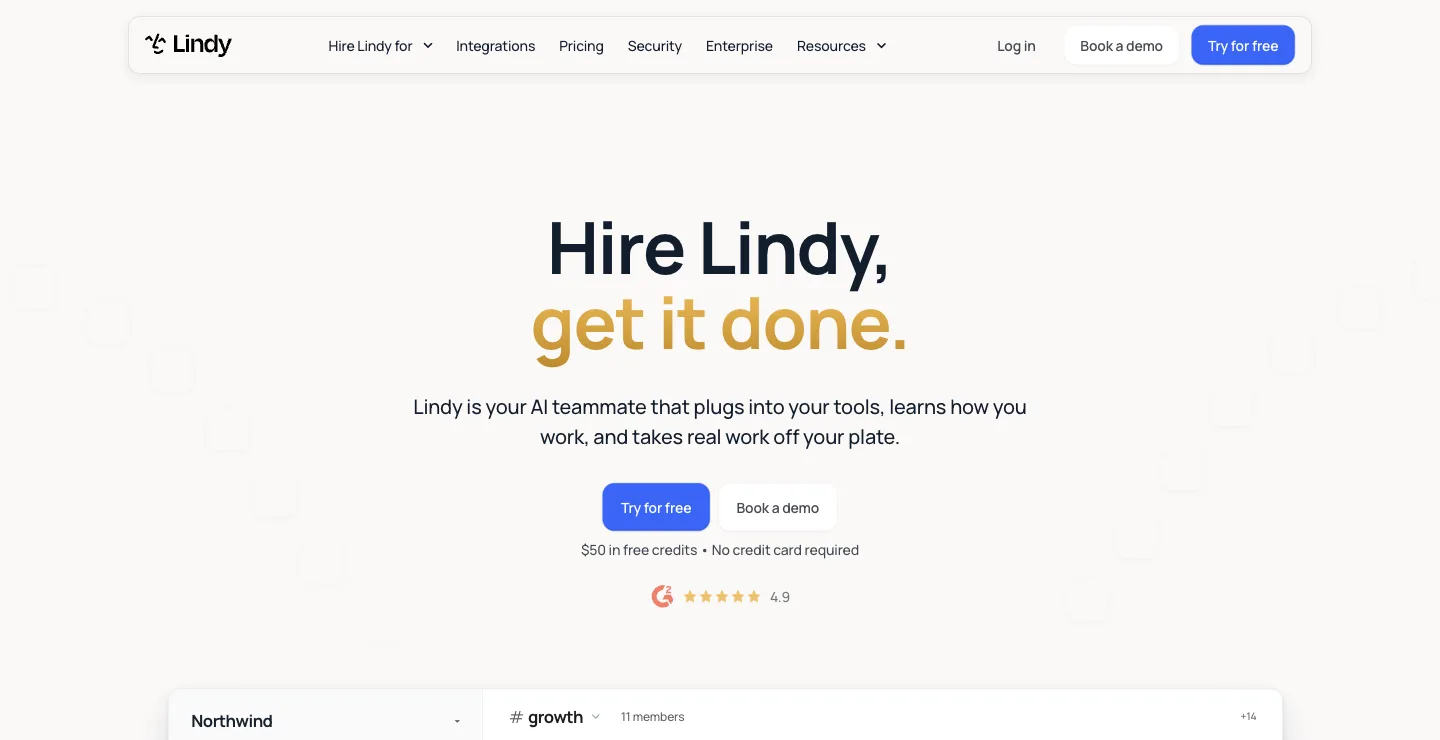
Lindy's homepage on October 18, 2026.
Price: as of October 22, 2026, Lindy starts you with $50 in free credits that last 7 days. Team starts at $29.99 a month for 3,000 credits, pooled across the team, and "Every active user in your workspace is billed." Monthly credits don't roll over, top-ups cost $10 per 1,000 credits, and Enterprise adds SSO, SCIM, audit logs and a signed BAA.
Does well: nothing to build to get started, with approvals built in.
The catch: it is one helper that answers when asked, not a team of agents who each own a job, and the bill counts every active user and then credits. More in our Lindy alternatives guide.
Best for: small teams that want inbox and meeting follow-up handled in Slack and iMessage.
n8n vs Dock
Both can run AI agents on a schedule with a person approving the sensitive steps. The difference is whether you build the work or hire for it.
With n8n, your team designs each workflow, wires each agent into it, adds a review step where it matters and hosts it if you self-host. You get full control and a predictable bill per run. With Dock, the company hires a team: a Chief of Staff coordinates specialists who each own a job, hand work to each other and bring you only the decisions. The case for that model is in hire agents, not headcount.
| n8n | Dock | |
|---|---|---|
| Shape | Workflows with AI agent nodes that you build | A team of specialist agents with roles and reporting lines |
| Who builds it | Your team, node by node | Nobody; you hire ready-made specialists |
| How work moves | Along the connections in each workflow | Agents hand work to each other; a Chief of Staff coordinates |
| Approvals | A human review step added to AI tool calls | Permissions per agent, fitted to each role |
| Where it runs | n8n's cloud or your own servers | Your Mac or Dock's cloud; cloud agents 24/7 |
| Price (Oct 2026) | Community Edition free; cloud from €20 a month billed annually | $20, $100 or $200 per person a month with 5, 10 or 20 always-on agents |
| Best at | High-volume, fixed processes you want full control over | Recurring business work that needs judgment |
If you have an engineer who wants to design, host and control every step, n8n does that very well. If you want agents to own recurring work for the company, Dock is built for that.
How to choose
| If you want | Choose |
|---|---|
| Agents that own sales, marketing and ops work for the company | Dock |
| Simple hosted automations across the most apps | Zapier |
| A visual canvas with agents and workflows side by side | Make |
| Self-hosting with an MIT-licensed core | Activepieces |
| Code-first workflows and internal tools on your own servers | Windmill |
| Integrations for an AI product you are building | Pipedream |
| One governed platform for enterprise IT | Workato |
| To build AI agents without a workflow canvas | Gumloop or Relevance AI |
| One shared helper in Slack and iMessage | Lindy |
| Full control, self-hosting and a low cost per run | Stay on n8n |
More comparisons: Zapier alternatives, Gumloop alternatives, Relevance AI alternatives, Lindy alternatives.
FAQ
What is the best n8n alternative?
It depends on what you want. If you want another workflow builder, Zapier and Make are the closest hosted swaps, and Activepieces and Windmill keep self-hosting. If you want agents that own the work instead of workflows you build, we think Dock is the better fit: you hire specialists for sales, marketing and operations, they hand work to each other, a Chief of Staff coordinates them, and plans start at $20 per person a month with 5 agents always on. We build Dock, so weigh our view accordingly.
How much does n8n cost?
As of October 22, 2026, n8n's pricing page lists Starter at €20 a month with 2,500 workflow executions, Pro at €50 with 10,000 and Business at €667 with 40,000, all billed annually, plus custom Enterprise pricing. Business is self-hosted only. All plans include unlimited users, workflows and integrations, and an execution is one full run of a workflow however many steps it has.
Is n8n free?
The self-hosted Community Edition is free on GitHub, and you pay for your own servers and upkeep. n8n describes itself as fair-code, distributed under the Sustainable Use License and the n8n Enterprise License, so read the license before building a commercial product on it. The hosted plans start at €20 a month billed annually.
What is the best open-source n8n alternative?
Activepieces and Windmill. Activepieces releases its Community Edition under the MIT license, though AI agents come with its paid plans. Windmill's core is AGPLv3, and its free self-hosted plan has unlimited executions. Both are builders, so someone technical still builds the workflows and runs the servers.
n8n vs Zapier: which is better?
For a technical team, n8n usually wins on control, self-hosting and cost at volume, because it bills a whole workflow run as one execution and includes unlimited users. For a non-technical team, Zapier is easier to start with and covers more apps, at 9,000+, but it is cloud only and bills by tasks and agent activities. Both leave you building and maintaining the automations.
What is the difference between n8n and Dock?
n8n is a workflow automation platform with AI agent nodes that your team builds and can self-host, billed by workflow executions. Dock is a team of business agents the company hires: a Chief of Staff and specialists who each have a role, a reporting line and permissions, hand work to each other and bring you only the decisions. Dock plans are per person and include 5, 10 or 20 always-on agents.
Won't OpenAI or Anthropic just build this?
They might. The labs are strong, moving fast and may well add team features. Today, what each lab ships is built around its own models and one person's account. Dock is betting that a company will want a team of agents with roles and a reporting line, a memory the business owns, and the freedom to use whichever lab's model is best for each job. That is our reasoning, not a certainty.
In short: stay on n8n if you want to design, host and control every workflow, pick Zapier or Make for a hosted builder, Activepieces or Windmill to keep self-hosting, and Dock if your company wants agents that own the work. If that last one is you, see how Dock works or start free.