If you want a personal agent for your own work and inbox, the closest swaps for Claude Duet are Meta Muse, OpenAI Dots, Gemini Task (formerly Gemini Spark) and Instinct. If you want one narrower job done well, Claude on the Team plan, Grok Bot, Manus, Lindy and Perplexity Computer each fit a specific kind of team. When a company wants agents to run work for the business, not for one person's account, we think Dock is the better fit, because its agents work as a team with roles, approvals and a memory that stays with the company. We build Dock, so weigh our view accordingly. The full list is Dock, Meta Muse, OpenAI Dots, Claude on the Team plan, Grok Bot, Gemini Task, Manus, Lindy, Perplexity Computer and Instinct.
Claude Duet is a good product. Anthropic opened a research preview on October 21 of "a new app where Claude works as a proactive agent," one that "comes to you with what needs your attention, completes tasks you ask of it, keeps working when you step away, and checks with you before it acts on your behalf" (Claude on X). Anthropic says it built Duet "for professionals and small business owners with more on their plates than they can track." Coverage from Engadget, 9to5Mac and 9to5Google framed it as Anthropic's answer to Meta Muse and OpenAI Dots. This guide is for the founders who then asked how their bookkeeper, their cofounder and their sales lead were supposed to use it too.
Dock agents can run on Claude Opus 5.5, the same model Duet is built around, so the real question in this guide is who the agent works for.
Every claim below about another vendor links to the vendor's own page or launch coverage, as of October 22, 2026.
What Claude Duet is
Duet runs on Claude Opus 5.5 and decides how much effort a job needs. It works on its own computer in the cloud, so it keeps working after you close the app, and Anthropic's announcement says it has a virtual machine with its own browser. Each morning it sends a short brief on what matters in your connected apps, then checks them every few hours and messages you when something needs attention (MacRumors).
It carries over your memory, skills and connected apps from your Claude account, and can use more than 6,000 connectors and plugins, including Gmail, Slack, QuickBooks, Stripe, HubSpot, Docusign and Shopify. Per Anthropic's help article, it can check your Stripe account for unpaid invoices and draft reminder emails for you to approve, and it can make approved purchases through Link, Stripe's wallet, and Shop Pay, Shopify's wallet, with a one-time card for each purchase. It is designed to ask before it sends a message, makes a payment, signs a document or deletes anything, and some actions, like trading securities or moving money between accounts, are off-limits even with approval.
It comes as a standalone app on iOS and Android and on claude.ai (announcement). During the research preview, Duet is included with Pro and Max at no extra cost, but it uses your plan's five-hour and weekly limits, and background work like the morning brief and check-ins counts too (help article). Pro is $20 a month and Max starts at $100.
A lot of this is careful work. The approval rules are specific, Duet never directly sees your passwords or sign-in tokens, and a dedicated classifier is designed to refuse to share the most sensitive information, such as card numbers and government IDs.
Why teams look for a Claude Duet alternative
Duet is built around one person's Claude account. That is a sensible design for a personal agent, and it shapes what a company can do with it today.
Access is one account, one person. Anthropic's help article says access "is tied to the email address you gave us," and Duet "isn't available on Team or Enterprise plans yet." Anthropic says it plans to bring Duet to those plans later. For now, if the owner sets Duet up to chase invoices and then goes on vacation, nobody else on the team has that Duet to open.
Memory follows the person. Duet carries over the memory, skills and connectors from your own Claude account. What it learns about your customers and pricing exceptions lives there, and a colleague who joins the waitlist starts from their own account.
Usage comes out of one plan. Duet shares your Pro or Max limits with the rest of Claude, and its background checks count, so Anthropic warns you may hit limits sooner than with chat alone (9to5Mac). There is no pooled team allowance.
Availability is narrow. The preview is for Pro and Max users in the US, through a waitlist, and invitations go out in waves with no set date (help article).
Some channels are not there yet. Duet does not make phone calls or send texts, Microsoft 365 is not yet available as a connector, and Anthropic's own announcement says Duet "can't yet show you its browser" and runs in its own app, separate from the main Claude app.
None of that is a flaw in a personal agent. It matters when three people need to see and steer the same pipeline, client list or month-end close. Our personal agent vs business agent guide covers the difference in more depth.
Where Dock is the better fit
These are the reasons we think Dock suits a company that wants agents running its work, and where Duet is built differently.
The agents work as a team for the company. Each Dock agent has a name, a role, a reporting line and permissions. Agents hand work to each other, share a Company Brain, and bring sensitive actions to a person for approval. A Chief of Staff runs the team and is reachable by email and iMessage. Duet gives one person one agent, tied to that person's Claude account.
You keep Claude, and add choice. Dock agents run on Claude models first and by default, with models from OpenAI and other labs a menu pick, so your writer can stay on Claude while another agent uses a different model. In the Mac app, Bring your own plan has a row for Claude models as well as OpenAI ones.
What the agents learn stays with the company. Dock agents keep what they learn in the Company Brain and shared workspaces, so it stays when someone leaves or you change models. What Duet learns lives in one person's Claude account.
The agents keep working on a schedule. Cloud agents run 24/7 on their own machines, or on your Mac, with 2,000+ platforms built in plus the apps you connect. One example: Shawn Dej, CEO of YourStory AI, runs an eight-agent sales org in Dock that works 400+ schools and 150+ community colleges, and every send waits for his OK, which he gives by text.
On price, Dock is per person: $20, $100 or $200 a month with 5, 10 or 20 always-on agents, as of October 2026. Duet is included with Claude Pro at $20 a month or Max from $100, for one person's agent.
Where Dock is not the right pick
- If you want one proactive agent for your own inbox, calendar and errands, a personal agent such as Duet, Muse, OpenAI Dots, Gemini Task or Instinct is simpler. If you already pay for Claude Pro or Max in the US, Duet costs nothing extra to try once you are off the waitlist.
- If you want Duet's checkout features, Dock is not built for them. Dock will not buy something for you with Shop Pay or a one-time card.
- If you want to design and wire every agent step by step yourself, a workflow builder where you configure each step gives you more control.
- Dock is a young company. SOC 2 Type II is not yet attested. If you need a signed BAA or a completed SOC 2 report today, look elsewhere.
- If your team already lives in Claude, ChatGPT or Google's apps, the agent built into that plan (Claude Cowork and @Claude on the Team plan, Dots or Gemini Task) may be enough.
Won't the big AI labs just build this?
They may. The labs are strong and moving fast: Meta shipped Muse on September 8, OpenAI shipped Dots on September 29 and Anthropic opened Duet on October 21. Anthropic says it plans to bring Duet to Team and Enterprise plans later, so team features may well come. Today, what each lab ships is built around its own models and one person's account. Our bet is that a company will want a team and a memory it owns, separate from any one lab, and the freedom to use whichever lab's model is best for each job. That is our reasoning, not a certainty. Either way, Dock agents run on the labs' models, Opus 5.5 included, so as those models improve, so do the agents.
The category is crowded. Most products in it are builders you configure or agents for one person. Dock is built to run specific jobs end to end, like lead generation, follow-ups and collections.
How we picked
We read the pages covering Duet's launch and the tools they compare it with, then checked prices on the vendor's own site or help center. Duet's details come from Anthropic's announcement, help center and pricing page, checked on October 22, 2026. Anything we could not confirm from the vendor or reputable coverage is left out.
Each tool was judged on five questions that matter to a small team:
- Can more than one person on the team use the same agents and see the same work?
- Does the agent keep working when nobody is watching, on a schedule or in the background?
- What does it cost for a team of five, in plain dollars?
- Where does the agent run, and who controls what it can touch?
- Does it ask a person before the sensitive actions?
We also kept personal agents on the list. Some readers searching for a Duet alternative really do want a proactive agent for their own work, and it would be odd to pretend otherwise.
We compared each tool from its own website, pricing page and help docs, plus launch coverage, as of October 22, 2026. We did not run paid trials. The screenshots under each pick come from those public pages, captured on October 14, 2026. Prices change, so check each vendor's pricing page before you buy.
Claude Duet alternatives compared
| Tool | Best for | Starting price | Team features | Where agents run |
|---|---|---|---|---|
| Claude Duet (reference) | One professional or owner on Claude Pro or Max in the US | Included with Pro ($20/mo) or Max (from $100/mo); waitlist | One Duet per account; not on Team or Enterprise yet | Its own computer in Anthropic's cloud |
| Dock | Teams that want a team of business agents | $20 per person per month | Shared workspaces for people and agents, shared company knowledge | Your Mac or the cloud, your choice |
| Meta Muse | Owner-operators on a budget | Free; Power $20/mo; Max $100/mo | None found | Muse's secure cloud computer |
| OpenAI Dots | ChatGPT users who want one always-on agent | ChatGPT Pro from $100/mo; Business Premium seat $100/mo billed annually | One dot per person; only the owner can direct it | OpenAI's cloud computer, optional access to your own computer |
| Claude on the Team plan | Teams that want Claude shared in Slack and an agent for each person | Team Standard $20/seat/mo billed annually | @Claude in Slack, one Claude per channel (beta) | Anthropic's cloud |
| Grok Bot | Tech-forward teams already on a Grok plan | Premium $30/mo; Teams $30/user/mo | Team Bots in public beta, memory kept per user | One persistent cloud computer per user |
| Gemini Task (formerly Gemini Spark) | People who live in Gmail and Google Drive | Google AI Pro $19.99/mo | Personal Google accounts; select business users | Google's cloud, 24/7 |
| Manus | Research, slides, sites and one-off projects | Team from $20/seat/mo | Pooled credits, shared projects and skills, free guests | Manus cloud sandbox |
| Lindy | Inbox, meeting and Slack workflows | Team from $29.99 per active user/mo for 3,000 credits ($49.99 for 5,000) | Pooled credits, each active user billed a seat | Lindy cloud |
| Perplexity Computer | Research-heavy work | Enterprise Pro $40/seat/mo | Enterprise seats, admin and SSO | Perplexity cloud |
| Instinct | Personal life admin by text | Free, invite only | None; personal use license | Its own computer, phone number and inbox |
1. Dock
Dock gives your company a team of AI agents that run real jobs end to end, around the clock, while your people set the strategy and approve what goes out. Each agent has a name, a role, a reporting line and permissions, with a job like sales, lead generation, marketing or ops, and their work lands in tables and docs everyone can open. What they learn goes into a Company Brain the whole company uses, so it stays with the business. A Chief of Staff agent keeps the roster moving and is reachable by email and iMessage, so you can ask for a status update from your phone. Dock is backed by Y Combinator (S26).
It fits founders and owners of knowledge-work teams, such as agencies, consultancies, accounting and law firms, and tech teams under about 20 people, who want work done for the company instead of for one login.
Plans are per person, per month: Starter $20, Standard $100 and Scale $200, each with a monthly allowance of business credits. They include 5, 10 or 20 always-on agents. Details are on the pricing page.
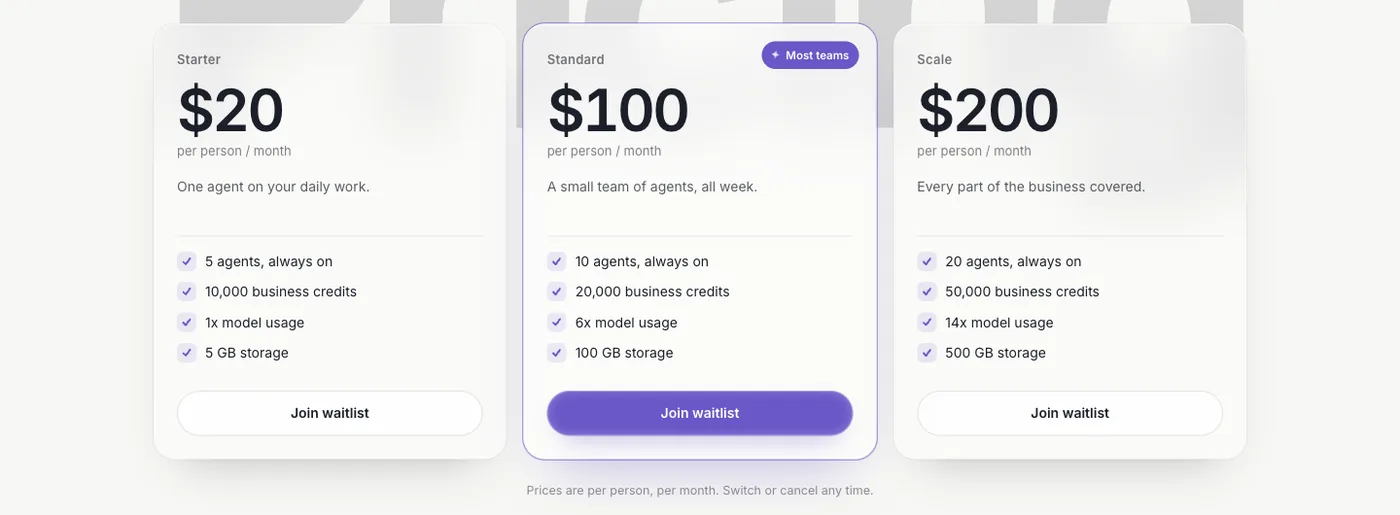
Dock's pricing page on October 14, 2026.
What it does well: shared work. An agent works in the workspaces its owner can access inside the same company, at the owner's permission level, plus any workspace they're added to directly. Inheritance never crosses into another company. So when your ops lead hires an invoicing agent, your bookkeeper can open the same table and see every reminder the agent sent. Agents run on your Mac or in the cloud, your choice, and each one can run on the model that suits their job, Claude Opus 5.5 included. You can hire a ready-made specialist from the Agent Marketplace or build your own. As of the October 13 release, every agent can reach more than 2,000 platforms on your business credits, such as Google Maps listings, ElevenLabs voiceovers and Hunter lead data, with no accounts to open first. Sensitive changes like plan changes, removing people or sending an email campaign wait for a person's approval.
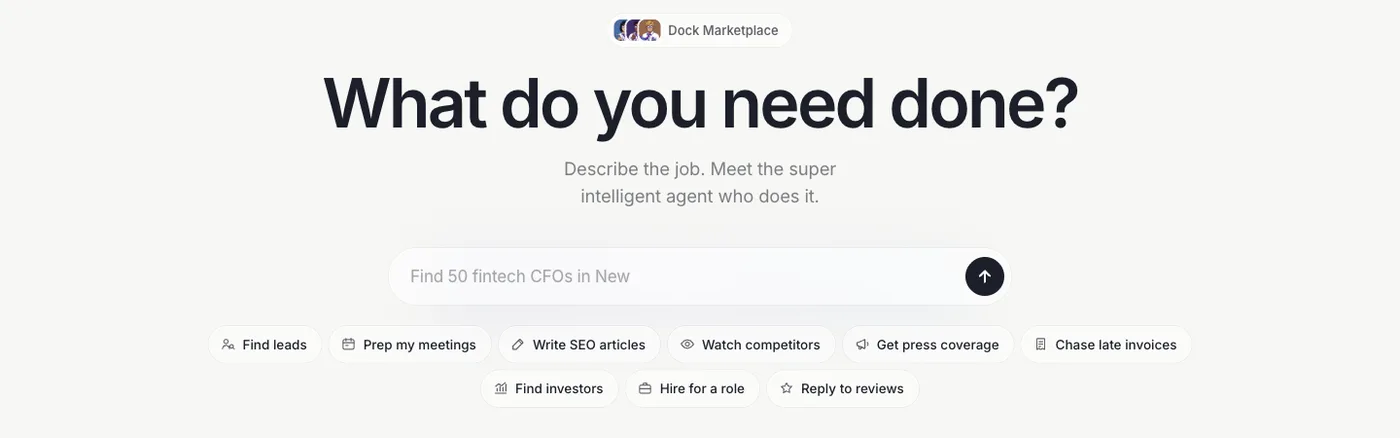
Dock's Agent Marketplace page on October 14, 2026.
Where it falls short: Dock is young. Our security page says SOC 2 Type II is not yet attested, so if your clients require that report today, check back later. Dock also skips the personal side on purpose. It will not check out at an online store for you the way Duet can.
Best for: companies that want agents holding standing jobs, like sales, invoicing or pipeline, with work the whole team can see and a person approving what matters.
2. Meta Muse
Meta's Muse is a personal agent with its own secure computer in the cloud, launched on September 8. Since September 29, Muse for Small Business adds skills and connectors for owners, including Shopify, QuickBooks, Slack, Notion and Klaviyo. Like Duet, it is a proactive agent for one person, and it is one of the two products launch coverage compared Duet with.
It fits solo owner-operators in the US or Canada who want an always-on agent for personal and business errands at little or no cost.
Pricing: Muse is free with a usage limit. Paid plans are Power at $20 a month for 500M Muse tokens a week and Max at $100 a month for 3B.
What it does well: the free tier is an easy way to try an always-on agent without a waitlist, and the small-business connectors cover common storefront and finance tools. Meta's safety write-up is careful work.
Where it falls short: Meta describes Muse as "a personal AI agent" on muse.ai/business, and we found no seats, shared workspaces or admin roles. It is limited to people 18 and over in the US and Canada, and it runs on Meta's own Muse models.
Best for: a business of one that wants a free, always-on agent and does not need Claude specifically. Our Muse alternatives guide and Dock vs Muse comparison go further.
3. OpenAI Dots
Dots are OpenAI's always-on agents, launched at DevDay on September 29 and powered by GPT-6 Astra. Each dot has its own cloud computer, starts with your ChatGPT memory, and keeps working on a goal between conversations. You reach it in ChatGPT on web, mobile and desktop, and in Slack and Microsoft Teams.
It fits people who already run their day in ChatGPT and want one agent that can own a project, like keeping an investor deck current.
Pricing: per OpenAI's help center, your first dot is included with ChatGPT Pro or Business Premium. Pro starts at $100 a month, with $200 and $500 tiers. A Business Premium seat costs $125 a month, or $100 billed annually, and a Business workspace needs at least two seats.
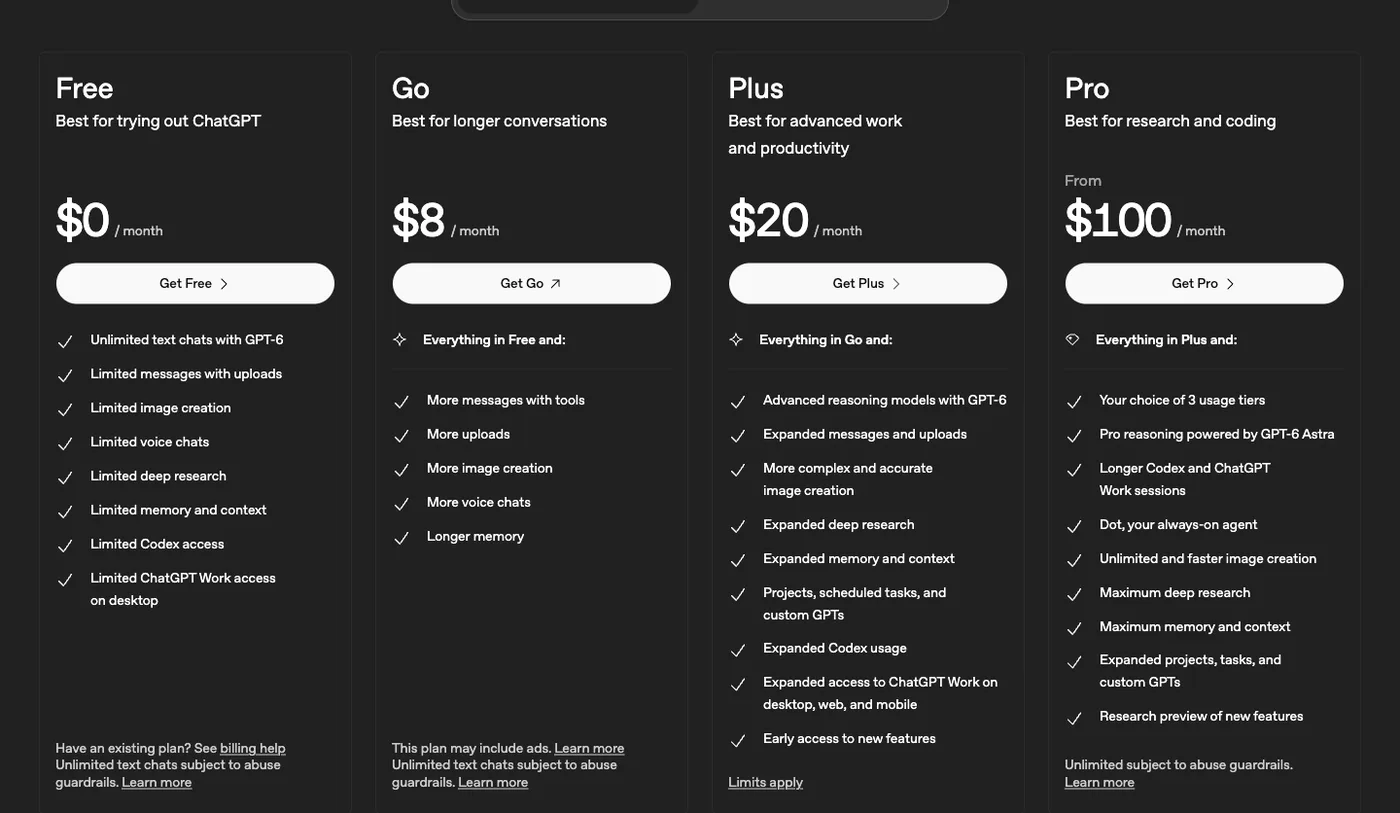
ChatGPT's pricing page on October 14, 2026, with Dot listed under Pro.
What it does well: unlike Duet today, a dot is available on a business plan, and it works in Slack and Teams. Custom Rules let you allow, block or require approval for specific actions, and connecting your own computer is off until you turn it on.
Where it falls short: OpenAI's admin guide, Manage dots in ChatGPT workspaces, says "only a dot's owner can direct it." Each person gets one dot today, and Pro dots are not offered in the EEA, Switzerland or the UK.
Best for: people who already run their day in ChatGPT and want one strong agent that can own a project. Our OpenAI Dots alternatives guide has more.
4. Claude on the Team plan (Cowork and @Claude)
If you want to stay with Anthropic and share Claude across a team today, the Team plan is the route Duet does not cover yet. The pricing page says "Claude Cowork is now just Claude," and Claude Cowork runs tasks in Anthropic's cloud, so "close your laptop and Claude keeps going," with scheduled tasks that run with no device online. Claude Tag, shown as @Claude on the pricing page, puts a team agent in Slack: "Within a given Slack channel, there's one Claude that interacts with everyone."
It fits teams that want Claude's quality for every person, plus one shared Claude in the channels where work happens.
Pricing: the Team plan, for 2 to 150 people, costs $25 per Standard seat per month, or $20 billed annually, and $125 per Premium seat, or $100 billed annually (claude.com/pricing). @Claude is listed for Team and Enterprise only.
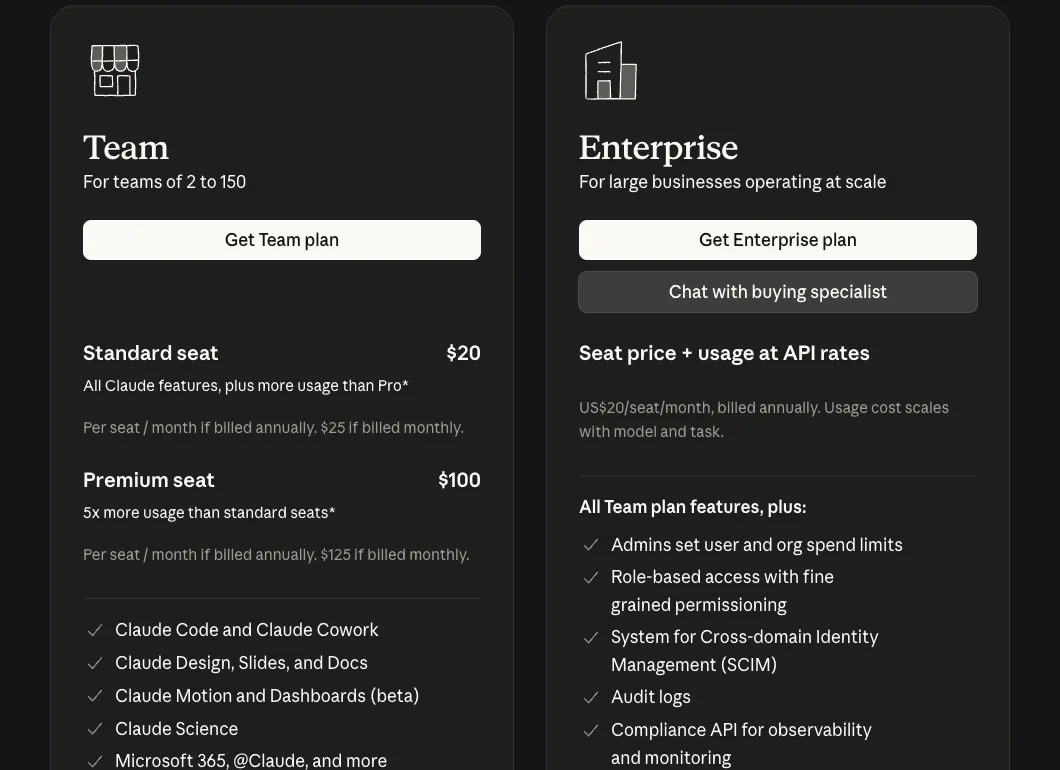
Claude's pricing page on October 14, 2026.
What it does well: it has a real team plan with seats and billing in one place, and the whole channel shares one Claude, which is the shape Duet does not have yet.
Where it falls short: Claude Tag is in beta, works in Slack today, and only an Owner or Primary Owner can set it up. Memory is off by default on Team and Enterprise. You get one general agent per channel, so roles like "the bookkeeper" or "the SDR" are yours to define in prompts, and Duet itself is not on this plan yet.
Best for: teams that want to stay on Claude and share one agent in Slack while Duet is limited to Pro and Max.
5. Grok Bot
Grok Bot from SpaceXAI (formerly xAI) offers "AI teammates you can give real work to." Bots sign in to your tools on a persistent cloud computer, learn a workflow by watching you do it once, run routines on a schedule, and pass work between each other in a shared thread.
It fits tech-forward teams already paying for a Grok plan, especially in sales, recruiting and operations, where its role templates (Sales Outbound, Expense Manager, Chief of Staff) are useful starting points.
Pricing: as of October 22, 2026, Grok Bot is included with SpaceXAI's Premium at $30 a month, Super at $100 or Ultra at $200, or Teams at $30 per user a month, with weekly Bot usage included and more billed at token cost (x.ai/bot).
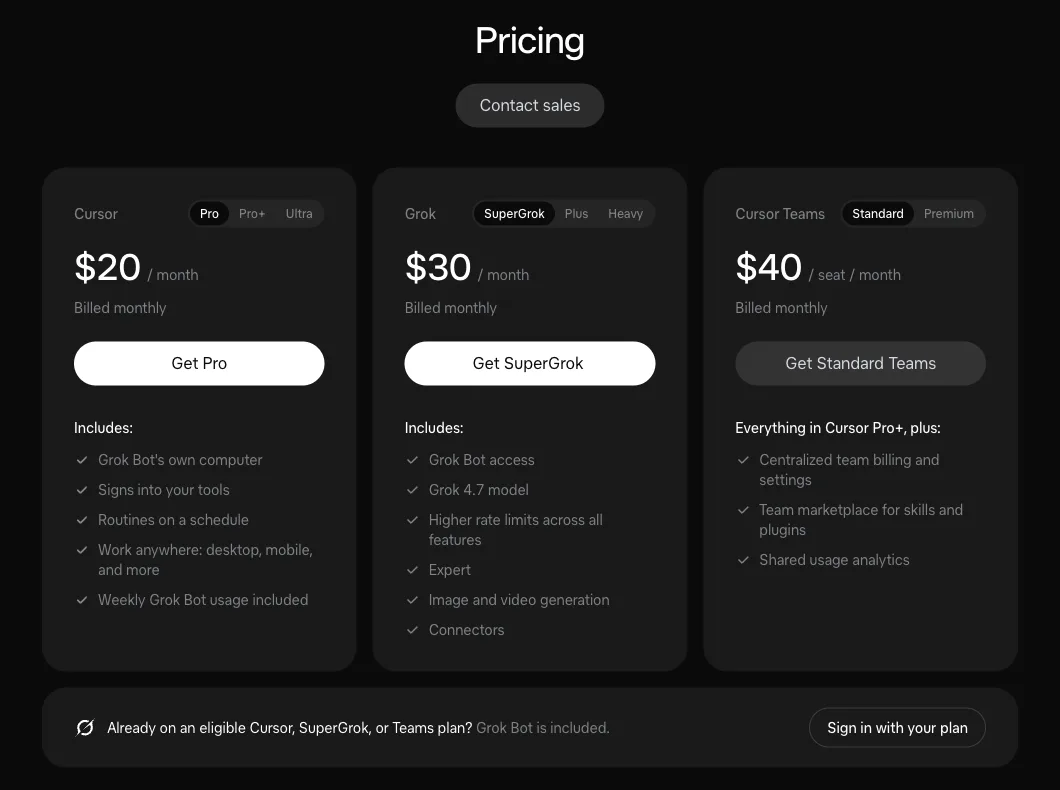
The pricing section of Grok Bot's page on October 14, 2026.
What it does well: it is the most work-shaped of the big-lab agents. Several Bots can run in parallel on different jobs. Team Bots, in public beta since September 28 on Teams and Enterprise plans, are shared bots everyone on the team can reach, each with its own Slack handle.
Where it falls short: isolation is per user. All of one person's Bots share one cloud computer, files, browser and logins included, per the FAQ on x.ai/bot. Team Bots keep separate memories for each user, so what the bot learns from you does not carry over to a colleague.
Best for: teams already on a Grok plan that want bots signing in to their tools. Our Dock vs Grok Bot comparison goes further.
6. Gemini Task (formerly Gemini Spark)
Gemini Task is Google's 24/7 personal agent, under the Chat and Task toggle in the Gemini app. It runs in Google's cloud even when your laptop is closed, connects to Gmail, Calendar, Drive, Docs and Sheets, and uses Tasks, Skills and Schedules to repeat work on your terms.
It fits founders who run their whole business out of a personal Google account and want an agent that can, for example, log every inquiry from Gmail into a client tracker sheet.
Pricing: it comes with Google AI Pro at $19.99 a month and AI Ultra from $99.99 (gemini.google). It is not offered in the EEA, the UK or Switzerland.
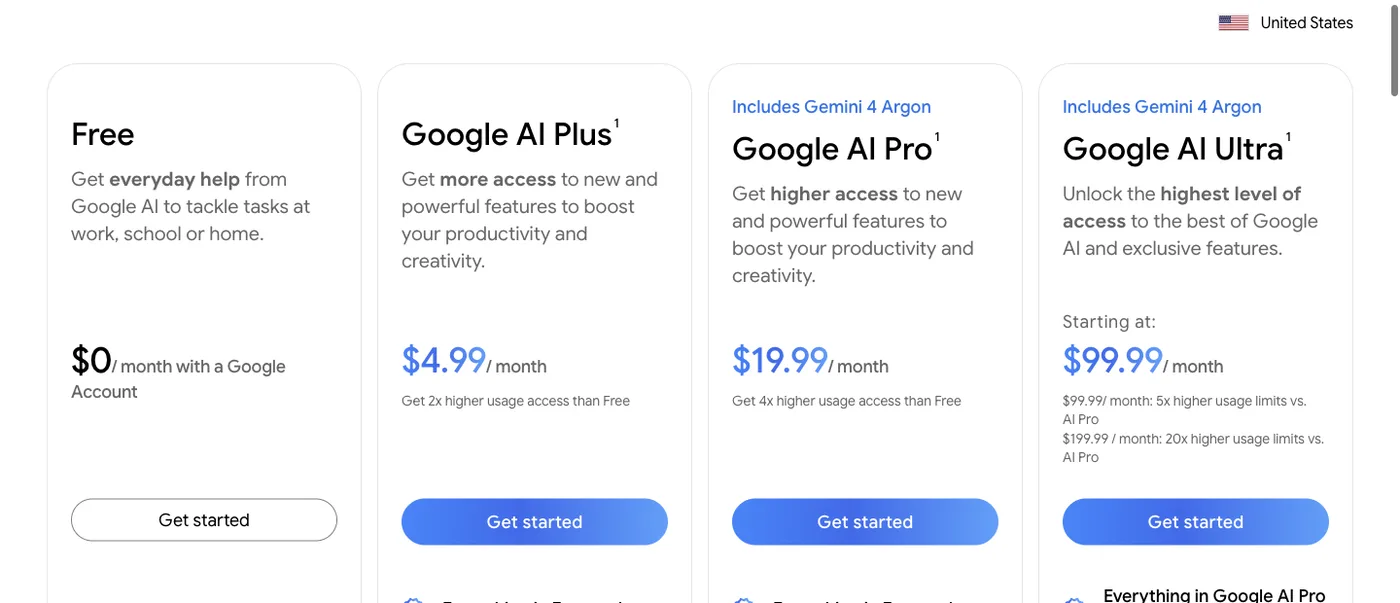
Google's Gemini subscriptions page on October 14, 2026.
What it does well: native access to Google's apps with no setup and a low entry price.
Where it falls short: Google AI Pro and Ultra require a personal Google account that you manage yourself. Google's Gemini Task page says select business users have access, with more businesses over the coming weeks, so most work accounts will wait.
Best for: solo founders on a personal Gmail account who want an affordable always-on agent.
7. Manus
Manus is a general agent that takes a goal and delivers a finished result, such as a research report, a slide deck, a website or a chart, working in its own cloud sandbox. It can split a big job across many sub-agents at once.
It fits small teams that need lots of one-off deliverables, like competitor research, pitch decks or a landing page, more than they need an agent holding a standing job.
Pricing: per manus.im/team, Manus Team starts at $20 per seat per month or $200 per seat per year, with 4,000 credits per seat per month pooled across the team. SSO is free from 30 seats and a flat $150 add-on below that. Guests who only view and comment are free.
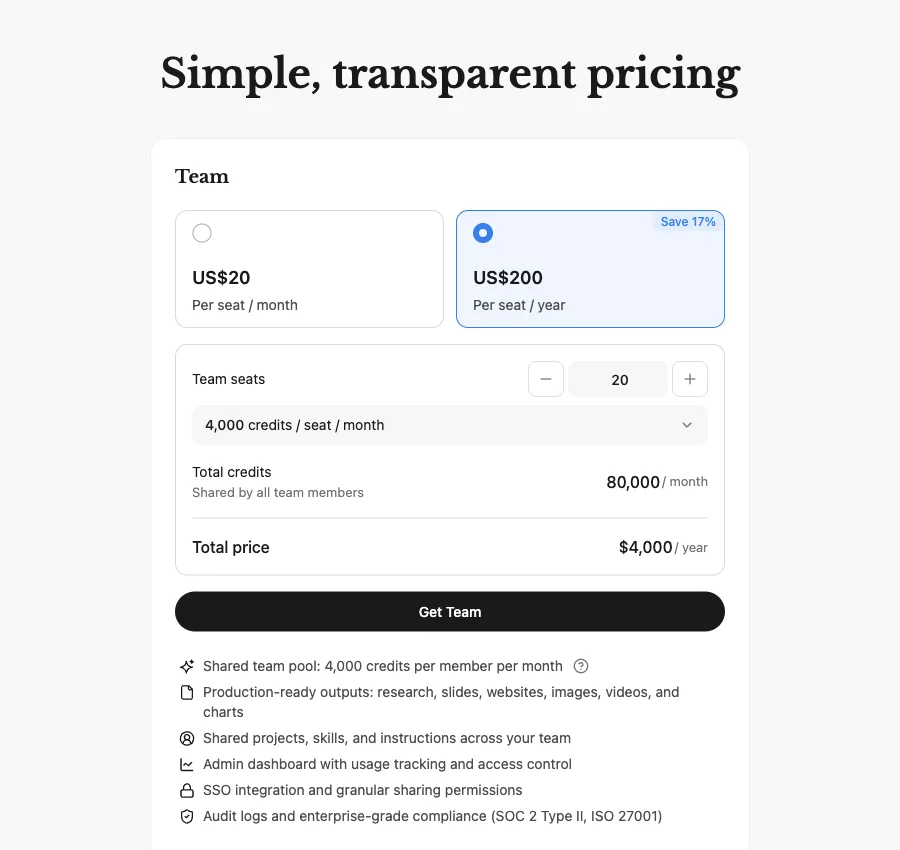
Manus's Team pricing on October 14, 2026.
What it does well: the team plan is practical. Shared projects, skills and instructions mean one person's setup helps everyone, and pooled credits stop a quiet month from going to waste.
Where it falls short: Manus is strongest at tasks with a clear end. It is less suited to an agent that owns a recurring job, like chasing every open invoice every Monday, and credit costs vary with how complex each task is.
Best for: polished one-off deliverables on demand, like research reports, decks and sites.
8. Lindy
Lindy works inside your team's tools and Slack, handling inbox triage, meeting follow-ups and research, and waiting for approval before anything with outside impact.
It fits teams whose pain is email and meetings, and that live in Slack.
Pricing: a free plan comes with $50 in credits that last seven days. Team starts at $29.99 per active user a month for 3,000 credits (the 5,000-credit tier is $49.99), with credits pooled across the team. Enterprise adds SSO, SCIM and audit logs (lindy.ai/pricing).
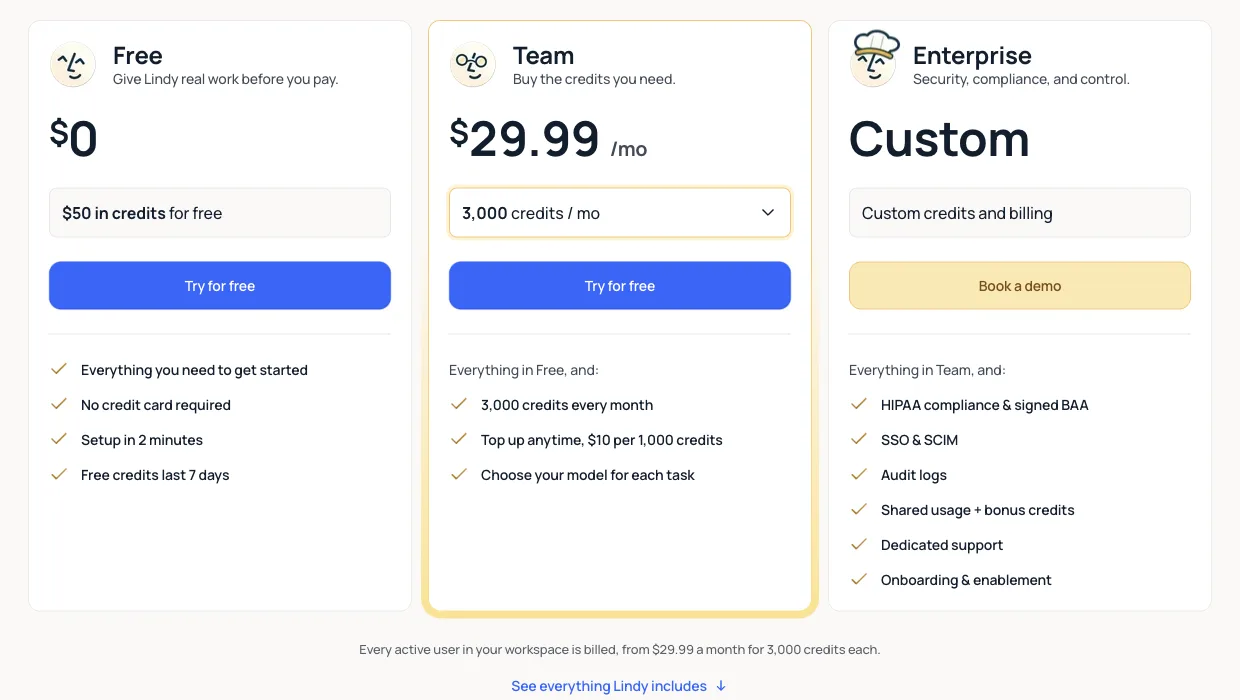
Lindy's pricing page on October 14, 2026.
What it does well: it is focused on the daily admin that eats a founder's mornings, which is close to what Duet's morning brief targets, and pooled credits suit a small team.
Where it falls short: every active user is billed, and monthly credits do not roll over, so work out your real monthly cost before you commit.
Best for: teams whose main pain is inbox and meeting follow-up, mostly in Slack.
9. Perplexity Computer
Perplexity Computer is Perplexity's agent for multi-step work across the web, your files and connected apps. It runs on credits, where 100 credits equal $1.
It fits teams where most agent work is research: market scans, account research before sales calls, sourcing and due diligence.
Pricing: for teams, Enterprise Pro costs $40 per seat per month or $400 a year, and Enterprise Max $325 per seat per month.
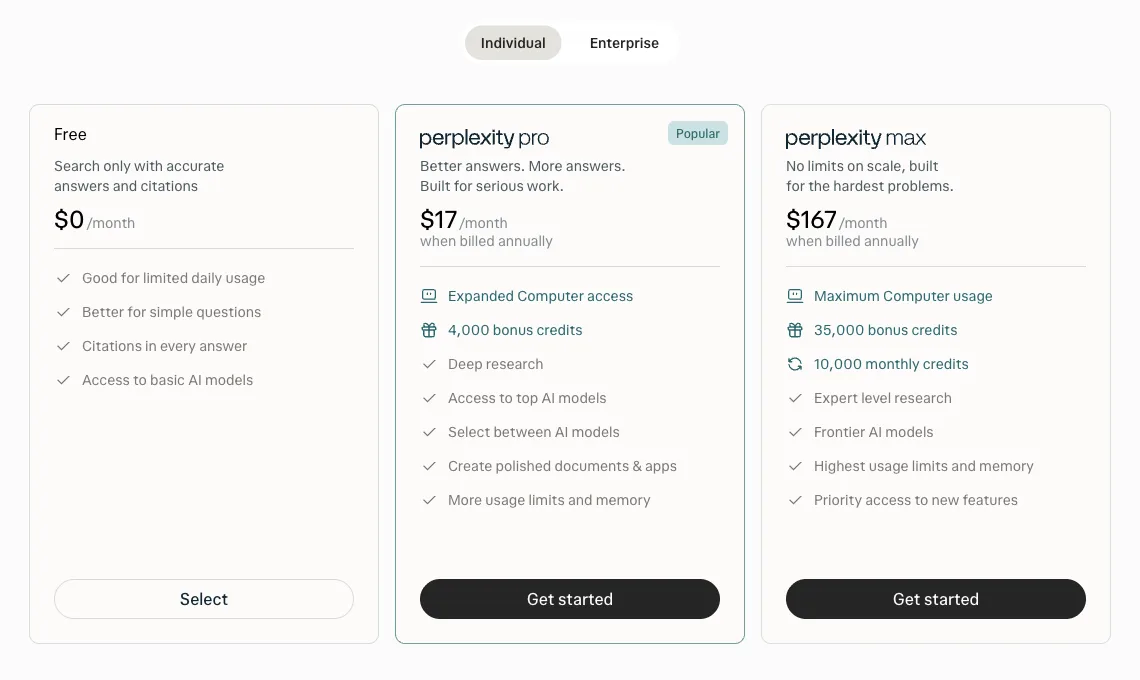
Perplexity's pricing page on October 14, 2026.
What it does well: research quality and citations. If your team's agent work starts with "find out," Perplexity is a strong home for it.
Where it falls short: Perplexity's admin guide lists 500 Computer credits a month per Enterprise Pro seat, which is about $5 of agent work, so heavier use means buying credits. It is built around research tasks, less around agents that hold ongoing jobs.
Best for: teams whose agent work is mostly research, with citations they can check.
10. Instinct
Instinct is a personal agent you text, email or call. It has its own phone number, its own computer and its own inbox, and it connects to Google Workspace, Slack and Notion. Since October 5 it can join group chats that include people without an account.
It fits people who want an agent for life admin, like disputes, bookings, gifts and appointments, without opening an app. Duet does not make calls or send texts; Instinct is built around them.
Pricing: free during its invite-only beta, with no published price.
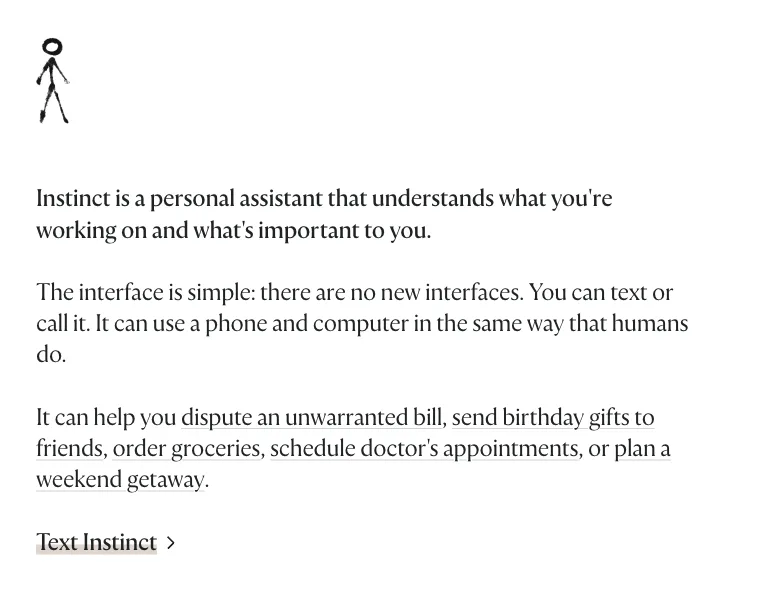
Instinct's homepage on October 14, 2026. It publishes no pricing page.
What it does well: the no-app design is the purest version of a personal agent, and reviewers like it for errands.
Where it falls short for a business: its terms grant a license "for your personal use only," and there is no team or business plan.
Best for: people who want an agent for their own life admin by text, and who wanted Duet mainly for errands.
Also considered
Hark Pro launched October 6 as a free personal agent with paid tiers at $20 and $100 a month. OpenClaw is free, open-source and self-hosted, and you pay your model provider. Relevance AI suits operators who want to build sales agents step by step. Microsoft 365 Copilot suits companies already run on Microsoft 365, which Duet does not connect to yet.
Claude Duet vs Dock
Duet works for one person. Dock is built to work for a business: a team of agents that keeps jobs moving while you are out, with a memory that stays with the company and a person approving what matters. Both can run on Claude Opus 5.5.
| Claude Duet | Dock | |
|---|---|---|
| Built for | One professional or small business owner | Teams of people and agents |
| Who can see the work | The account holder | Everyone with access to the workspace |
| Agents | One Duet per Claude account | A team of agents, each with a name, a role and a reporting line |
| Memory | Your Claude account's memory, skills and connectors | A Company Brain the whole company uses, plus each agent's own |
| Price | Included with Pro ($20/mo) or Max (from $100/mo); waitlist | Starter $20, Standard $100, Scale $200 per person per month, with 5, 10 or 20 always-on agents |
| Where it runs | Its own computer in Anthropic's cloud | Your Mac or the cloud, your choice; cloud agents run 24/7 |
| Models | Claude Opus 5.5 | The model that suits each job, Claude Opus 5.5 included, plus OpenAI and other labs |
Duet is better for one person's own work: a morning brief, checkout with Link or Shop Pay, and a Claude account you already use. For the work two or more people touch, which has to keep going while you are out and which someone has to answer for, we think Dock is the better fit. You can also use both: keep Duet for your own day and run Dock agents on Opus 5.5 for the company.
How to choose a Claude Duet alternative
You run a team and want agents doing standing jobs for the company: sales, lead generation, marketing, ops. Choose Dock.
You are a business of one in the US or Canada and want a free always-on agent: choose Meta Muse.
Your team already pays for ChatGPT and you want one strong agent per person on a business plan: choose OpenAI Dots on Business Premium.
You want to stay on Claude and share it across a team now: choose Claude on the Team plan, with @Claude in Slack.
Your team already lives in Grok and you want bots that sign in to your tools: choose Grok Bot.
You are a solo founder on a personal Gmail account: choose Gemini Task.
You need finished decks, reports and sites on demand: choose Manus.
Your pain is the inbox and meeting follow-up, mostly in Slack: choose Lindy.
Most of your agent work is research: choose Perplexity Computer.
You actually wanted a better agent for your own life, by text: choose Instinct, or join the Duet waitlist.
Plenty of people will end up with a personal agent for their own day and business agents for the company, which is a sensible setup. The AI agents for business guide explains how to pick the first job to hand over.
More comparisons: Meta Muse alternatives, OpenAI Dots alternatives, Grok Bot alternatives, Instinct alternatives, Claude Cowork alternatives.
FAQ
What is the best Claude Duet alternative for a business?
It depends on the job. For a team that wants agents running work for the company, we think Dock is the better fit, because people and agents share the same workspaces and the work stays with the company; we build Dock, so weigh that accordingly. To stay on Claude with a team, use the Team plan with @Claude. For a free personal agent, Meta Muse.
How much does Claude Duet cost?
During the research preview, Duet is included with Claude Pro ($20 a month) and Max (from $100 a month) at no extra cost. It uses your plan's five-hour and weekly limits, and background work like the morning brief and check-ins counts toward them.
Can a team share one Claude Duet?
Not today. Anthropic's help article says access is tied to the email address you signed up with, and Duet is not available on Team or Enterprise plans yet. Anthropic says it plans to bring Duet to those plans later.
Who can get Claude Duet?
Pro and Max subscribers in the US, through a waitlist. Invitations go out in waves, so joining the list does not set a date.
What model does Claude Duet use?
Claude Opus 5.5. Duet decides how much effort a job needs, and you cannot pick a different model. Dock agents can also run on Opus 5.5.
What is the difference between Claude Duet, Meta Muse and OpenAI Dots?
All three are proactive personal agents with their own cloud computer. Duet runs on Claude Opus 5.5 and comes with Claude Pro or Max in the US. Muse is free to start, runs on Meta's models and is available in the US and Canada. Dots run on GPT-6 Astra and come with ChatGPT Pro from $100 a month or a Business Premium seat.
Can Claude Duet pay invoices or buy things?
It can check your Stripe account for unpaid invoices and draft reminder emails for you to approve, and it can make purchases you approve through Link or Shop Pay, using a one-time card. It asks before any payment, and moving money between accounts is off-limits even with approval.
Won't Anthropic or OpenAI just build this?
They may. The labs are strong, they move fast, and Anthropic says Duet is coming to Team and Enterprise plans later. Dock's bet is that a company will want a team and a memory it owns, separate from any one lab, and the freedom to use whichever lab's model is best for each job. That is our reasoning, not a certainty, and Dock agents run on the labs' models, so they improve as those models do.
In short: for your own day, Duet or another personal agent; for one narrow job, the tool built for it; for a company that wants agents running its work, we think Dock is the better fit. Start for free.