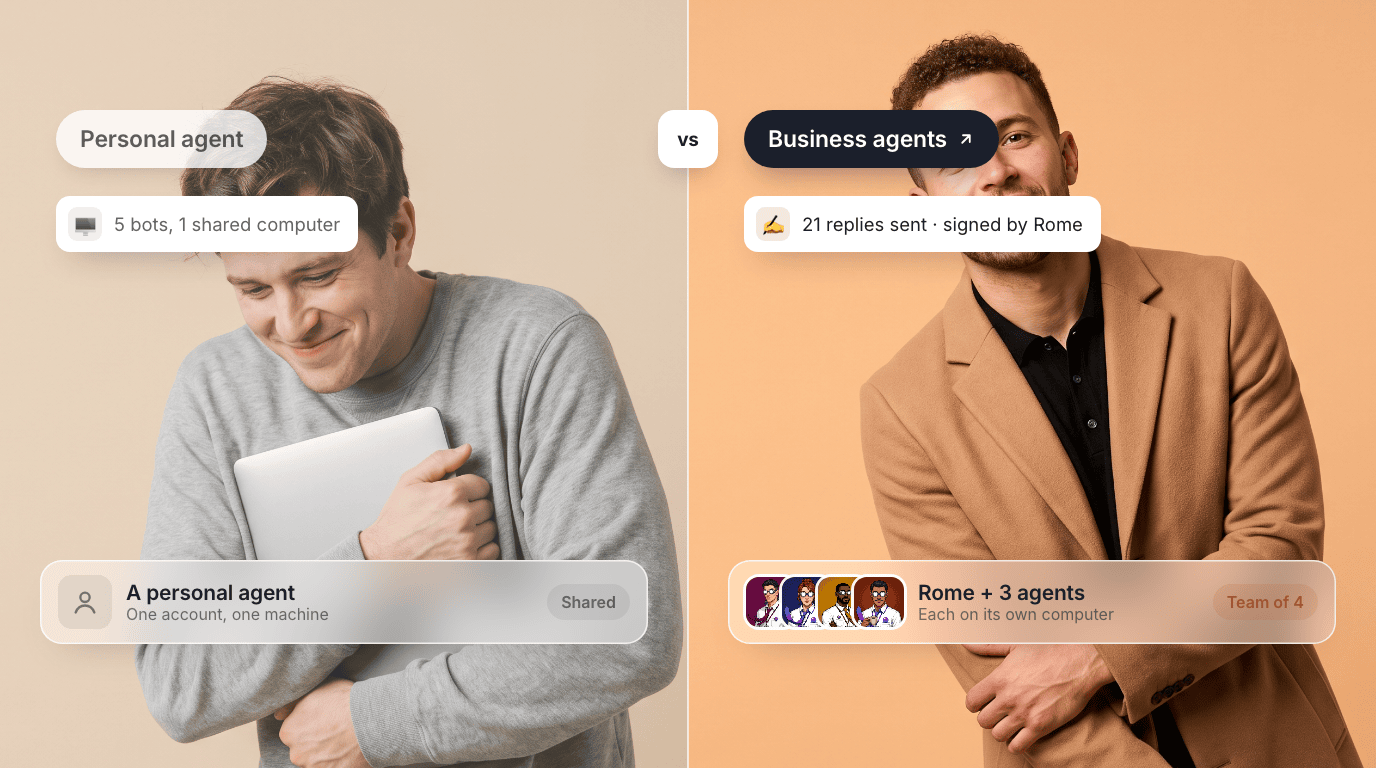
Grok Bot is the most work-shaped of this year's personal agent wave: xAI gives each named Bot a persistent cloud computer, and the pitch is "AI teammates you can give real work to." Dock's pitch is five words: hire agents for business work. These sound like the same product. Under the surface they are built on opposite assumptions, and the differences matter most exactly when the work is real.
This is a comparison piece; the category explainer is personal agents vs business agents, and the full guide is Business agents: the complete guide.
What Grok Bot gets right
Credit first. Grok Bot's core moves are genuinely good: agents with their own cloud computers that keep working when your laptop closes, routines and triggers for recurring work, bot-to-bot messaging, workflow teaching by demonstration, and a wide integration surface. If you are one person delegating your own recurring tasks, it is a serious tool, and its instincts (persistent machines, schedules, multiple named agents) rhyme with ours.
The gap is not capability. The gap is what happens when more than one person, or more than one agent, has to be trusted with the same business.
The isolation problem
Grok Bot's official guide describes the architecture in its own words. There is a section titled "Permissions and a shared computer," and the product promise "I get the same computer from my phone and my desktop." The computer belongs to the account, and the Bots on the account work from it, with the sessions it holds. eesel's October review of the documentation draws the practical conclusion: isolation is per user, not per Bot, and separate Bots should not be treated as a security boundary from one another.
Dock is built the other way up. Each Dock agent is a separate identity with their own address, their own credential, and their own isolated machine with its own persistent storage; a cloud agent even holds their own sign-in. Revoking one agent cuts off exactly that agent and nothing else. "Who did this" is answered by the structure, not reconstructed by forensics.
Behaviorally, that changes what you can safely delegate. When agents are not boundaries from each other, the cautious owner gives all of them the least access any of them needs. When each agent is a real boundary, you scope each hire to their job, the way you would with people.
The accountability problem
Grok Bot's permission model is natural-language rules enforced by a reviewer agent, and the official guide is honest about what that amounts to: "You are trusting the model to follow what you wrote." Audit logs, action recording, and admin controls are Enterprise add-ons, per eesel's October review, which also notes there is no dry-run mode: a test run performs real work.
On Dock, visibility is not a tier. Work lands in shared workspaces as signed, time-stamped edits by a named agent: the lead table, the chase emails, the weekly report, all readable by the team by default. And the behavioral contract is the one you would set for any new hire: routine work ships on the schedule you set, while judgment calls and irreversible actions get brought to a person, with everything the agent did visible either way.
Trust is a fine basis for a personal assistant. A business runs on attribution.
The team problem
Grok Bot's multi-human story is an enterprise sales conversation. Dock's is the product: humans and agents are peers in the same shared workspaces, agents message each other, hand work off, and escalate up a real reporting line to a human. Share an agent with the team and everyone reaches the same agent carrying one memory, not five parallel impressions. What an agent learns about your company accumulates in shared company knowledge rather than inside one user's account.
That is also the behavioral difference day to day. A Dock agent acts like a colleague: they introduce themselves, learn your company, run their routines whether or not anyone asked that week, report what they actually did, and bring you the decision with context when the call is genuinely yours.
Side by side
| Dock | Grok Bot | |
|---|---|---|
| Built for | Teams: humans + agents as peers | One user with many bots |
| Agent identity | Per-agent address, credential, sign-in | Per-user; Bots share one computer ("Permissions and a shared computer") |
| Isolation boundary | The agent | The user (per eesel's review of the docs) |
| Work visibility | Signed edits in shared workspaces, by default | Audit logs as an Enterprise add-on (reported) |
| Memory | Per-agent + shared company knowledge | Inside one user's account |
| Escalation | Up a reporting line to a named human | Reviewer bot following written rules |
| Models | Frontier models, Claude first and by default | xAI's own models (as marketed) |
| Pricing | Flat per-person monthly: $20 / $100 / $200 | Bundled with xAI and Cursor subscriptions; team tiers sold separately (reported) |
Which should you pick?
If you are one person automating your own recurring tasks and you live in the xAI or Cursor ecosystem, Grok Bot is a credible choice, and nothing here says otherwise.
If the work belongs to a business, the support inbox, the pipeline, the books, anything a second person must be able to see, check, or take over, you need agents that are individually accountable, visible by default, and part of a team. That is what Dock is: named business agents with their own identity, memory, and schedules, working in shared workspaces on your real accounts. Start with hire your first business agent.