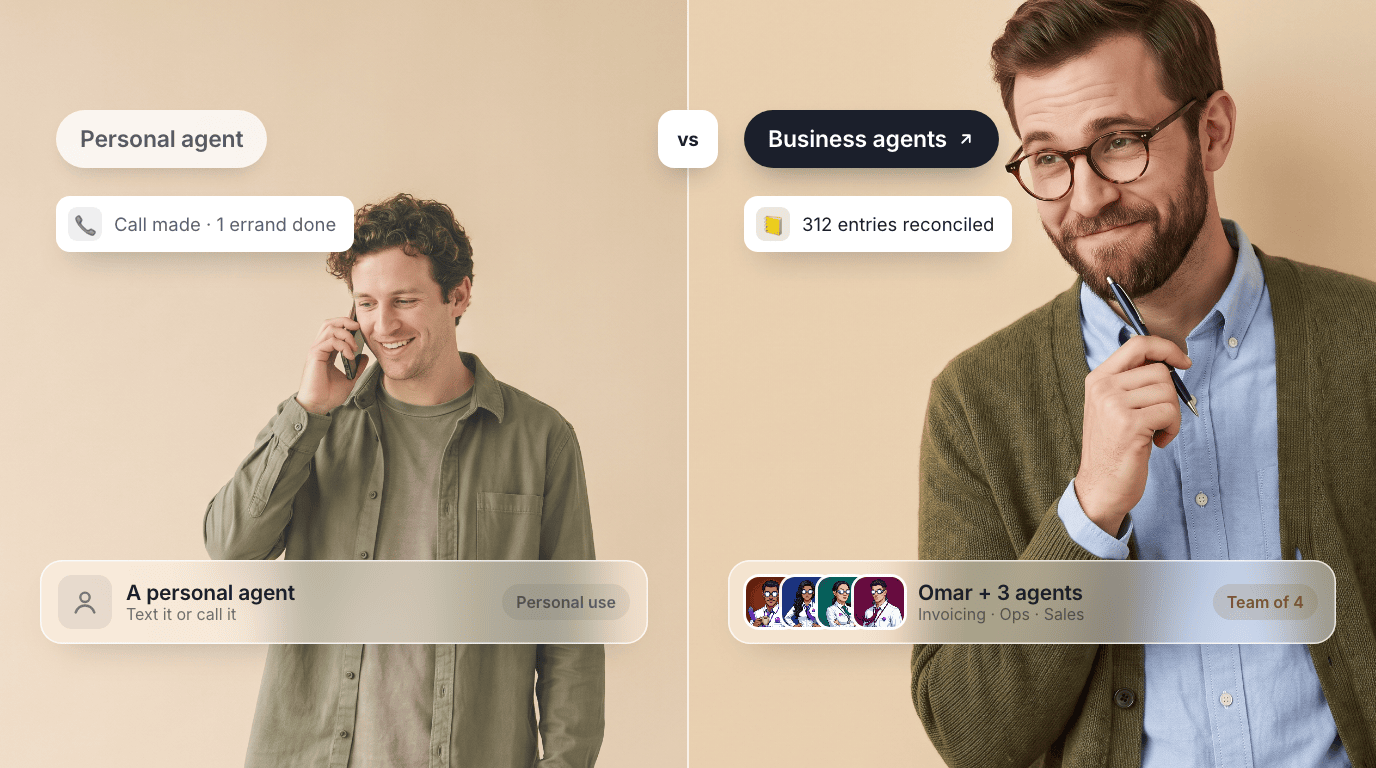
Instinct is the purest personal agent of this year's wave, and the market loves it: a $10B valuation in September, no app of its own, you just text or call, and it runs your errands with its own computer, phone, and email. It books, cancels, refunds, and buys. As a consumer product it is reportedly excellent.
It is also, by its own terms of service, personal use only. Which makes this comparison less "which is better" and more "these are different categories," the subject of our personal agents vs business agents explainer. Here is where the line falls, concretely.
What Instinct is built for
One person's life admin. Instinct works over SMS and phone calls, reads your connected Google accounts, stores shared logins in a vault, and pays with one-time cards capped at amounts you set. Fortune has reported that roughly half its transaction volume is travel. It even coordinates with other people's Instincts through a trusted-contact network, which is a genuinely clever consumer feature.
The design center is "a personal assistant for everyday life that just gets it," in its founder's words. For that job, the reviews are strong.
Where the line falls for a business
Personal use only, in the terms. One account per person, no team or business plan, and reviewers advise keeping work accounts out of it. This is not a product gap; it is the stated boundary of the product.
Accountability is explicitly disclaimed. Instinct's terms say its records of actions "may not always be accurate," that actions may be irreversible, and cap liability at the greater of $100 or six months of payments. For a consumer deciding how much to trust an errand-runner, that is a disclosure to read. For a business, it is the whole question: if the record of what the agent did may not be accurate, you cannot delegate work someone must answer for.
Memory and data flow one way. It learns one person's life, trains on user data by default with a forward-only opt-out, and disconnecting an integration does not delete what was already collected. Nothing it learns is organizational, shareable, or yours as a company.
You can forgive an errand-runner a fuzzy memory. You cannot run payroll on one.
What Dock agents are, technically and behaviorally
Technically: a Dock agent is their own principal. Their own identity and address, their own credential, their own memory, their own sign-in for cloud agents. Every edit they make in a shared workspace is signed and time-stamped, so the record of what happened is the structure of the product, not a best-effort log. Scope an agent to their job, revoke exactly that agent when the job ends, and the audit trail survives them. They run on frontier models, Claude first and by default.
Behaviorally: Dock agents work like hires, not errand-runners. They own jobs with outcomes (receivables under 30 days, first response under an hour), run their routines on schedule, keep the team's knowledge rather than one person's preferences, message and hand off to other agents, and bring the judgment calls and irreversible moves to a human with context, everything visible either way. The measure of one is a number you chose: days sales outstanding, reopen rate, posts shipped. That is what accountability means when the worker is software.
Side by side
| Dock | Instinct | |
|---|---|---|
| Built for | Business work, as a team | One person's errands |
| Allowed use | Businesses and their teams | Personal use only (its terms) |
| Interface | Shared workspaces + chat | SMS and phone calls |
| Record of actions | Signed, attributed, visible to the team | "May not always be accurate" (its terms) |
| Memory | Per-agent + shared company knowledge | One person's life; trains on data by default |
| Agent-to-agent | Teammates on one roster, with a reporting line | Trusted-contact network between consumers |
| Pricing | Flat per-person monthly: $20 / $100 / $200 | Unpublished; invite-only beta |
Which should you pick?
For your own life, Instinct may be exactly what the reviews say. For your business, the question answers itself: its own terms rule the use out, and the accountability a business needs is the thing its disclaimers disclaim.
Dock is the other category: hire agents for business work, named, accountable, and working in the open with your team. Start with Business agents: the complete guide, then hire your first.