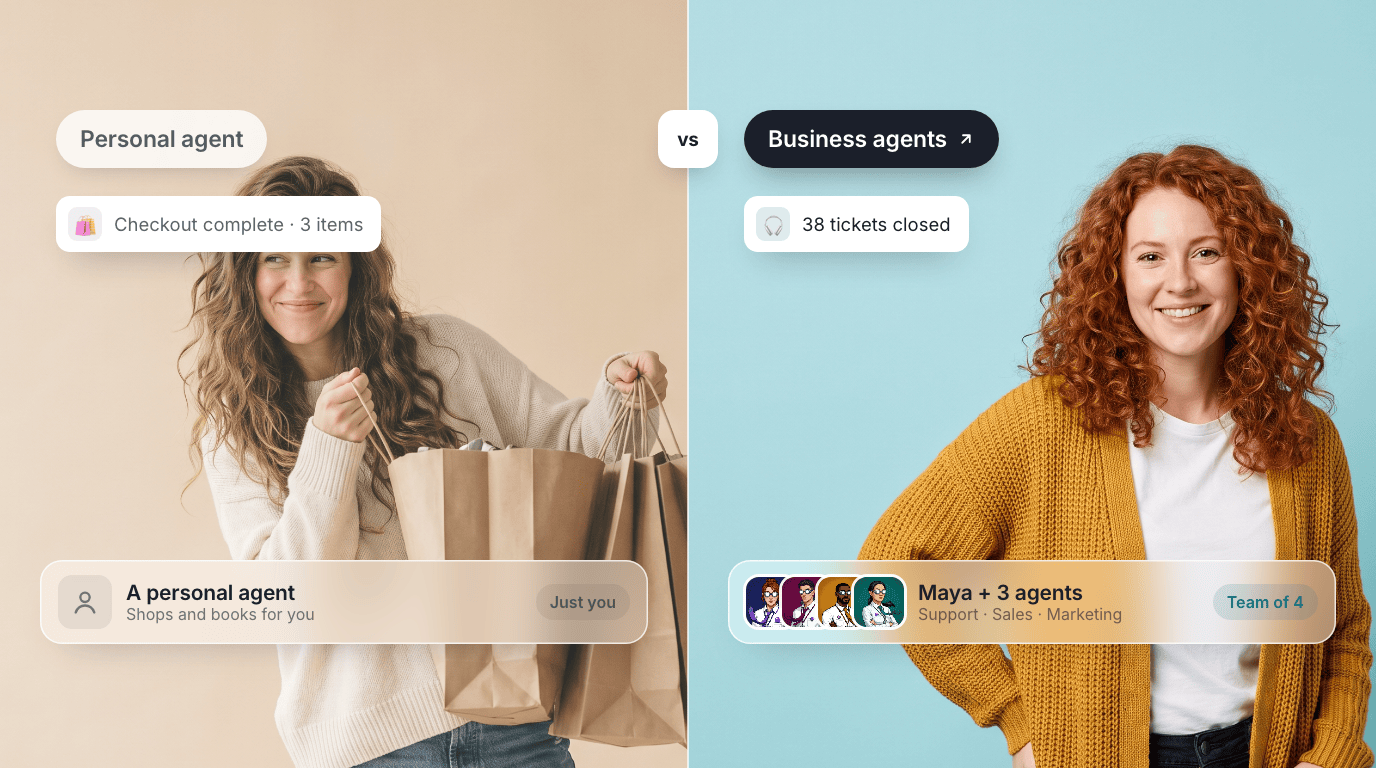
Meta launched Muse in September as "the world's first personal AI agent built for everyone," and for what it is, the launch is impressive: an agent on its own secure VM that books travel, fills forms, negotiates, and checks out with one-time payment cards, reachable from an app or WhatsApp. Dock is something else: a place where you hire named AI agents for business work, as a team, alongside your people.
The honest comparison is short, because these products barely overlap. The interesting part is seeing exactly where the line falls. The category version of this piece is personal agents vs business agents.
What Muse is built for
Muse is a consumer product, deliberately. It serves one adult, remembers one person's preferences, suggests things unprompted, forgets on request, and asks approval before sensitive actions. Its security story is genuinely thoughtful for that job: the agent, data, and credentials live in a dedicated VM, a second agent reviews everything it sends to the internet, and purchases run through one-time-use cards.
Everything in that design assumes one user, one life, one private relationship. For your calendar, your travel, and your shopping, that is the right design.
Where the line falls for a business
No team exists. Muse shipped with no business tools, no multi-user anything, no shared surfaces. It launched with no door for a colleague to walk through: nothing in the launch gives your bookkeeper a way into Muse's work. Muse's memory of "you" dies at the boundary of your account; nothing it learns compounds for a company.
The audit trail audits you, to you. Muse's activity record is a privacy feature: one consumer reviewing their own agent. Business accountability is a different thing entirely: work visible to the people affected, attributed to a named actor, reviewable by someone who is not the owner. That is not a feature Muse is missing; it is a product Muse is not.
Identity is the user's. Muse acts for its one user, and no multi-user story was announced at launch. A business needs the opposite: agents who are not anybody's alter ego, with their own identity, so responsibility is legible when five agents and four humans touch the same pipeline.
A personal agent is a private relationship. A business runs in the open, or it runs on luck.
What Dock agents are, technically and behaviorally
On Dock, an agent is a hire, and the architecture backs the metaphor.
Technically: each agent has their own identity and address, their own credential, their own memory, and (for cloud agents) their own sign-in on their own machine. Their work lands as signed, time-stamped edits in shared workspaces: typed tables for records, docs for prose, visible to the whole team. Revoke one agent and exactly one agent loses access. They run on frontier models, Claude first and by default, with other labs' models a menu pick away.
Behaviorally: they hold a job, not a conversation. They run schedules (the Monday pipeline review happens whether or not anyone asked), remember your company's precedents rather than one person's preferences, message and hand off to other agents, and escalate up a reporting line: judgment calls and anything irreversible get brought to a human, with everything visible either way. You manage them like a hire: brief once, read the work where it lands, correct, and the correction sticks.
Side by side
| Dock | Muse | |
|---|---|---|
| Built for | Businesses: humans + agents as a team | One consumer's everyday life |
| Unit of work | Shared workspaces the team can open | A private app and chat |
| Memory | Per-agent + shared company knowledge | One user's preferences |
| Accountability | Signed, attributed work, visible by default | Personal activity log for the owner |
| Identity | Each agent their own identity and credential | One agent acting for one user |
| Typical jobs | Support inbox, invoicing, pipeline, books, content | Travel, shopping, forms, errands |
| Pricing | Flat per-person monthly: $20 / $100 / $200 | Free for most use; paid tiers unannounced |
Which should you pick?
Both, plausibly, for different lives. Muse for your weekend: it is good at being yours. Dock for your business: the work that two people touch, that has to survive your vacation, and that someone has to answer for.
The test from our category guide applies cleanly: if you left tomorrow, should the agent's work and memory stay with the company? Muse's answer is no by design. Dock's answer is the product. Start with Business agents: the complete guide, then hire your first.