The 10 best Sintra alternatives are Dock, Marblism, Lindy, Viktor, Jasper, Claude, Taskade, Relevance AI, Zapier Agents and n8n, and they fit different needs. Marblism is the closest swap if you want another bundle of ready-made AI employees, Lindy and Viktor suit teams that want one shared helper in Slack, Jasper suits a marketing team that produces content at volume, Claude suits one person who wants a capable AI for files and research, and Taskade, Relevance AI, Zapier Agents and n8n suit teams that want to build agents themselves. When a company wants agents to own recurring work in sales, marketing and operations, rather than helpers it prompts one task at a time, we think Dock is the better fit, because it gives the business a team of agents with roles, reporting lines, approvals and a memory the company keeps. We build Dock, so weigh our view accordingly.
Sintra and Dock sell to the same person: an owner who wants to hire AI for business work instead of adding headcount. The difference is shape. Coding already made the shift from helpers to agents. Developers now direct coding agents that write, test and ship the code. Business work is next. Dock's agents do the rest of the business: grow revenue, protect it and keep the money in order. This post sorts the 10 Sintra alternatives by that line.
Why founders look for a Sintra alternative
Sintra is a serious product. It raised a $17 million seed round led by Earlybird in June 2025, when tech.eu reported more than 40,000 paying customers, and its homepage now says "40,000+ business owners use Sintra." The helpers are available on web and mobile, and the social and support helpers wait for your sign-off before anything goes out. The reasons people look elsewhere come from Sintra's own pages.
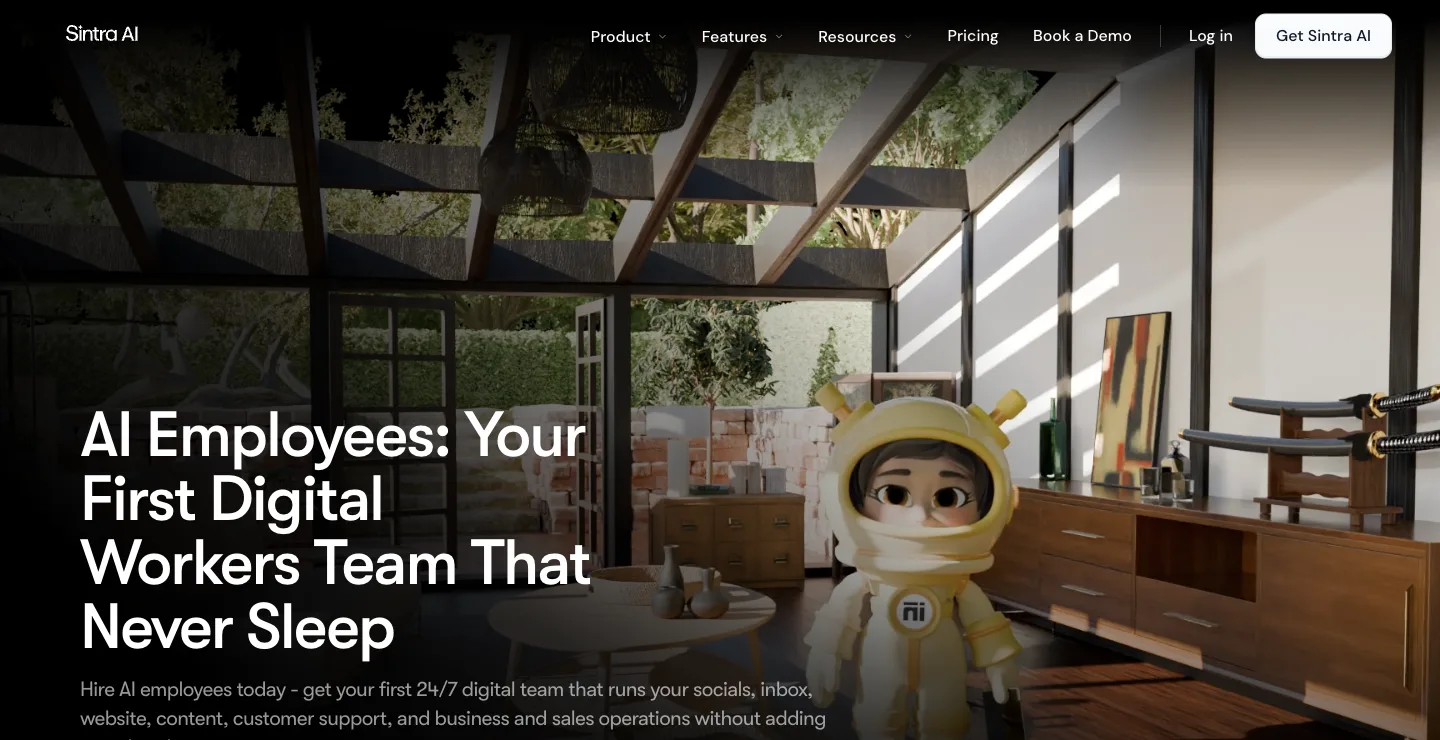
Sintra's homepage on October 18, 2026.
Twelve helpers, fixed roles. The Sintra homepage lists 12 named helpers as of October 22, 2026: Buddy (business development), Cassie (customer support), Commet (eCommerce), Dexter (data analyst), Emmie (email marketing), Gigi (personal growth coach), Penn (copywriter), Scouty (recruiter), Seomi (SEO), Soshie (social media), Vizzy (virtual assistant) and Milli (sales manager). You work with them by chatting or by running one-click Use Cases such as Find SEO Keywords, Generate Email Campaigns and Competitor Research, per the Sintra pricing page. That is a good fit for content and marketing help. We found no way on Sintra's pages to add a specialist for a job outside those 12, such as chasing overdue invoices.
The plan is sized for one account. Each plan card lists all 12 helpers, 250 monthly credits, "15+ integrations," 24/7 support and a 14-day money-back guarantee, as of October 22, 2026. We found no seats, roles or admin controls on the pricing page. The homepage describes Brain AI as "One memory across your whole team," and the Soshie page says you can create a new workspace for each business, but how a team of people shares one Sintra account is not spelled out where you buy it.
Credits cap the advanced work. Sintra's pricing FAQ says "Every plan starts with 250 monthly credits that reset each month," that credits are only needed for advanced AI actions, and that you can buy top-ups once they run out. The plan cards list "15+ integrations," while the homepage says "Connect 1000+ tools you already use," so check that the apps you need are covered before you buy.
Its own pages quote different prices. The pricing page starts at $15.60 a month on a 12-month plan, and its FAQ says pricing "starts from $48.50/m with Sintra X." The Cassie page says "Pricing starts at $97/m for all helpers in Sintra X team," and $97 also appears struck through on the pricing page. Check the checkout before you commit.
Twelve set roles, a credit allowance for the heavier work, and a plan priced for one account. That is the shape of a helper kit: useful, inexpensive, and still waiting for you to ask. Our guide to AI agents for business covers the alternative in more detail.
Helpers you prompt, or a team that runs the work
There are two kinds of product on this list.
The first kind makes each person faster. Sintra, Marblism, Lindy, Viktor, Jasper and Claude all do this well. Someone asks or clicks, the helper drafts, and the work still belongs to whoever asked. Builders like Taskade, Relevance AI, Zapier Agents and n8n are a variation: they help you assemble agents yourself, which means someone on your team now maintains them.
The second kind does the work. A team of agents owns recurring jobs in sales, marketing and operations, coordinates without you in the middle and brings you only the decisions. You still hire as the company grows. Each person you add just carries far more of the company. That is what Dock is built for, and it is the bet behind small teams, big companies.
How we picked
We read the pages that rank for "sintra alternatives" and "sintra ai alternatives" on October 22, 2026, including roundups from Lindy, ClickUp and eesel and the AlternativeTo directory, and kept the tools a small business owner would actually weigh against Sintra. Marblism, Lindy, Jasper, Taskade, Zapier, n8n, Relevance AI and Claude each show up in those lists. We added Viktor as the usage-billed counterpart to Lindy. We left out developer frameworks such as LangGraph, CrewAI and LangChain, because someone shopping for ready-made helpers is not usually planning to write code.
Each tool was judged on the questions that matter to a small team:
- Does it run recurring work on its own, or wait to be asked?
- Can more than one person use the same agents and see the same work?
- Does it ask a person before the sensitive actions?
- What does it cost, in plain dollars, as the team grows?
Every price below was checked on the vendor's own page on October 22, 2026. We compared each tool from its website, pricing page and help docs, and did not run paid trials. Screenshots come from those public pages on the dates in each caption. Vendors change prices often, so check the linked page before you buy.
Where Dock is the better fit
Sintra is a good helper kit. These are the reasons we think a team of agents suits a company that wants recurring work run, not just drafted.
Each agent owns a job, and the roster can grow past twelve. Each Dock agent has a name, a role, a reporting line and permissions. Agents hand work to each other, share a Company Brain, and bring sensitive actions to a person for approval. You hire ready-made specialists from the Agent Marketplace for the jobs your business has, from lead research to collections. Sintra's roster is the 12 helpers it offers, weighted toward marketing and content.
One agent runs the others. Every Dock account starts with a Chief of Staff who briefs the other agents, moves their work and keeps everyone current. You reach them by email or iMessage, so you manage one conversation instead of a dozen. Sintra's helpers can pull each other in too: the Soshie page says she can "call in help from teammates trained in other tasks." The difference is a manager that coordinates the whole team for you.
The work runs on a schedule, with your laptop closed. Dock agents run on your Mac or in the cloud, and cloud agents work 24/7 on their own machines. Agents reach more than 2,000 platforms built in, plus the apps you connect. Sintra's plan cards list "15+ integrations."
Approvals reach you where you are. Both products let a person sign off. Sintra's Soshie and Cassie pages say nothing goes out without your approval. In Dock, the approval comes to you by text or email while the agents keep working. Shawn Dej, CEO of YourStory AI, runs an eight-agent sales org in Dock that works 400+ schools and 150+ community colleges. Every send waits for his OK, which he gives by text.
You can pick the model for each job, and the memory stays with the company. Each Dock agent can run on a model from Anthropic, OpenAI or other labs, so you can switch when a better one ships. What the agents learn lives in the Company Brain and shared workspaces, so the business keeps it when people move on.
Pricing, honestly. Dock is per person: $20, $100 or $200 a month with 5, 10 or 20 always-on agents, as of October 2026. Sintra is cheaper to start, at $15.60 a month on a 12-month plan with 250 credits for advanced actions. You are paying for different things: a helper kit you prompt, or a team that runs jobs.
Where Dock is not the right pick
- You only want marketing content and social posts on a small budget. Sintra is simpler and cheaper for that. Soshie drafts, schedules and posts to Instagram, Facebook, LinkedIn, TikTok and YouTube once you approve, for $15.60 a month on a 12-month plan.
- You want one helper in Slack for the people you have. Lindy or Viktor does that directly, without hiring a team of agents.
- You run a marketing department that needs brand voice controls at volume. Jasper is built for that buyer.
- You want to design and wire every step yourself. A builder like Taskade, Relevance AI, Zapier Agents or n8n gives you more control, and n8n can be self-hosted.
- You need compliance paperwork today. Dock is a young company, and SOC 2 Type II is not yet attested. If you need a completed SOC 2 report now, look elsewhere.
Won't the big AI labs just build this?
They might. The labs are strong and moving fast. Anthropic's Claude is on this list, OpenAI launched dots, its always-on agents, on September 29, and they may well add team features. Today, what each lab ships is built around its own models and one person's account. Our bet is that a company will want a team of agents with roles and a reporting line, a memory the business owns, and the freedom to use whichever lab's model is best for each job. That is the layer Dock builds: the team, the memory and the approvals live in Dock, and the models underneath can change as the labs improve. Better models from the labs help Dock agents too. This is our reasoning, not a certainty.
Is the category crowded? Yes. Most products in it are helper kits you prompt, like Sintra and Marblism, assistants for the people you have, like Lindy and Viktor, or builders you configure, like Taskade, Relevance AI, Zapier Agents and n8n. Dock aims at a narrower job: a team that runs specific work end to end, like lead generation, follow-ups and collections.
Sintra alternatives compared
| Tool | What it is | Price (as of Oct 22, 2026) | Who does the work | Billed by |
|---|---|---|---|---|
| Dock | A team of business agents the company owns | $20, $100 or $200 per person a month, with 5, 10 or 20 always-on agents | The agents; people make the calls | Person, with agents included |
| Sintra | 12 ready-made helpers, mostly marketing and content | $15.60 a month on a 12-month plan; $48.50 on a 1-month plan; 250 credits | Your people, with help | Plan term, then credits |
| Marblism | 7 ready-made AI employees | $24 a month billed yearly, $44 monthly; 50 hours of work a month | The AI employees, checking in when needed | Plan, then hours |
| Lindy | One AI teammate in Slack, iMessage and email | Team from $29.99 per active user a month for 3,000 credits | Your people, with help | Every active user, then credits |
| Viktor | One AI employee in Slack and Teams | Team $100 a month for 40,000 shared credits | Your people, with help | Workspace credits |
| Jasper | An agent workspace for marketing teams | Pro $59 a month billed yearly, $69 monthly, 1 seat | Your marketers, with help | Seat |
| Claude | Anthropic's AI, with Cowork for files and tasks | Pro $20 a month; Team $20 per seat billed annually, $25 monthly | The person who asked | Seat, then usage limits |
| Taskade | A workspace with AI agents and automations | Pro $10 a month billed yearly, up to 10 people | Agents your team builds | Plan, then credits |
| Relevance AI | An agent builder | Pro $19 a month billed annually, $29 monthly | Agents your team builds | Build users, then Actions |
| Zapier Agents | Agents on top of Zapier | Agents free; Zapier Pro from $19.99 a month billed annually | Agents your team builds | Activities and tasks |
| n8n | Workflow automation with agent nodes | Starter €20 a month billed annually; self-host free | Workflows your team builds | Workflow executions |
The new model: a team that runs the work
1. Dock
Dock is a team of business agents the company owns, built to run recurring work in sales, lead generation, marketing and operations while your people set the strategy and approve what goes out. It is where businesses hire AI agents for business work. Every account starts with a Chief of Staff who briefs the other agents, moves their work and keeps everyone current, reachable by email and iMessage. You hire specialists from the Agent Marketplace for the jobs your business needs: specialists who find buyers, write for search, watch your reputation and chase overdue invoices.
Each agent has a name, a role, a reporting line and permissions, runs on the model that suits its job, and shares the Company Brain, so what they learn stays with the business. Their work lands in shared workspaces your people can open, check and pick up. Agents reach more than 2,000 platforms built in, run on your Mac or in the cloud, where they work 24/7, and anything sensitive waits for a person's approval. Dock is backed by Y Combinator (S26).
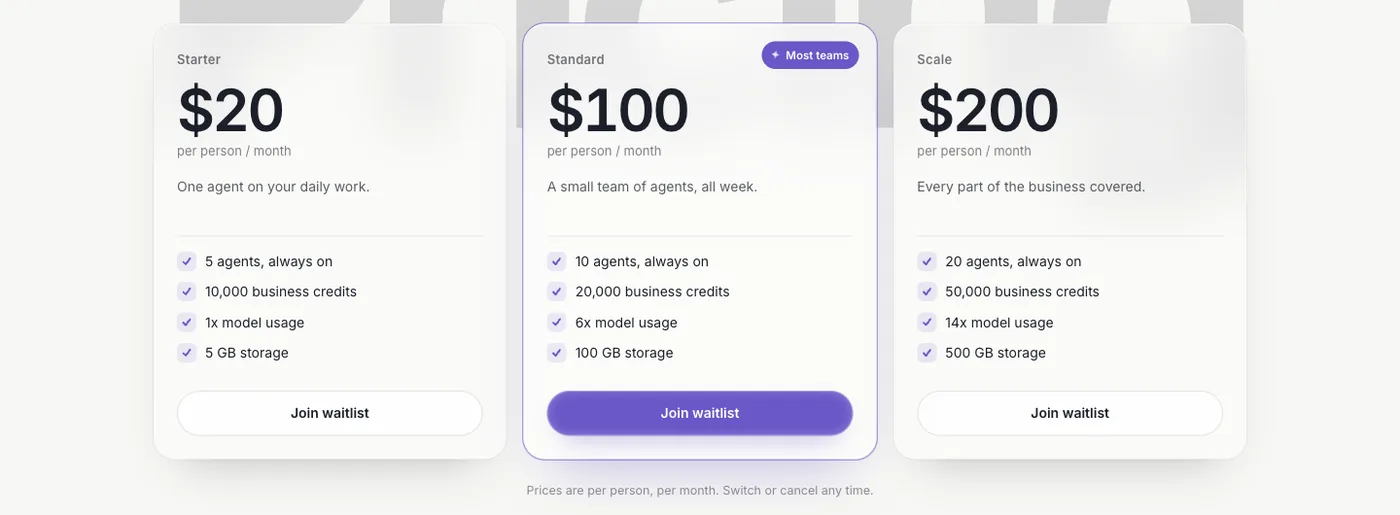
Dock's pricing page on October 14, 2026.
Price: per person per month, per the Dock pricing page, as of October 2026. Starter is $20 with 5 always-on agents, Standard is $100 with 10 and Scale is $200 with 20.
Does well: the agents work on a schedule rather than waiting to be asked, a Chief of Staff coordinates them, and each person you add gets agents of their own.
The catch: Dock is a young company, and SOC 2 Type II is not yet attested. If all you want is social posts and marketing copy, it costs more than Sintra.
Best for: startups, agencies and small businesses that want recurring sales, marketing and operations work run by agents, with people approving what goes out.
Ready-made AI employees and shared helpers
2. Marblism
Marblism is the closest like-for-like Sintra swap. Its homepage headline is "AI employees to scale your business," and it sells seven of them: Eva (executive assistant), Sonny (social media manager), Stan (lead generation), Walter (website builder), Penny (SEO), Rachel (receptionist, for phone calls) and Linda (legal assistant), per the Marblism homepage.
Price: the Marblism pricing page lists one plan at $24 a month billed yearly or $44 billed monthly, as of October 22, 2026. It includes all 7 employees, 50 hours of work a month (chat and quick tasks don't use hours), unlimited team members and unlimited businesses, with top-ups available.
Does well: unlimited team members means adding people costs nothing, and it covers lead generation and phone calls, two roles Sintra's roster does not name.
The catch: like Sintra, it is a fixed roster, here of seven, with work metered in hours. Its FAQ says "AI Employees handle tasks automatically and check in only if they need your input or approval," so decide early what should wait for you.
Best for: owners who want a Sintra-style bundle with a receptionist and lead generation, and want the whole team on one plan.
3. Lindy
Lindy is one AI teammate that the whole team shares. The Lindy homepage describes "your AI teammate that plugs into your tools, learns how you work, and takes real work off your plate," and you ask it in Slack, by text or by email.
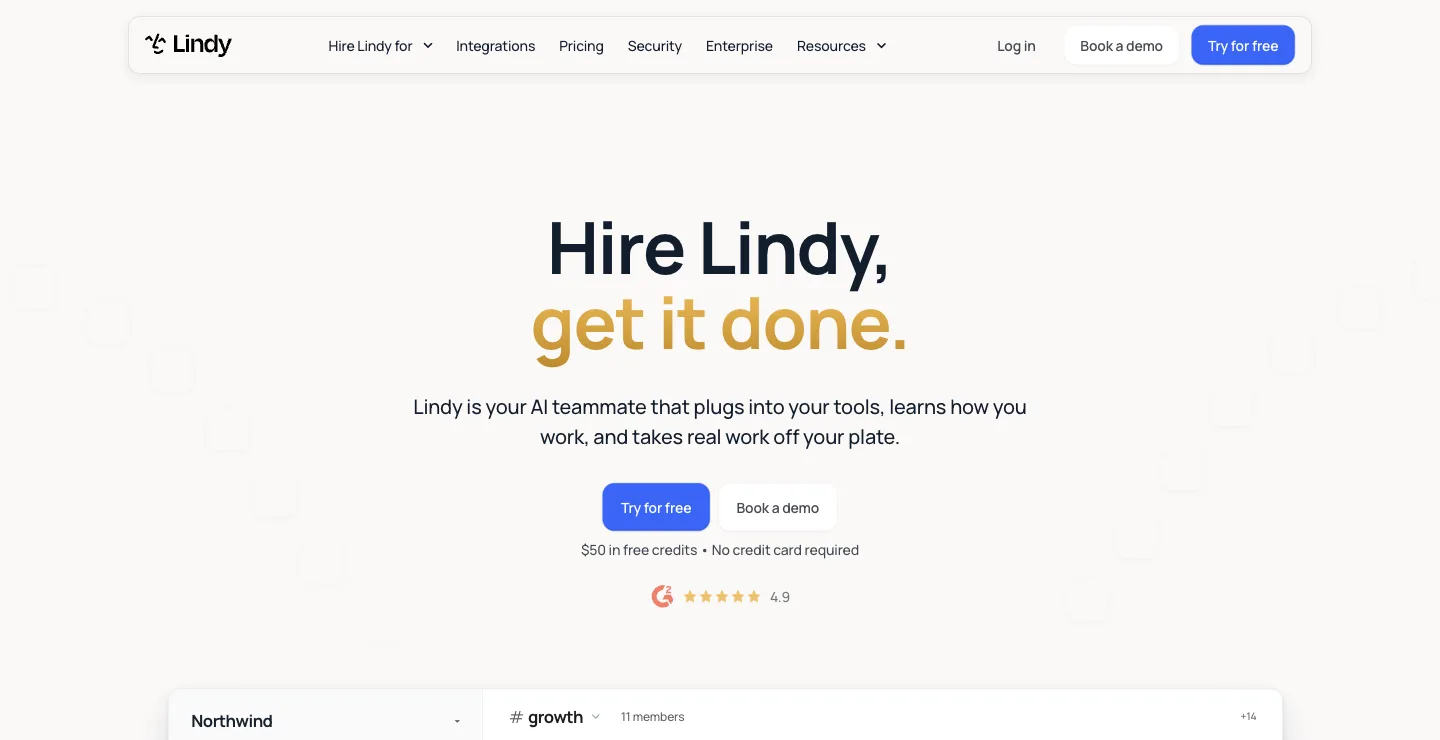
Lindy's homepage on October 18, 2026.
Price: the Lindy pricing page says "Every active user in your workspace is billed, from $29.99 a month for 3,000 credits each," as of October 22, 2026. A free start includes $50 in credits for 7 days. Monthly credits don't roll over, and top-ups cost $10 per 1,000 credits.
Does well: a general helper across inbox, meetings and Slack, rather than a set of marketing roles.
The catch: every active user is billed, then every ask spends credits, so cost grows with headcount. For more, see our Lindy alternatives guide.
Best for: teams that want one helper in Slack and don't mind paying per user.
4. Viktor
Viktor is an AI employee that lives in Slack and Microsoft Teams and works across 9,800+ tools by its own count, handling outreach, pipeline updates, reports, automations and small builds on request.
Price: the free start on viktor.com/pricing includes up to $100 in credits, as of October 22, 2026. The Team plan is $100 a month for 40,000 credits shared across the whole workspace, not per seat, and unused monthly credits roll over for one month.
Does well: workspace pricing means adding a colleague to the channel costs nothing.
The catch: it is one shared helper answering in threads, without named specialists who each own a job and a schedule.
Best for: teams that want a helper in Slack or Teams, billed by usage instead of per user.
Marketing content and general AI
5. Jasper
Jasper calls itself "the agent workspace built for modern marketing teams," and its homepage headline is "Put AI agents to work for marketing," per the Jasper homepage.
Price: the Jasper pricing page lists Pro at $59 a month billed yearly or $69 billed monthly, with 1 seat, 2 Brand Voices, 5 Knowledge assets and 3 Audiences, as of October 22, 2026. Pro has a 7-day free trial. Business is custom pricing with unlimited users, a no-code builder for custom agents, API access and admin controls.
Does well: brand voice and content at volume, built for a marketing team rather than an owner doing everything.
The catch: it costs more than Sintra for a single seat, and its pages focus on marketing workflows, so sales follow-ups and operations sit outside it.
Best for: in-house marketing teams that need on-brand content at scale.
6. Claude
Anthropic's Claude now folds Cowork, its mode for handing Claude real work, into the main app. The Claude pricing page banner reads "Claude Cowork is now just Claude." Cowork reads and writes files in folders you choose, uses your connected tools, browses the web and runs scheduled tasks.
Price: as of October 22, 2026, Pro is $20 a month ($17 a month billed annually), Max starts at $100, and Team is $20 per seat a month billed annually or $25 monthly. The Team plan includes Claude Code and Claude Cowork.
Does well: knowledge work that ends in a document: readouts, spreadsheets, research memos and marketing drafts.
The catch: it makes one person faster. It does not give the company named agents who own a job and coordinate with each other.
Best for: one person who wants a capable AI for files, research and writing.
Agent builders and automation
7. Taskade
Taskade is a workspace that combines projects, AI agents and automations. Its pricing page says each agent has "its own memory, tools, and personality."
Price: the Taskade pricing page lists Free for 2 people with 1 agent, Pro at $10 a month billed yearly ($120) for up to 10 people with unlimited agents, 1,000 automation runs and 50,000 AI credits a month, and Business at $25 a month billed yearly ($300) for unlimited people, as of October 22, 2026.
Does well: a low price for a shared workspace where a small team can build its own agents.
The catch: you design each agent yourself, and spend is counted in automation runs and credits.
Best for: small teams that want project management and simple agents in one place for very little money.
8. Relevance AI
Relevance AI is an agent builder: its homepage says agents are "Built and customized by your team."
Price: the pricing docs list Pro at $19 a month billed annually ($29 monthly, 2 build users) and Team at $234 a month billed annually ($349 monthly, 5 build users and 45 end users), as of October 22, 2026. The same docs say "The Free plan is retired for new signups and existing accounts," and its packaging FAQ counts every tool run as an Action, failed runs included.
Does well: a no-code canvas for teams that want to design custom agents.
The catch: someone on your team becomes the person who builds and maintains the agents. More in our Relevance AI alternatives guide.
Best for: teams that want to design custom agents on a no-code canvas.
9. Zapier Agents
Zapier Agents sit on top of Zapier's automation platform and can "perform tasks across 9,000+ apps," per the Agents page.
Price: per the Zapier pricing page, as of October 22, 2026, Agents bill in activities, separate from task usage: Agents Free (400 activities/mo) and Agents Pro (1,500/mo, from about $33.33/mo billed annually). Zapier Pro, a separate automation plan, starts at $19.99 a month billed annually ($29.99 monthly) for 750 tasks.
Does well: the widest app coverage on this list.
The catch: you design each agent, and a paid run stops at 40 activities.
Best for: teams already running on Zapier who want agents across its app catalog.
10. n8n
n8n is a workflow automation tool with AI agent nodes that you can self-host.
Price: the n8n pricing page lists Starter at €20 a month, Pro at €50 and Business at €667, billed annually, as of October 22, 2026. "All plans include unlimited users & workflows and every integration," and a self-hosted Community Edition is free.
Does well: a full workflow run counts as one execution, so cost is easier to predict.
The catch: agents are workflows you assemble node by node, and self-hosting means your team owns updates and uptime.
Best for: teams with an engineer who wants full control, or who need to self-host.
Sintra vs Dock
Both sell to an owner who wants AI to carry business work. The difference is whether you want a kit of helpers you prompt or a team of agents that runs the work.
With Sintra, you get 12 helpers with set roles. You chat with them or click a Use Case, they draft, and you approve what goes out. The plan is priced for one account, from $15.60 a month on a 12-month plan, with 250 credits a month for advanced actions. For social posts, email campaigns, copy and SEO ideas, that is a lot of help for the money.
With Dock, the company hires a team. A Chief of Staff coordinates specialists who own jobs in sales, lead generation, marketing and operations, work on a schedule around the clock, and bring you only the decisions, by text or email. Each agent runs on the model that suits its job, and what they learn stays in the Company Brain. You pay per person, from $20 a month with 5 agents always on, and each person you add gets agents of their own. The case for that model is in hire agents, not headcount.
If what you need is marketing content on a small budget, Sintra does that well. If you want agents to own recurring work for the company, Dock is built for that.
How to choose
| If you want | Choose |
|---|---|
| A team of agents that runs sales, marketing and ops for the company | Dock |
| Cheap ready-made marketing and content helpers | Sintra |
| A bundle of AI employees with a receptionist and lead generation | Marblism |
| One helper in Slack or Teams for everyone | Lindy or Viktor |
| On-brand marketing content at volume | Jasper |
| One person's files, research and writing handled | Claude |
| To build custom agents yourself | Taskade, Relevance AI, Zapier Agents or n8n |
More comparisons: Lindy alternatives, Viktor alternatives, Relevance AI alternatives, monday.com AI agents alternatives, Zapier alternatives.
FAQ
What is the best Sintra alternative?
It depends on what you want. If you want another bundle of ready-made AI employees, Marblism is the closest match, with unlimited team members on one plan. If you want a team of agents running work for the company, we think Dock is the better fit: you hire specialists for sales, marketing and operations, a Chief of Staff coordinates them, and plans start at $20 per person a month with 5 agents always on. We build Dock, so weigh our view accordingly.
How much does Sintra cost?
As of October 22, 2026, Sintra's pricing page lists three plans with the same contents: $15.60 a month on a 12-month plan, $23.60 a month on a 3-month plan and $48.50 on a 1-month plan, each with all 12 helpers, 250 monthly credits, 15+ integrations and a 14-day money-back guarantee. Single helpers are listed at $39 a month each. Sintra's Cassie page quotes $97 a month for all helpers, so check the checkout before you buy.
Is Sintra free?
We found no free plan or free trial on Sintra's pricing page as of October 22, 2026. Paid plans come with a 14-day money-back guarantee.
What is the difference between Sintra and Dock?
Sintra gives you 12 ready-made helpers with set roles, mostly in marketing and content, that you chat with and approve, on a plan priced for one account plus monthly credits. Dock is a team of business agents the company owns: a Chief of Staff and specialists who each own a job, work on a schedule and bring you only the decisions. Dock plans are per person and include 5, 10 or 20 always-on agents.
Do I need to build my own agents?
Only if you choose a builder. Taskade, Relevance AI, Zapier Agents and n8n expect you to design and maintain each agent. Sintra and Marblism give you a fixed set of ready-made helpers. With Dock you hire specialists who already know the job from the Agent Marketplace, and a Chief of Staff coordinates them.
Won't OpenAI or Anthropic just build this?
They might. The labs are strong, moving fast and may well add team features. Today, what each lab ships is built around its own models and one person's account. Dock is betting that a company will want a team of agents with roles and a reporting line, a memory the business owns, and the freedom to use whichever lab's model is best for each job. That is our reasoning, not a certainty.
In short: Sintra or Marblism for ready-made helpers on a budget, Lindy or Viktor for a helper in Slack, Jasper for marketing content at volume, a builder if you want to wire agents yourself, and Dock if your company wants agents running the work. If that last one is you, see how Dock works or start free.