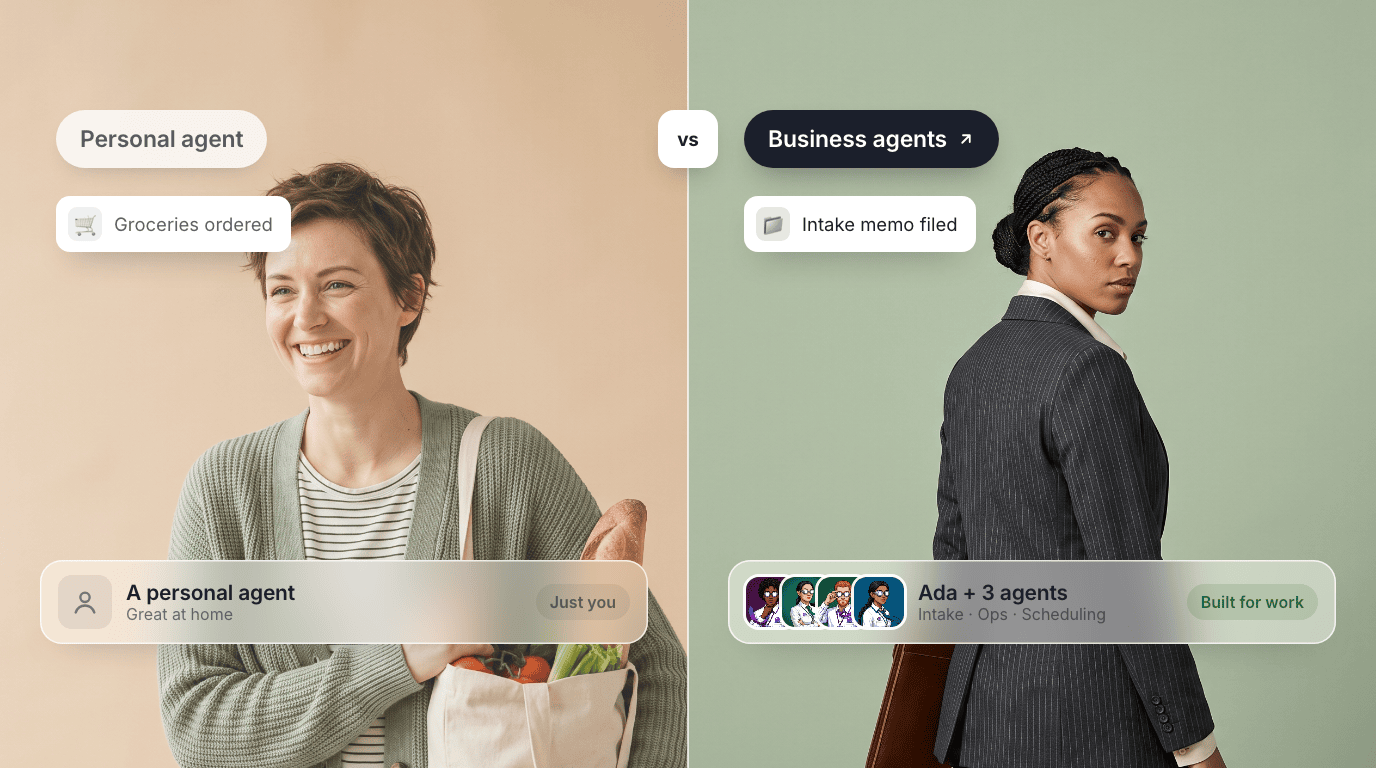
An honest disclosure first: Dock makes business agents, not personal ones. We are the wrong product for your grocery list, and this page is not going to pretend otherwise. But we watch this category professionally, our customers ask constantly, and the honest answer to "which personal agent should I get" deserves a page that is not written by one of them.
So: the best personal AI agents right now, what each is actually good at, and the one question to ask before you point any of them at your business.
Instinct: best for life admin without an app
Instinct is the purest expression of the category: no app, no interface, you text or call, and it handles errands with its own computer, phone, and email. It books, cancels, refunds, and buys with one-time payment cards capped at amounts you set, and Fortune has reported that roughly half its transaction volume is travel. Invite-only and free during beta. Its terms are explicit that it is for personal use only, which is the right honesty: that is what it is for, and reviewers say it is excellent at it.
Muse: best for everyday tasks inside your existing apps
Meta's Muse launched in September as a "secure, private personal AI agent" for everyone: booking, forms, email, negotiation, and checkout, from an app, the web, or WhatsApp. The security design is genuinely thoughtful for a consumer product: the agent and its credentials live in a dedicated VM, a second agent reviews everything outbound, and purchases run through one-time-use cards. Free for most use, with paid tiers unannounced. No business features exist, on purpose.
Grok Bot: best for a power user automating their own work
xAI's Grok Bot gives each named Bot a persistent cloud computer that keeps working when your laptop closes, with routines, triggers, and a wide integration surface. Of the personal wave, it is the most capable at recurring, work-shaped tasks for one person, and the most honest fit for a solo power user. Note its own guide's framing before you stretch it further: the Bots on your account share one computer, and the permission model is written rules a model is trusted to follow ("You are trusting the model to follow what you wrote").
The question to ask before any of them touch your business
All three are built around one user: one account, one memory, one identity. The moment work belongs to a business, someone else must be able to see it, check it, and take it over, and the agent doing it needs an identity of their own so accountability is legible. That is a different product category. The full explanation is in personal agents vs business agents, and the detailed comparisons are here: Dock vs Grok Bot, Dock vs Muse, Dock vs Instinct.
And if what you actually need is a business agent
Then you are on the wrong listicle, and the right one is Business agents: the complete guide: named agents with their own identity, memory, and schedules, working in shared workspaces with your team, flat per-person pricing from $20 a month. Keep the personal agent for the personal kind.