

The 10 best Lindy alternatives are Dock, Viktor, Sintra, Claude (Cowork is now part of Claude), OpenAI Dots, Grok Bot, Relevance AI, Gumloop, Zapier Agents and n8n, and they fit different needs. Viktor is the closest swap if you want one shared helper in Slack, Claude, OpenAI Dots and Grok Bot suit one person who wants an agent of their own, Sintra covers marketing content on a small budget, and Relevance AI, Gumloop, Zapier Agents and n8n suit teams that want to build agents themselves. When a company wants agents to run the work rather than one assistant helping its people, we think Dock is the better fit, because it gives the business a team of agents with roles, approvals and a memory the company keeps. We build Dock, so weigh our view accordingly.
Coding already made that shift. Developers now direct coding agents that write, test and ship the code. Business work is next. Dock's agents do the rest of the business: grow revenue, protect it and keep the money in order. This post sorts the 10 Lindy alternatives by that line.
Why founders look for a Lindy alternative
Lindy is a serious product. Its homepage shows logos from Shopify, Adobe and Autodesk, it connects to "Gmail, Slack, Notion, HubSpot, and 1,500+ more," and anything with outside impact waits for a person's approval. The reasons people look elsewhere come from Lindy's own pages.
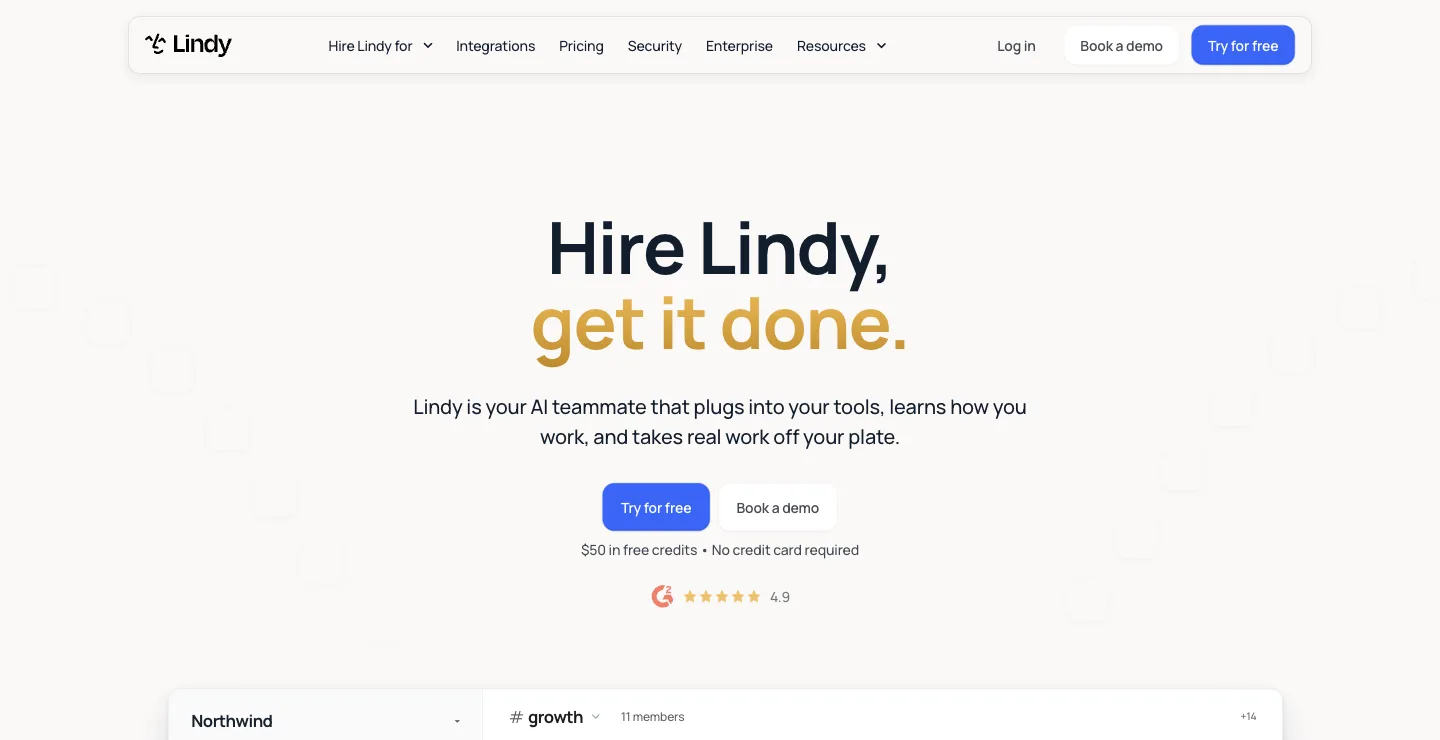
Lindy's homepage on October 18, 2026.
One teammate for everyone. The Lindy homepage says "Hire Lindy, get it done" and describes "your AI teammate that plugs into your tools, learns how you work, and takes real work off your plate." You ask in a Slack channel and "Lindy responds in thread." The whole team shares one Lindy. That is a helper for the people you have. It is not a roster of agents who each own a job.
The bill counts people. The Lindy pricing page says "Every active user in your workspace is billed, from $29.99 a month for 3,000 credits each," as of October 19, 2026. Lindy's homepage gives the starting price as $49.99 per user, so its own two pages disagree. Teammates who join from Slack get a 7-day free trial before their seat is billed. Either way, the cost grows with headcount, which matters if you are trying to stay lean.
Then it counts credits. Credits pool across the team, and monthly credits "don't roll over." Lindy's own page puts everyday asks at 2 to 250 credits, deep work at 250 to 1,000 and big builds at 1,000 to 2,500, so a busy month is hard to predict. When the pool runs dry, Lindy pauses the actions that use credits until the next cycle. Top-ups cost $10 per 1,000 credits.
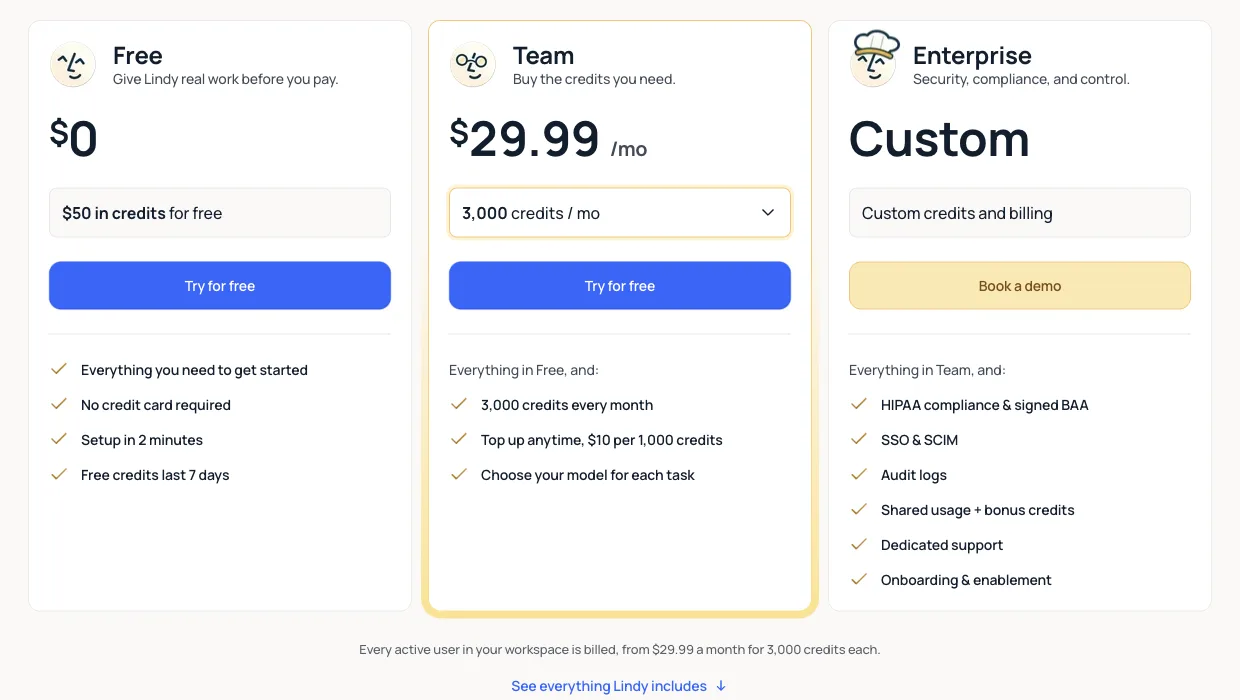
Lindy's pricing page on October 14, 2026.
A seat for every person who talks to it, a meter on every ask, and one assistant answering in threads. That is the shape of an assistant for your team. Our guide to AI agents for business covers the alternative in more detail.
An assistant for your team, or a team that runs the work
There are two kinds of product on this list.
The first kind makes each person faster. Lindy, Viktor, Claude, OpenAI Dots and Grok Bot all do this well. Someone asks, the assistant helps, and the work still belongs to whoever asked. Builders like Relevance AI, Gumloop, Zapier Agents and n8n are a variation: they help you assemble agents yourself, which means someone on your team now maintains them.
The second kind does the work. A team of agents owns recurring jobs in sales, marketing and operations, coordinates without you in the middle and brings you only the decisions. You still hire as the company grows. Each person you add just carries far more of the company. That is what Dock is built for, and it is the bet behind small teams, big companies.
How we picked
We looked for tools that founders and business owners actually compare with Lindy: agents in chat, ready-made helpers, personal agents and agent builders. Lindy's prices were checked on its own pages on October 19, 2026. Prices for the other nine come from their own pages, checked between October 13 and 17, 2026 for our Relevance AI and Grok Bot guides. Vendors change prices often, so check the linked page before you buy.
Where Dock is the better fit
Lindy is a good assistant. These are the reasons we think a team of agents suits a company that wants recurring work run, not just helped.
Each agent owns a job. Each Dock agent has a name, a role, a reporting line and permissions. Agents hand work to each other, share a Company Brain, and bring sensitive actions to a person for approval. Lindy's homepage describes one AI teammate that the whole team asks in a Slack thread, which is a different shape: it helps the people you have rather than giving each job an owner.
You can pick the model for each job. Dock agents run on Claude models first and by default, with models from OpenAI and other labs a menu pick for any agent. Being able to switch matters because the top model can change.
The memory belongs to the company. What the agents learn lives in Dock's Company Brain and shared workspaces, not inside one model's chat history, so the company keeps it when you switch models or people move on.
The work runs on a schedule. Cloud agents run 24/7 on their own machines, on schedules, with 2,000+ platforms built in plus the apps you connect. Shawn Dej, CEO of YourStory AI, runs an eight-agent sales org in Dock that works 400+ schools and 150+ community colleges. Every send waits for his OK, which he gives by text.
Pricing counts people once. Dock is per person: $20, $100 or $200 a month with 5, 10 or 20 always-on agents, as of October 2026. Lindy bills every active user, then meters each ask in pooled credits that don't roll over.
Where Dock is not the right pick
- You want one assistant for your own work or inbox. A personal agent like Claude with Cowork, OpenAI Dots or Grok Bot is simpler, and it may already come with a plan you pay for.
- You only need a helper in Slack for the people you have. Lindy or Viktor does that directly, without hiring a team of agents.
- You want to design and wire every step yourself. A builder like Relevance AI, Gumloop, Zapier Agents or n8n gives you more control, and n8n can be self-hosted.
- You need compliance paperwork today. Dock is a young company. SOC 2 Type II is not yet attested, and Dock is not HIPAA-eligible. If you need a completed SOC 2 report or a signed BAA now, look elsewhere. Lindy's Enterprise plan offers a signed BAA.
Won't the big AI labs just build this?
They might. The labs are strong and moving fast, two of their agents, OpenAI's dots and Anthropic's Claude with Cowork, are on this list, and they may well add team features. Today, what each lab ships is built around its own models and one person's account. Our bet is that a company will want a team of agents with roles and a reporting line, a memory the business owns, and the freedom to use whichever lab's model is best for each job. That is the layer Dock builds: the team, the memory and the approvals live in Dock, and the models underneath can change as the labs improve. Better models from the labs help Dock agents too. This is our reasoning, not a certainty.
Is the category crowded? Yes. Most products in it are builders you configure, like Relevance AI, Gumloop, Zapier Agents and n8n, or helpers for the people you have, like Lindy, Viktor and the lab agents. Dock aims at a narrower job: a team that runs specific work end to end, like lead generation, follow-ups and collections.
Lindy alternatives compared
| Tool | What it is | Price (Oct 2026) | Who does the work | Billed by |
|---|---|---|---|---|
| Dock | A team of business agents the company owns | $20, $100 or $200 per person a month, with 5, 10 or 20 always-on agents | The agents; people make the calls | Person, with agents and business credits included |
| Lindy | One AI teammate in Slack, iMessage and email | Team from $29.99 per active user a month for 3,000 credits | Your people, with help | Every active user, then credits |
| Viktor | One AI employee in Slack and Teams | Team $100 a month for 40,000 shared credits | Your people, with help | Workspace credits |
| Sintra | 12 ready-made marketing helpers | From $15.60 a month on a 12-month plan, 250 credits | Your people, with help | Plan, then credits |
| Claude (Cowork is now part of Claude) | Claude doing file and research tasks for one person | Pro $20 a month; Team $25 per seat | The person who asked | Seat, then usage limits |
| OpenAI Dots | One always-on agent per person | Included with ChatGPT Pro ($100 to $500) or a Business Premium seat ($125) | The person who owns the dot | Seat |
| Grok Bot | Named bots in one person's account; Team Bots in public beta | Premium $30/mo, Super $100, Ultra $200; Teams $30/user | The account owner | Subscription, then usage |
| Relevance AI | An agent builder | Pro from $19 a month billed annually; public page is Enterprise only | Agents your team builds | Build users and end users, then Actions |
| Gumloop | An agent builder | Pro from $37 a month, unlimited seats | Agents your team builds | Credits |
| Zapier Agents | Agents on top of Zapier | Agents free; Zapier Pro from $19.99 a month billed annually | Agents your team builds | Activities and tasks |
| n8n | Workflow automation with agent nodes | Starter €20 a month billed annually; self-host free | Workflows your team builds | Workflow executions |
The new model: a team that runs the work
1. Dock
Dock is a team of business agents the company owns, built to run recurring work in sales, marketing and operations while your people set the strategy and approve what goes out. It is where businesses hire AI agents for business work. Every account starts with a Chief of Staff who briefs the other agents, moves their work and keeps everyone current, so you manage one conversation instead of ten. You hire specialists from the Agent Marketplace for the jobs your business needs: a Lead Researcher and a Signals Analyst to find buyers, a Content Writer and an SEO Analyst for search, and a Reputation Manager to protect what you have.
Each agent has a name, a role, a reporting line and a schedule, runs on the model that suits its job, and shares the Company Brain, so what it learns stays with the business. Their work lands in shared workspaces your people can open, check and pick up. Agents reach more than 2,000 platforms on your business credits plus the apps you connect, work in the cloud with your laptop closed, and anything sensitive waits for a person's approval. You can text or email your Chief of Staff, and in chat on the web or in the Mac app you can dictate to any agent, with your words landing in the message box.
Price: per person per month, per the Dock pricing page. Starter is $20 with 5 always-on agents and 10,000 business credits. Standard is $100 with 10 agents and 20,000 credits. Scale is $200 with 20 agents and 50,000 credits. The first 7 days are free with no card.
Does well: the agents work on a schedule rather than waiting to be asked, a Chief of Staff coordinates them, and every new hire runs on Dock with agents of their own.
The catch: Dock is younger than Lindy. SOC 2 Type II is not yet attested, and Dock is not HIPAA-eligible, while Lindy's Enterprise plan offers a signed BAA.
Best for: startups and agencies that want recurring sales, marketing and operations work run by agents, with people approving what goes out.
Shared assistants and ready-made helpers
2. Viktor
Viktor is an AI employee that lives in Slack and Microsoft Teams and works across 9,800+ tools by its own count, handling outreach, pipeline updates, reports, automations and small builds on request.
Price: the free start on viktor.com/pricing includes up to $100 in credits with no card. The Team plan is $100 a month for 40,000 credits shared across the whole workspace, and unused credits roll over.
Does well: it is the closest like-for-like Lindy replacement, and usage pricing means adding a colleague to the channel costs nothing.
The catch: like Lindy, it is one shared assistant answering in threads, without named specialists who each own a job and a schedule.
Best for: teams that want a Lindy-style helper in Slack or Teams, billed by usage instead of per user.
3. Sintra
Sintra sells 12 ready-made "AI Employees," including Buddy for business development, Emmie for email marketing, Seomi for SEO and Soshie for social media, per the Sintra homepage.
Price: the Sintra pricing page shows a 12-month plan at $15.60 a month, a 3-month plan at $23.60 and a 1-month plan at $48.50, each with all 12 helpers and 250 monthly credits.
Does well: the cheapest way on this list to get ready-made marketing helpers.
The catch: the plan cards list "15+ integrations" and 250 credits for advanced actions. That covers content help. It is lighter on operational work like outbound or collections.
Best for: marketing content help on a small budget.
Personal agents and AI work modes
4. Claude (Cowork is now part of Claude)
Cowork, now part of the main Claude app, is Anthropic's mode for handing Claude real work: it reads and writes files in folders you choose, uses your connected tools, browses the web and runs scheduled tasks.
Price: on claude.com/pricing, Pro is $20 a month, Max starts at $100, and Team is $25 per seat a month. Cowork uses plan limits faster than chat.
Does well: knowledge work that ends in a document: readouts, spreadsheets, research memos.
The catch: it makes one person faster. It does not give the company named agents who own a job and coordinate with each other. More in our Claude Cowork alternatives guide.
Best for: one person who wants files, research and documents handled by Claude.
5. OpenAI Dots
OpenAI launched dots on September 29. A dot is an always-on agent with its own cloud computer and browser that you can message in ChatGPT, Slack or Microsoft Teams.
Price: your first dot is included with ChatGPT Pro at $100, $200 or $500 a month, or with a ChatGPT Business Premium seat at $125 per user a month. Pricing for more dots has not been published.
Does well: a capable agent for each person, with Custom Rules that allow, require approval for or block specific actions.
The catch: today each person gets one primary dot, so it is one person's agent rather than a team.
Best for: people already on ChatGPT Pro or Business Premium who want an always-on agent of their own.
6. Grok Bot
Grok Bot gives each named Bot a persistent cloud computer, lets you teach a routine by doing it once, and keeps working with your laptop closed. Bots can message each other.
Price: as of October 22, 2026 it is included with SpaceXAI's Premium at $30 a month, Super at $100 or Ultra at $200, or Teams at $30 per user a month, with extra usage billed on top.
Does well: the most work-shaped personal agent, with routines, triggers and bot-to-bot messaging.
The catch: the Bots belong to one person's account and share its cloud computer. Team Bots, in public beta since September 28 on Teams and Enterprise plans, add shared bots in Slack, but they keep separate context and memories for each user. For the full comparison, see Dock vs Grok Bot.
Best for: a power user who wants personal agents that learn routines and keep working with the laptop closed.
Agent builders and automation
7. Relevance AI
Relevance AI is an agent builder: its homepage says agents are "Built and customized by your team."
Price: the pricing docs list Pro at $19 a month billed annually ($29 monthly, 2 build users) and Team at $234 a month billed annually. The public pricing page shows only Enterprise, and every tool run counts as an Action, failed runs included.
Does well: a no-code canvas for teams that want to design custom agents.
The catch: someone on your team becomes the person who builds and maintains the agents. More in our Relevance AI alternatives guide.
Best for: teams that want to design custom agents on a no-code canvas.
8. Gumloop
Gumloop calls itself "the multiplayer AI agent builder."
Price: the Gumloop pricing page lists Pro from $37 a month after a 14-day trial, with 20,000 credits a month and unlimited seats.
Does well: unlimited seats, so the bill does not grow as people join.
The catch: you still build and maintain every agent, and spend is credit-based.
Best for: teams that like building agents and want seats to stay free as people join.
9. Zapier Agents
Zapier Agents sit on top of Zapier's automation platform and can "perform tasks across 9,000+ apps," per the Agents page.
Price: per the Zapier pricing page, Agents bill in activities: Agents Free (400 activities/mo) and Agents Pro (1,500/mo, from about $33.33/mo billed annually). That is separate from Zapier Pro, which starts at $19.99 a month billed annually.
Does well: the widest app coverage on this list.
The catch: you design each agent, and a paid run stops at 40 activities to ask before continuing.
Best for: teams already running on Zapier who want agents across its app catalog.
10. n8n
n8n is a workflow automation tool with AI agent nodes that you can self-host.
Price: the n8n pricing page lists Starter at €20 a month, Pro at €50 and Business at €667, billed annually, with unlimited users. A self-hosted Community Edition is free.
Does well: a full workflow run counts as one execution, so cost is easier to predict.
The catch: agents are workflows you assemble node by node, and self-hosting means your team owns updates and uptime.
Best for: teams with an engineer who wants full control, or who need to self-host.
Lindy vs Dock
Lindy calls itself an AI teammate. The difference is whether you want one assistant that helps your people or a team of agents that runs the work.
With Lindy, your team shares one assistant. People ask in Slack, by text or by email, and Lindy helps. Every active user is billed, and every ask spends pooled credits that reset each month.
With Dock, the company hires a team. A Chief of Staff coordinates specialists who own jobs in sales, marketing and operations, work on a schedule around the clock, and bring you only the decisions. Each agent runs on the model that suits its job, and what they learn stays in the Company Brain, so the company keeps it. You pay per person, from $20 a month with 5 agents always on, and each person you add gets agents of their own. Your people set the strategy and approve what goes out. The case for that model is in hire agents, not headcount.
If what you need is a helper in Slack for the people you have, Lindy does that well. If you want agents to own recurring work for the company, Dock is built for that.
How to choose
| If you want | Choose |
|---|---|
| A team of agents that runs sales, marketing and ops for the company | Dock |
| One helper in Slack or Teams for everyone, billed by usage | Viktor |
| Cheap ready-made marketing helpers | Sintra |
| One person's files and research handled | Claude (Cowork is now part of Claude) |
| An always-on agent for each person on ChatGPT Business | OpenAI Dots |
| To build custom agents yourself | Gumloop, Relevance AI, Zapier Agents or n8n |
More comparisons: Viktor alternatives, Sintra alternatives, Relevance AI alternatives, monday.com AI agents alternatives, Claude Cowork alternatives.
FAQ
What is the best Lindy alternative?
It depends on what you want. If you want a like-for-like helper in Slack, Viktor is the closest match, billed by workspace credits instead of per user. If you want a team of agents running work for the company, we think Dock is the better fit: you hire specialists for sales, marketing and operations, a Chief of Staff coordinates them, and plans start at $20 per person a month with 5 agents always on. We build Dock, so weigh our view accordingly.
How much does Lindy cost?
As of October 19, 2026, Lindy's pricing page lists a free start with $50 in credits that last 7 days, and Team from $29.99 per active user a month for 3,000 credits, with larger credit tiers above that. Lindy's homepage gives the starting price as $49.99 per user. Every active user in the workspace is billed, monthly credits do not roll over, and top-ups cost $10 per 1,000 credits.
Is Lindy free?
Lindy has a free start with $50 in credits that last 7 days and no credit card. After that, every active user in the workspace is billed on the Team plan.
What is the difference between Lindy and Dock?
Lindy is one AI teammate your whole team shares, in Slack, iMessage and email, billed for every active user and then by credits. Dock is a team of business agents the company owns: a Chief of Staff and specialists who each own a job, work on a schedule and bring you only the decisions. Dock plans are per person and include 5, 10 or 20 always-on agents.
Do I need to build my own agents?
Only if you choose a builder. Relevance AI, Gumloop, Zapier Agents and n8n expect you to design and maintain each agent. Lindy and Viktor give you a ready assistant. With Dock you hire specialists who already know the job, and a Chief of Staff coordinates them.
Won't OpenAI or Anthropic just build this?
They might. The labs are strong, moving fast and may well add team features. Today, what each lab ships is built around its own models and one person's account. Dock is betting that a company will want a team of agents with roles and a reporting line, a memory the business owns, and the freedom to use whichever lab's model is best for each job. That is our reasoning, not a certainty.
{
  "@context": "https://schema.org",
  "@type": "FAQPage",
  "mainEntity": [
    {
      "@type": "Question",
      "name": "What is the best Lindy alternative?",
      "acceptedAnswer": {
        "@type": "Answer",
        "text": "It depends on what you want. If you want a like-for-like helper in Slack, Viktor is the closest match, billed by workspace credits instead of per user. If you want a team of agents running work for the company, we think Dock is the better fit: you hire specialists for sales, marketing and operations, a Chief of Staff coordinates them, and plans start at $20 per person a month with 5 agents always on. We build Dock, so weigh our view accordingly."
      }
    },
    {
      "@type": "Question",
      "name": "How much does Lindy cost?",
      "acceptedAnswer": {
        "@type": "Answer",
        "text": "As of October 19, 2026, Lindy's pricing page lists a free start with $50 in credits that last 7 days, and Team from $29.99 per active user a month for 3,000 credits, with larger credit tiers above that. Lindy's homepage gives the starting price as $49.99 per user. Every active user in the workspace is billed, monthly credits do not roll over, and top-ups cost $10 per 1,000 credits."
      }
    },
    {
      "@type": "Question",
      "name": "Is Lindy free?",
      "acceptedAnswer": {
        "@type": "Answer",
        "text": "Lindy has a free start with $50 in credits that last 7 days and no credit card. After that, every active user in the workspace is billed on the Team plan."
      }
    },
    {
      "@type": "Question",
      "name": "What is the difference between Lindy and Dock?",
      "acceptedAnswer": {
        "@type": "Answer",
        "text": "Lindy is one AI teammate your whole team shares, in Slack, iMessage and email, billed for every active user and then by credits. Dock is a team of business agents the company owns: a Chief of Staff and specialists who each own a job, work on a schedule and bring you only the decisions. Dock plans are per person and include 5, 10 or 20 always-on agents."
      }
    },
    {
      "@type": "Question",
      "name": "Do I need to build my own agents?",
      "acceptedAnswer": {
        "@type": "Answer",
        "text": "Only if you choose a builder. Relevance AI, Gumloop, Zapier Agents and n8n expect you to design and maintain each agent. Lindy and Viktor give you a ready assistant. With Dock you hire specialists who already know the job, and a Chief of Staff coordinates them."
      }
    },
    {
      "@type": "Question",
      "name": "Won't OpenAI or Anthropic just build this?",
      "acceptedAnswer": {
        "@type": "Answer",
        "text": "They might. The labs are strong, moving fast and may well add team features. Today, what each lab ships is built around its own models and one person's account. Dock is betting that a company will want a team of agents with roles and a reporting line, a memory the business owns, and the freedom to use whichever lab's model is best for each job. That is our reasoning, not a certainty."
      }
    }
  ]
}
In short: Lindy or Viktor for a helper in Slack, a personal agent for your own work, a builder if you want to wire agents yourself, and Dock if your company wants agents running the work. If that last one is you, see how Dock works or start free.