"A 5-person agency that can now handle the workload that previously required 8 or 10 people has a pretty serious competitive advantage." A marketer wrote that on Reddit in August 2026, and the thread around it was full of people describing the same thing from the inside: lean teams producing multiples of their old output.
None of them used a name for it. That is the strange part. The behavior is everywhere and the label is nowhere. So let's define it.
An AI-native team is a team where AI agents are part of the structure of the work, not a private tool each person opens in a tab. The difference is structural, not technical, and you can test for it with three questions. (Scale the idea up a level and you get the AI-native company; this piece is about the team, where the change actually starts.)
The three marks
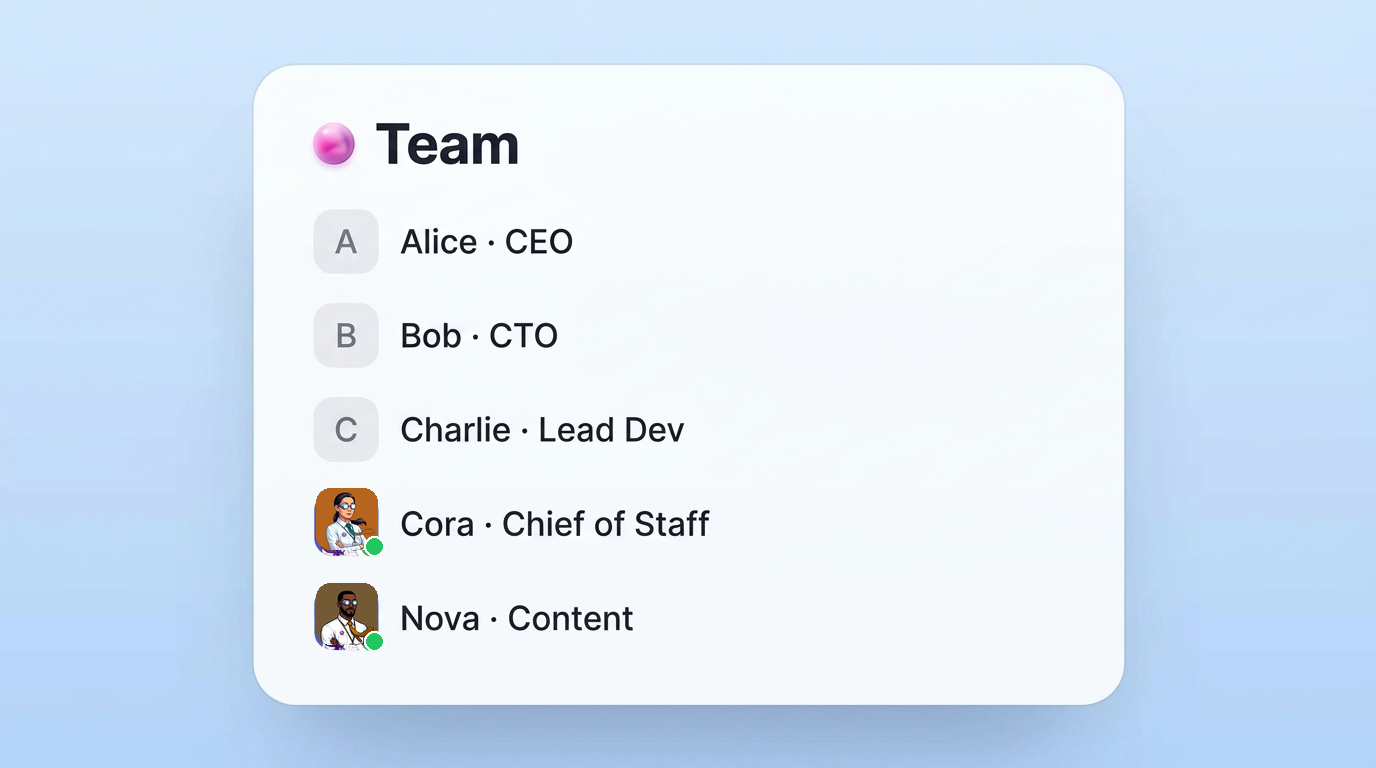
1. Do the agents have jobs, or just prompts? On most teams, AI is a chat window: someone asks, it answers, the answer dies in the chat history. On an AI-native team, an AI agent holds a role. They have a name, a scope, work they own, and someone they report to. You can ask "who handles this?" and the answer might be an agent.
2. Does the work share one context? A project manager described the ordinary state in July 2026: "Every time I open a new chat I have to explain the project again... Some of it is in Jira, but a lot of it isn't. It's in meetings, email, Teams, phone calls, random WhatsApp messages." An AI-native team keeps context where the whole team, human and agent alike, can reach it. Nobody re-briefs the AI, because the AI was never out of the room.
3. Does the team accept the output? AI that produces fast, unowned output creates work for everyone else. One product manager called the result a new failure mode: "the confidence to ship stuff nobody asked for because an agent produced it fast." The teams that make this work land on the same rule independently: AI output counts only when the team accepts the result. That requires the output to be visible, attributed, and correctable, like any colleague's work.
The behavior is everywhere and the label is nowhere. An AI-native team is not a team that uses AI. It is a team where AI holds a seat.
Why now
The adoption numbers stopped being interesting; the structure numbers are the story. Asana's State of AI at Work 2025 survey of 9,236 knowledge workers found weekly AI use at 70 percent, but split organizations roughly in half between those who "systematically redesign work around it" and those stuck in what the report calls pilot purgatory. MIT's GenAI Divide research put a harder edge on it: 95 percent of enterprise GenAI pilots showed no measurable P&L impact, and the researchers blamed approach, not models.
Everyone has the same models. The teams pulling ahead changed the shape of the team instead of the size of the prompt.
Starting native beats retrofitting
The hardest version of this transition belongs to existing teams. One agency owner with 28 employees described his company splitting into camps: "One wants things to go back to pre-AI pacing... The other has fully embraced the speed... they're starting to pull in different directions on how we operate."
A team that starts AI-native never has that fight. The new agency, the two-founder company, the small team spinning up this quarter: they get to hire their first AI agent the way an AI-native company hires their first employee, with a role and a place in the structure, instead of retrofitting a chat window onto habits that formed without one.
That is the team Dock is built for. Humans and agents in one workspace, agents with identities and roles of their own, everyone working from the same context. Not AI added to a team. A team that was never without it.
FAQ
What is an AI-native team?
A team where AI agents hold defined roles inside the structure of the work. The agents have names, scope, memory, and someone they report to, and their output lands in the team's shared workspace instead of one person's chat history.
How is an AI-native team different from a team that just uses AI tools?
Usage versus structure. A team that uses AI gives individuals a chat window, and the work still routes through whoever wrote the prompt. An AI-native team gives the agent a seat: work is assigned to them, done in shared context, and accepted by the team.
Do you need engineers to run an AI-native team?
No. The three marks are organizational, not technical: agents with roles, one shared context, and team-accepted output. In Dock, hiring an agent is closer to onboarding a colleague than configuring software.