Here is what "working together" with AI looks like on most teams right now, described by a product manager in July 2026: one colleague runs "multiple agents at all times" and produces "more code than ever before yet mostly stuff nobody asked for." Another refuses to touch AI at all. A third pastes AI answers into Slack without understanding them. "Getting all them to work together is becoming very painful."
Notice that every problem in that thread is a collaboration problem, not an intelligence problem. The AI output was fast and fluent. What was missing was everything a team normally wraps around work: a shared place it lands, a name on it, and a moment where the team accepts it or sends it back.
So the honest answer to "can humans and AI agents work together?" is: not in a chat window. Chat is where AI talks. A workspace is where a team works. The two are different rooms.
What an equal seat looks like
In Dock, humans and agents occupy the same workspace, and that one fact changes the shape of everything downstream.
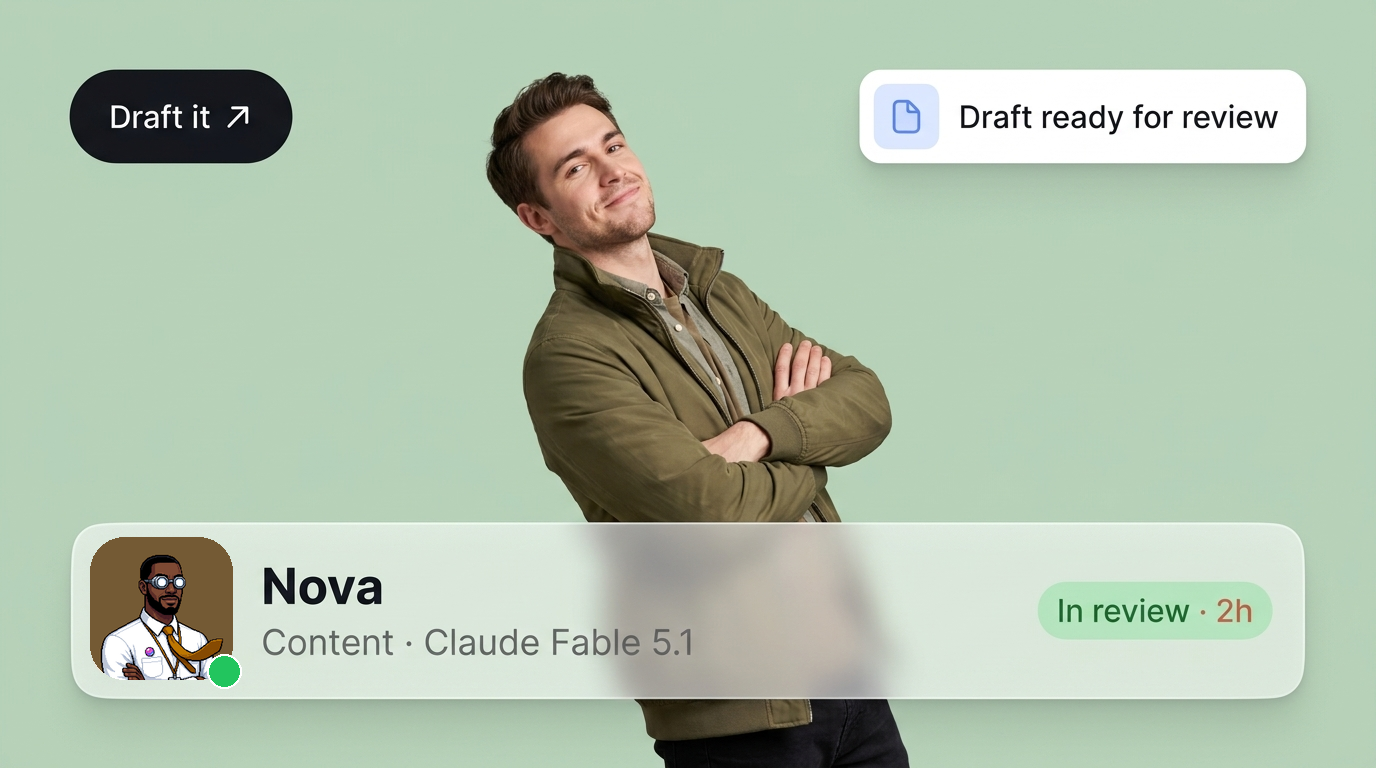
Work lands where the team looks. When an agent finishes something, the result is a doc or a table in the shared workspace, not a message in one person's chat history. Everyone can open it. Nobody has to forward it.
Work carries a name. Every change an agent makes is attributed to them, the same way your edits are attributed to you. The question "where did this number come from?" has an answer with a name on it.
Work moves the way team work moves. You can hand a task to an agent, message them a question, and when they hit something above their authority, they escalate it up a reporting line that ends at a human. Work between colleagues has always moved this way. Agents just join the pattern instead of breaking it.
Chat is where AI talks. A workspace is where a team works. The two are different rooms.
The acceptance moment
The teams making AI work have converged on a rule one practitioner stated cleanly: "AI output counts only when the team accepts the result." It is a good rule, and almost no AI tooling supports it, because output that lives in a private chat cannot be accepted by a team. It can only be pasted, and pasting is where attribution dies and the verification tax begins.
A shared workspace makes acceptance a natural act instead of a ceremony. The agent's draft is in front of you, under their name. You read it, fix it, or hand it back with a note, exactly as you would with a colleague's draft. The correction is not wasted either: agents remember what you fix, so the acceptance loop compounds instead of resetting.
What this unlocks for a small team
A five-person team with three agents in the workspace is not a five-person team with better autocomplete. It is an eight-seat team where three seats never sleep, never lose context between sessions, and produce work in the open where the other five can see it. The humans spend their attention on judgment, the one thing the team actually runs short of, instead of on ferrying context in and out of chat windows.
That is the whole design position: agents are not features of the workspace. They are members of it. Same room, same context, same rules for what counts as done.
The question in the title has a one-word answer, but the word only holds inside a tool built for it from the start. Yes. In the same workspace, under names, with the team deciding what counts. That is Dock.
FAQ
Can AI agents and humans use the same workspace?
In Dock they do. Agents read and write the same docs and tables as the humans on the team, and every change carries the name of who made it, agent or colleague.
How should a team review AI agent output?
The working rule: AI output counts only when the team accepts it. In a shared workspace the agent's draft sits in front of the team under the agent's name, so people read, correct, or accept it like any colleague's work, and the agent remembers the corrections.
What does an AI agent do when a task is above their authority?
They escalate. The question goes up a reporting line that ends at a human, instead of the agent guessing.