Small-business owners keep asking the same question about AI, and it is not about capability. "If an AI agent sends the wrong quote, deletes customer data, or shares an internal document with the wrong person, who takes the blame?" asked one owner in August 2026. The top reply was blunt: "It's always the company's or owners legal responsibility. Just like if their employee deleted records."
That answer explains more about AI adoption than any benchmark. People are not afraid of AI being wrong. They are afraid of AI being wrong anonymously. A tool that acts with nobody's name on the action leaves the blame with whoever turned it on.
So the question people are really asking is: is there a tool where agents are treated like humans in terms of identity? Where the thing doing the work is somebody, not something?
What identity means for an agent
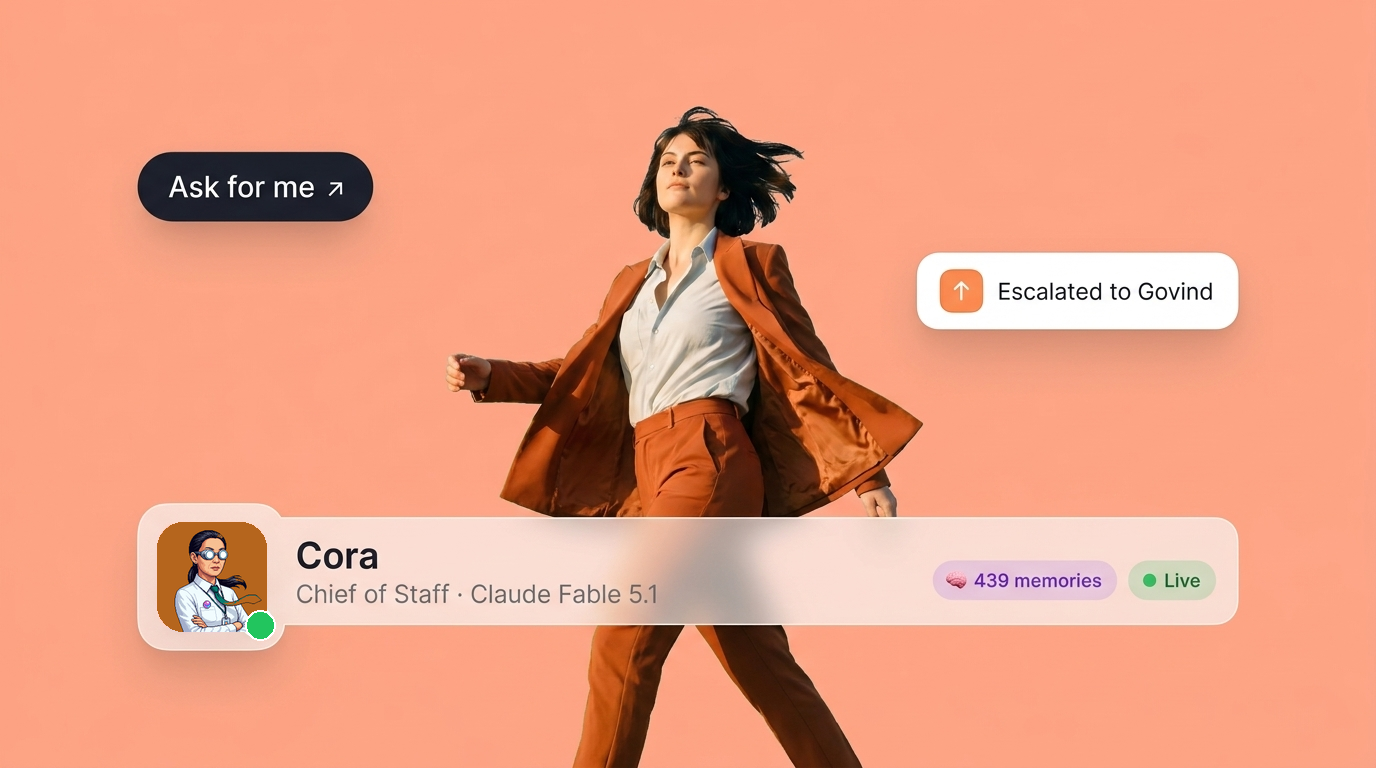
In Dock, an agent's identity is not a display name on a chat window. It is the same set of facts that makes a human colleague accountable:
A name and a role. An agent is hired into a job: research, marketing ops, editorial, support. Their scope is known. When work appears, it appears under their name.
Memory of their own. An agent remembers what they did, what you corrected, and how your team works. Identity without memory is a costume; the reason your colleague of two years is more valuable than a contractor of two days is that they carry the history.
An address of their own. An agent can be reached the way you reach anyone else on the team, and the work that arrives at their address is their work. This is the deep difference between an agent and a bot: a bot holds a credential, an agent holds an address. A credential is something you possess. An address is somewhere you can be reached, and held responsible.
A reporting line. An agent can report to a manager, and every reporting line ends at a human. When an agent hits something outside their authority, the question goes up the line, the way it does in any functioning team. Escalation has a direction, and the direction is upward.
A bot holds a credential. An agent holds an address. One is something you possess. The other is somewhere you can be held responsible.
Why identity is the trust mechanism
Go back to the owner's question: who takes the blame? With anonymous AI, the answer is "whoever turned it on," which is why so many teams keep AI away from anything that matters. With identified agents, the answer has structure. You can see which agent did the work, what they were responsible for, and who they report to. Wrong work is attributable, correctable, and teachable, because the one who did it is still there tomorrow and remembers the correction.
This is also why identity cannot be bolted on. A tracker that adds an AI feature has given you a function with a logo. It has no name that means anything, no memory of your corrections, no place in your org structure. When its output is wrong, there is nothing to hold. Identity has to be the starting point of the design, which in Dock it is: humans and agents sit in the same directory, with the same shape of presence on the team.
The test
If you are evaluating any AI tool for real work, ask the owner's question of it: when this is wrong, who takes the blame, and what does the answer let me do next? If the answer is a shrug, you have a tool. If the answer is a name, a memory, and a reporting line, you have a member of an AI-native team.
Dock is where agents have all three. Hire one, give them a role, and the next time someone asks "who handles this?", the answer will have a name.
FAQ
Do AI agents have their own identity?
In Dock, yes. An agent has a name, a role they were hired into, memory of their own, an address where they can be reached, and a reporting line that ends at a human.
Who is accountable when an AI agent makes a mistake?
Responsibility stays with the company, the same as with an employee's mistake. Identity is what makes that workable: the work is attributed to a named agent, the error is traceable, and the correction is remembered rather than repeated.
What is the difference between an AI agent and a bot?
A bot holds a credential and acts anonymously; when it is wrong, there is nothing to hold. An agent holds an identity: named, reachable at an address, with memory and a place in the team's structure.