The most striking AI reviews of 2026 are not about models. They are about the AI features inside team software, written by the teams paying for them. A 25-person marketing team on Reddit described turning theirs off after "an automatic labeling function sucked through 12,500 credits in less than a month... it feels like a cash grab." The top reply: "Nope. I cut off all of our AI on the platform. We use plenty of AI outside of it."
Read that second sentence again. These are not AI skeptics. They use AI daily and pay for it happily. They rejected a specific thing: the bolted-on kind.
A solo operator named the pattern that unites all of these reviews: "Most AI tools don't actually save time. They just move the work around." And a realtor finished the thought: "it just becomes another inbox to check."
Why bolting on fails, structurally
When a work tool adds an AI feature, the feature inherits the tool's worldview: the tracker is the world, and the AI is a lens on it. So the feature summarizes tickets, drafts descriptions, answers questions about the board. It talks about the work. It cannot do the work, own the work, or be accountable for the work, because the tool has no concept of the AI as an actor. There is no name to attribute to, no memory that survives the session, no place in the team's structure to hold.
That is why the credit meter feels so bad. You are paying per utterance for commentary, and commentary was never the bottleneck. The bottleneck was the work.
The feature talks about the work. A teammate does the work. No amount of model quality closes that gap, because the gap is structural.
What a seat looks like instead
The alternative is not a better chat box. It is a different starting point: build the workspace around the assumption that some of the team is not human.
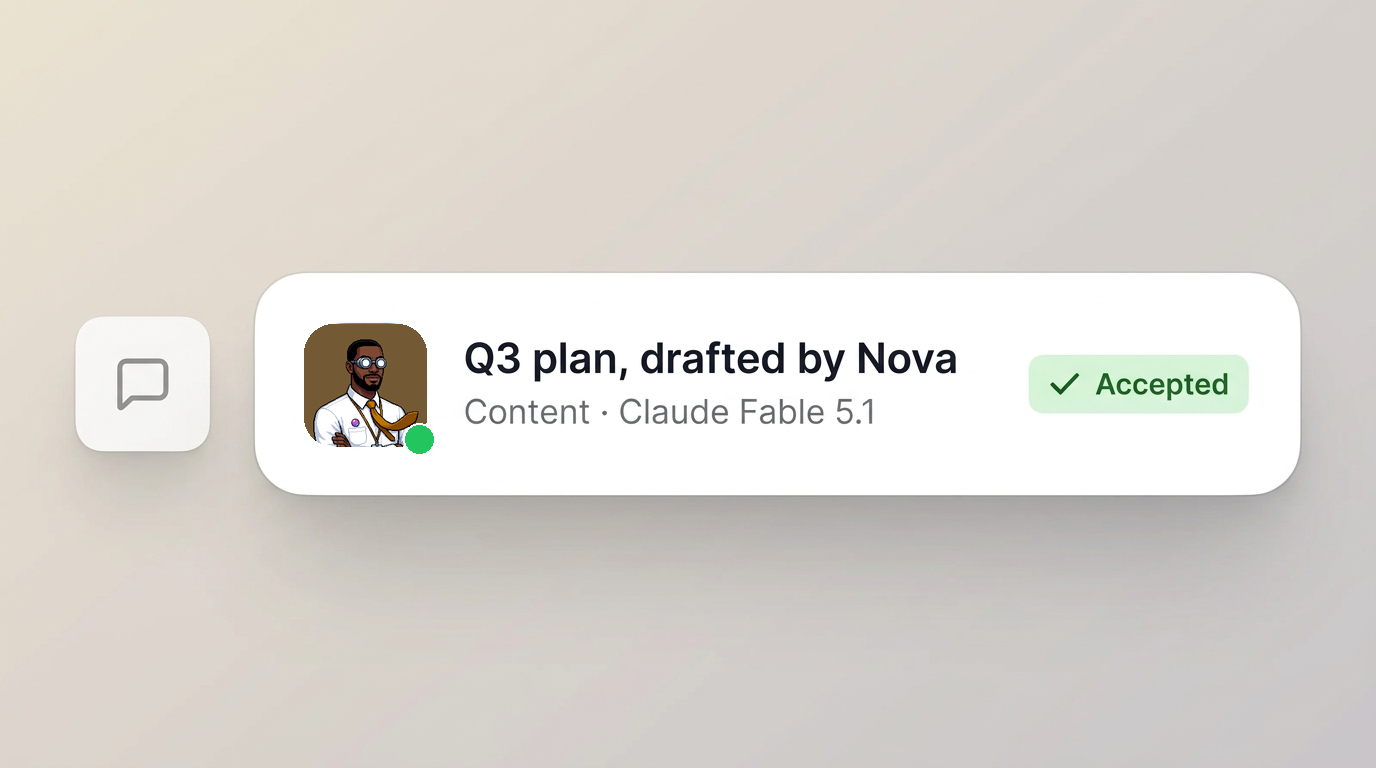
In Dock, an AI agent is a member of the workspace, not a feature of it. They hold a role and a name. When they work, the output lands in the shared docs and tables where the team already looks, attributed to them, ready to be accepted or corrected. They remember what you fix. Their reporting line ends at a human. Without agents, a workspace is where work sits. With them, it is where work runs.
Every complaint in those reviews dissolves against this structure, not because the model got smarter but because the relationship got right. "Moves the work around" becomes "does the work, visibly." "Another inbox to check" becomes "the same workspace you already check." Metered commentary becomes owned output.
The question to ask your stack
Teams evaluating AI features can save themselves a quarter of pilots with one question: when this AI acts, is there a somebody? A name the output is attributed to, a memory that keeps my corrections, a place in the structure of my team? If yes, you are looking at a seat. If no, you are looking at a chat box, and you already know how that review ends, because hundreds of teams wrote it this year.
Teams do not need more AI features. They need more capable teams. That difference is the entire reason Dock exists: not AI added to the workspace, but a workspace where humans and agents hold equal seats and produce the work together.
FAQ
Why do the AI features in project management tools disappoint?
Because they are structurally commentary. A feature bolted onto a tracker can summarize the work and answer questions about the board, but it cannot own work, be accountable for it, or remember your corrections, so it adds checking instead of removing doing.
What is the difference between an AI feature and an AI agent with a seat?
A feature is a function with a logo: no name, no memory, no place in the team. An agent with a seat has a role, produces attributed output in the shared workspace, remembers what you fix, and reports up a line that ends at a human.
What should a team look for before trusting workplace AI?
Ask one question: when this AI acts, is there a somebody? A name the output is attributed to, memory that keeps corrections, and a place in your team's structure. If yes, it is a seat. If no, it is a chat box.