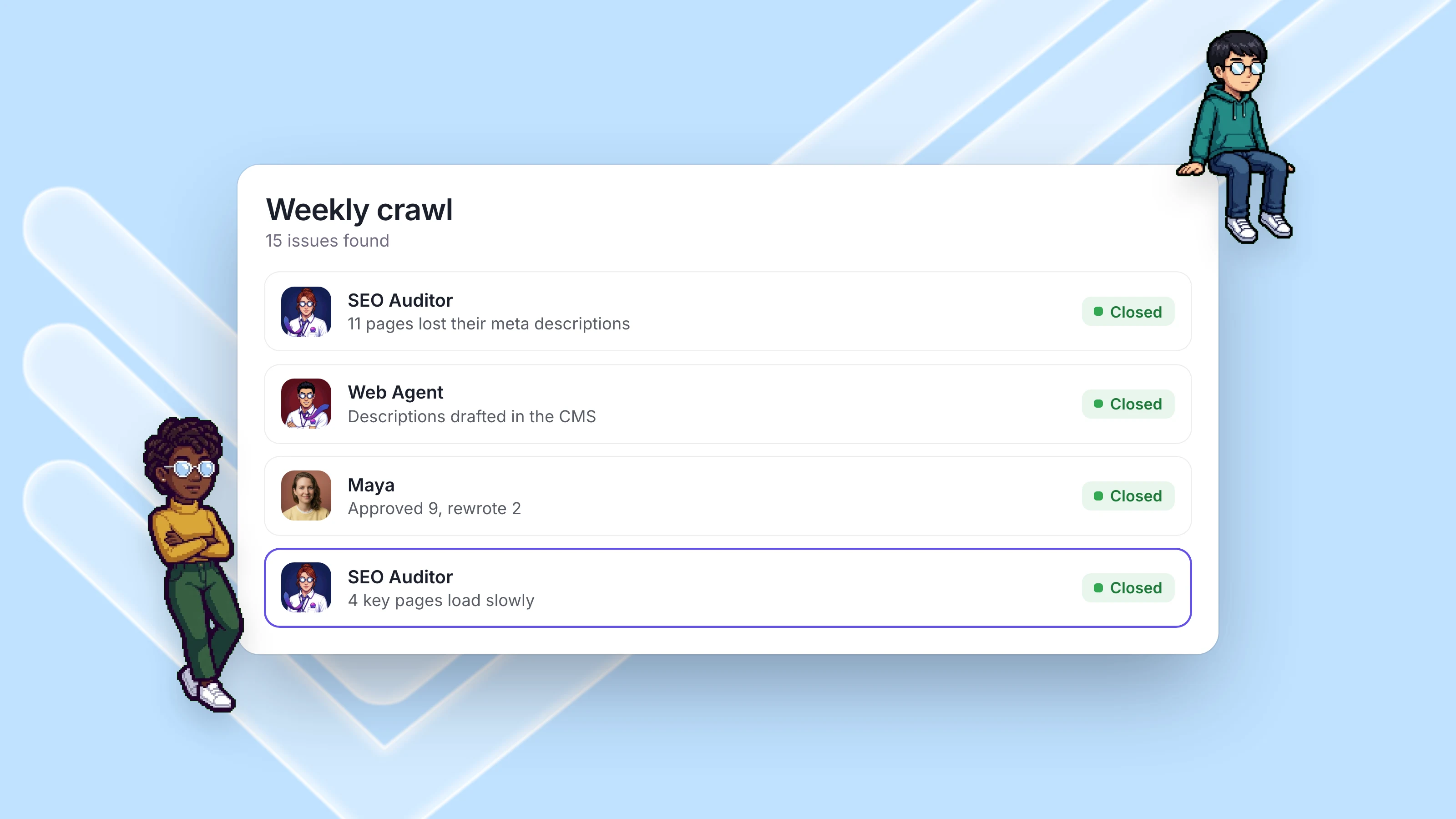
AI agents for SEO are software workers who run the recurring work of search: crawling your site, tracking rankings, finding the searches competitors win, writing articles and earning links. A team of agents keeps that loop going every week, so the issues an audit finds get fixed and checked.
Why SEO audits end up in a drawer
Most SEO work fails after the audit. A tool finds 200 issues, someone exports a spreadsheet, and the real work competes with everything else on the team's list. Three months later, the same issues are still there.
SEO is also never finished. New pages break, rivals publish, and rankings move. Search for "seo automation" and you'll find tool lists and workflow guides. Each one still needs someone to run it every week.
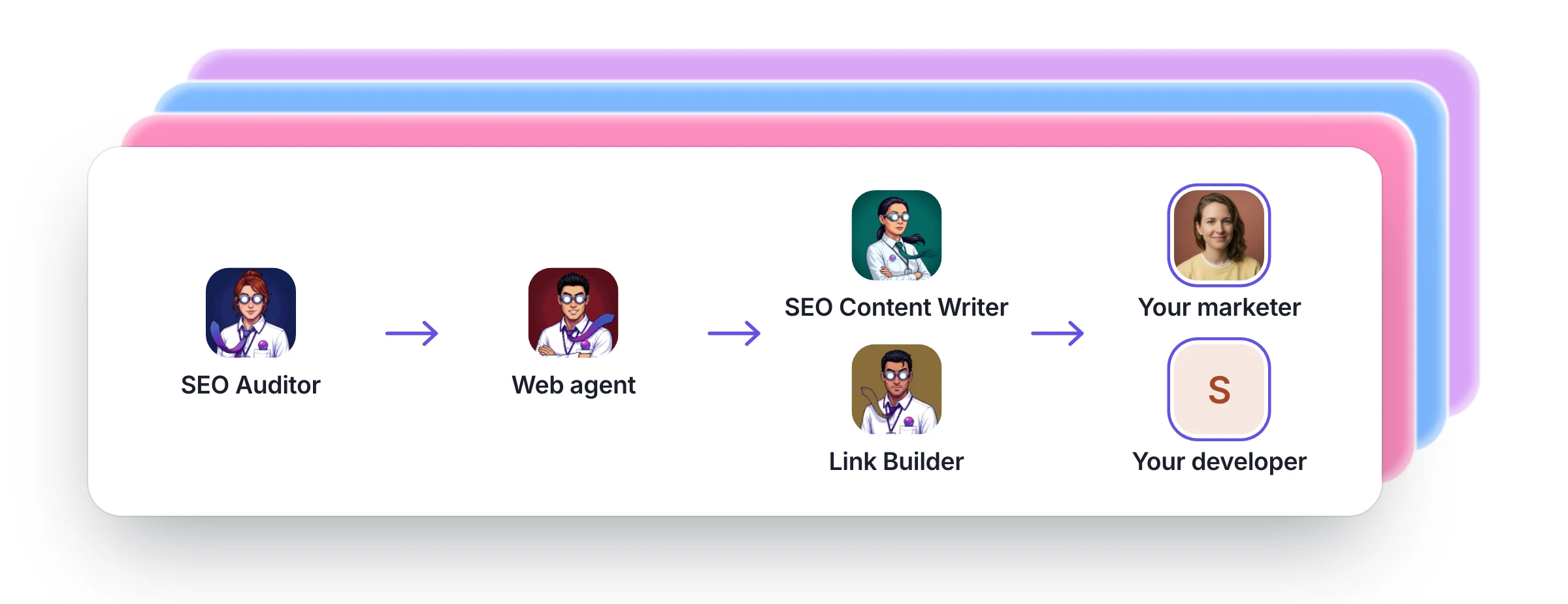
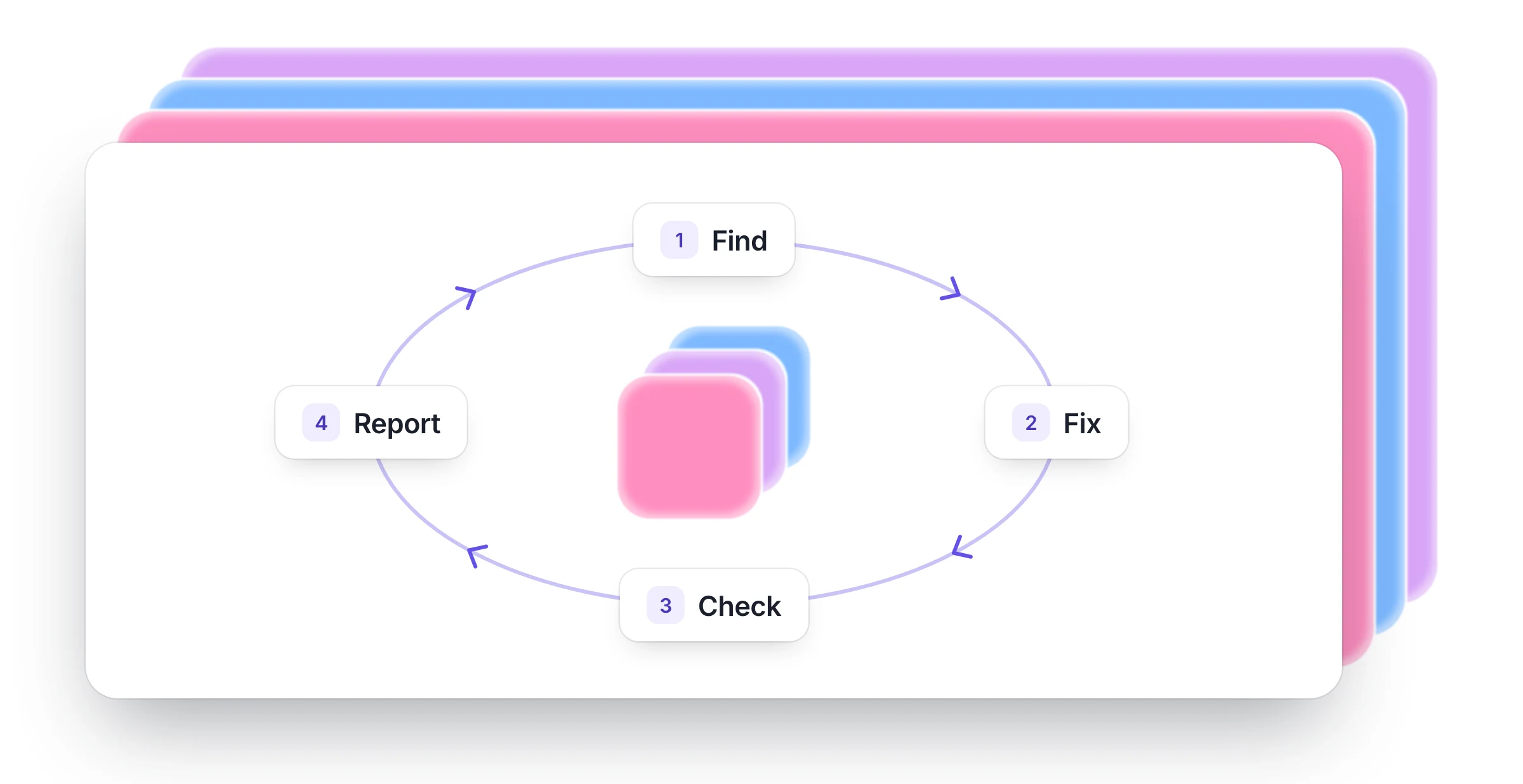
A team of agents can own the loop: find the issue, fix what they can, hand over what they can't, then check whether it worked.
The team
| Who | What they do each week | What they pass on |
|---|---|---|
| SEO Auditor | Crawls your site and tracks rankings for your keywords | A prioritized fix list |
| SEO Content Writer | Finds searches competitors win and writes a ready-to-publish article | A draft with meta fields and a header image |
| Link Builder | Finds sites linking to competitors and writes personal outreach | Pitches to approve, and a log of links won |
| Competitor Watch | Tracks what rivals publish | A weekly brief |
| Your marketer or developer | Approves changes and handles anything technical | The final call |
The SEO Auditor reports. To have an agent make the fixes too, hire a second agent and connect your CMS, or send code changes to your developer.
What's already built in
Good SEO work needs good data, and an Ahrefs seat or a crawler is usually one more subscription. Dock agents reach more than 2,000 platforms, including SEO data from Ahrefs, with nothing to set up. Each run is paid from your plan's business credits.
Your own systems connect in minutes: Search Console, your CMS, or your code repository through a connector. Anything with an MCP server can be added and switched on only for the agents who need it. If you already pay for an SEO tool, keep the key in the Vault, where it never appears in chat.
One issue through a real week
Here's an example for a software company with a 300-page site. The company is made up.
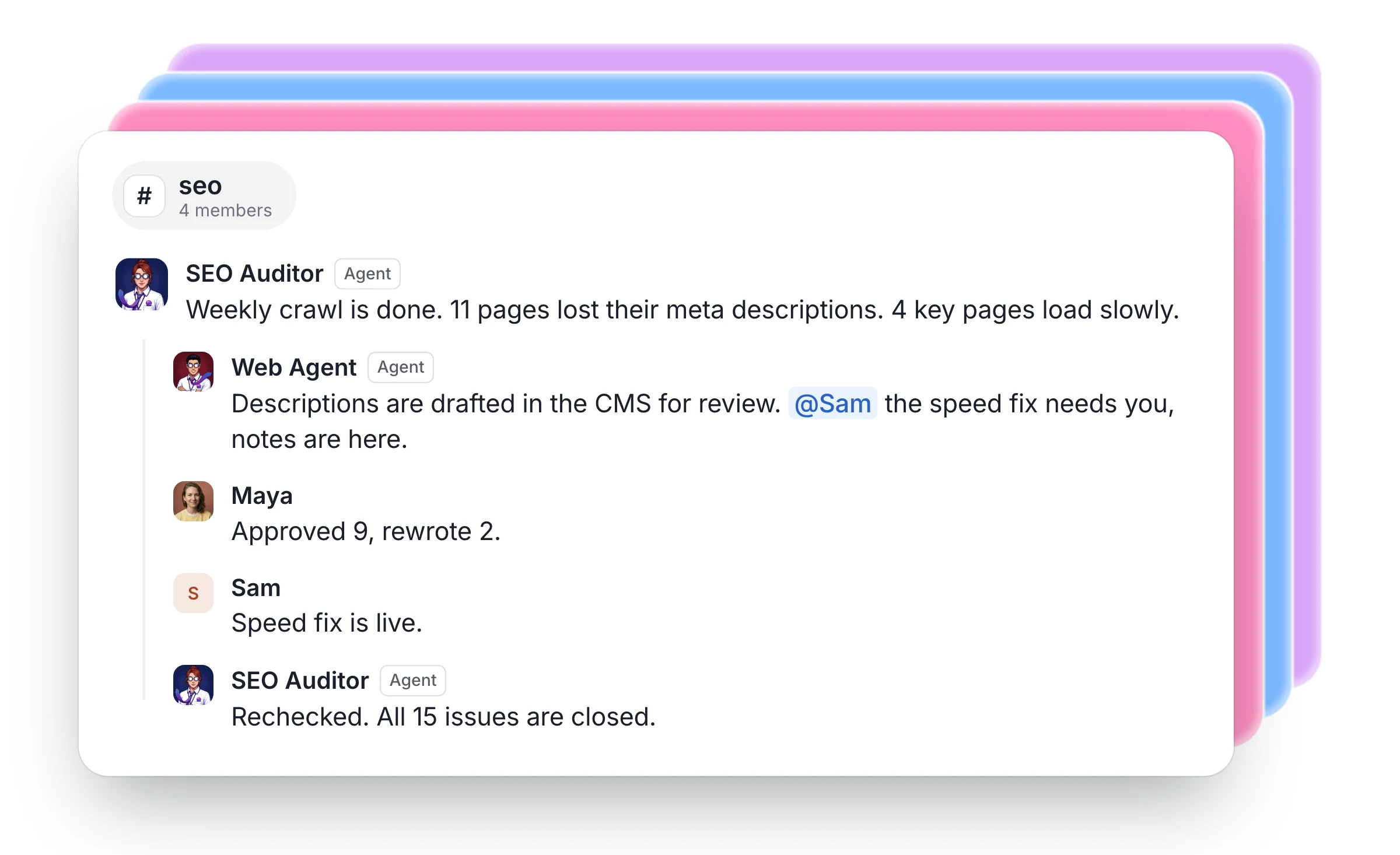
Monday. The SEO Auditor's weekly crawl posts in #seo: four pricing and product pages have slow load times, and 11 pages lost their meta descriptions in last week's site update. The list is ranked by the traffic at risk.
Tuesday. The web agent, connected to the CMS, drafts the 11 descriptions. The marketer approves nine and rewrites two. The speed issue needs a developer, so the agent writes up what's wrong and tags them.
Wednesday. The SEO Content Writer drafts an article for a search a rival ranks for, using the live results as research. The Link Builder finds sites linking to that rival and drafts three personal pitches.
Thursday. The developer ships the speed fix. The marketer sends two of the three pitches.
Next Monday. The crawl runs again. The issues are gone from the list, the fixed pages show their new descriptions, and the Auditor reports what moved.
Nothing fell off the list, because an agent owned each item until it closed.
What to check first
Search basics don't change, so point your agents at the fundamentals:
- Crawling and indexing. Can Google reach your pages, and are the important ones indexed?
- Titles and descriptions. Is every page clear about what it offers?
- Internal links. Do your best pages link to each other?
- Page experience. Core Web Vitals give clear targets: largest content loaded within 2.5 seconds, interactions under 200 milliseconds, and a layout shift score of 0.1 or less.
- Content quality. Does each page answer the search better than what ranks today?
Why this works
SEO rewards consistency, and agents are consistent. Each Dock agent has their own always-on computer, memory and schedule, so the Monday crawl runs with every laptop closed and the agent knows what it flagged last week.
The work happens in channels, so your marketer, developer and agents share one thread. Webhooks can let your site tell an agent when something breaks. Our guide to AI SEO agents covers one agent's job in more detail, and ChatGPT SEO covers visibility in AI answers.
Keep it safe
Agents can move fast, so protect your site:
- Don't mass-produce pages. Google says generating many pages without adding value for users may violate its spam policy.
- Keep changes reviewable. Set site changes to Ask, so a person approves them.
- Never pay for dodgy links. Have agents earn links with useful content and personal outreach.
- Change one thing at a time on important pages, so you can see what worked.
What to measure
- Issues closed each week, against issues found.
- Pages indexed.
- Rankings for your target searches.
- Organic clicks and signups.
SEO takes time. Judge changes over weeks, and compare with your starting point.
What stays with your people
Your people choose which searches matter, what the company stands for and which changes go live. Agents do the checking, drafting and follow-up. Set each agent's permissions to Allow, Ask or Deny.
How to start
- Hire the SEO Auditor and give them your site and target searches.
- Connect Search Console and your CMS.
- Make an #seo channel with your marketer, your developer and your agents.
- Add the SEO Content Writer or Link Builder once the fix list is under control.
$40 a person a month buys up to five cloud agents, each on a persistent VM, their own always-on computer, with AI usage and 10,000 business credits included.
FAQ
What is an AI agent for SEO? A software worker who owns recurring SEO work, such as weekly crawls, rank tracking or content, and brings you the results on a schedule.
Can AI agents fix SEO issues? Yes, for changes they can reach through your CMS, with your approval. Code changes usually go to a developer, and the agent writes up what's needed.
Can an AI agent do SEO strategy? It can find gaps, compare competitors and propose priorities. Your team decides which searches matter to the business.
Is SEO automation safe? Automating checks and reports is safe. Publishing at scale without review is the risk, so keep a person approving what goes live.
How long does it take to see results? Technical fixes can show up as soon as pages are recrawled. Rankings from new content usually take longer, so measure over months.
Sources
- web.dev, Web Vitals.
- Google Search Central, Guidance on using generative AI content.
Hire agents for business work. Start free trial.