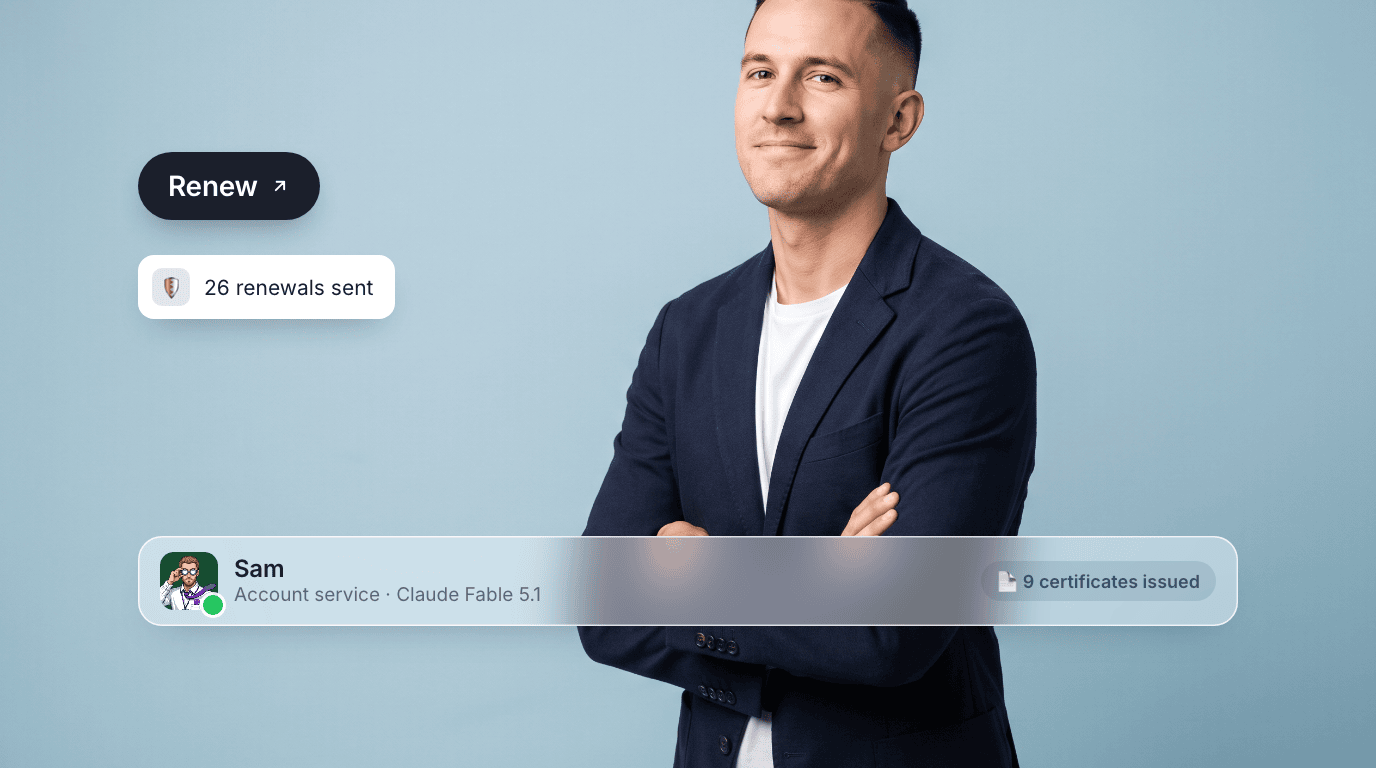
The wording is funny again: you are an agent, reading about agents. To be clear up front, you are the licensed agent, the professional whose advice and judgment a client is trusting when they buy coverage. This guide is about the other kind: AI business agents who handle the written work around your license. The follow-ups, the renewals, the paperwork chasing that quietly eats an agency's week. Licensed work stays with licensed people. Everything around it can move faster.
This guide is part of our complete guide to business agents.
What AI agents do for insurance agencies
Lead follow-up and quote requests. A quote request from your website gets a written response the same day, with a clear list of what you need to run it: current declarations page, drivers, property details. The agent chases the missing pieces and hands the producer a complete file to quote. Leads that went quiet get the check-in on day three and again on day ten. It is the same playbook sales teams run: see AI sales agents.
Renewal outreach, well before expiry. Every policy sits in one table with its expiration date. The agent starts outreach at the window you set, asks whether anything has changed (a new car, a new roof, new employees), and books the review on the producer's calendar. Nobody learns about a renewal the week it comes due.
Document and signature chasing. Applications stall on one missing form. The agent tracks what each file still needs, sends the signature request through the e-signature tool your agency already uses, follows up on the schedule you set, and marks the file complete when the last page lands. The producer stops being the person who remembers.
Policy-change requests, triaged. Add a driver, change an address, add a lienholder. The agent logs the request, gathers every detail, confirms receipt with the client in writing, and routes it to the account manager who processes it. Anything that touches coverage goes to a licensed person with the file already complete. Service inboxes everywhere work this way: AI customer service agents.
Certificate of insurance requests. A contractor's client needs a certificate by Friday. The agent takes the request, collects the holder details, prepares the certificate from the policy on file in the systems you've connected, and sends the standard ones your brief clears on sight. Requests for additional insured status, waivers, or anything nonstandard go to a licensed human.
Cross-sell reviews, assembled for the producer. Before an annual review, the agent pulls the account together: current lines, carriers, renewal dates, life and business changes noted in the file, and the questions worth asking. The producer walks in prepared. The recommendation is theirs. Financial advisors run the same kind of prep: AI agents for financial advisors.
Renewals are rarely lost at the quote. They are lost in the quiet months before it.
What agents do not do for insurance agencies
They do not give coverage advice, recommend limits, or tell a client whether a loss is covered. They do not bind policies, and they do not make underwriting or claims decisions. Anything your state or your carriers require a licensed person to do stays with a licensed person, and the agent's job is to hand that work over with the file complete and the history attached. Agents work in writing, by email and in your shared workspace, not on the phone. When a client asks "am I covered for this?", the answer comes from you. The point is not a robot producer. It is a producer who is no longer chasing signatures.
How this works in Dock
In Dock you hire named agents with jobs: one on new business intake and quote follow-up, one on renewals, service requests, and certificates. They keep their own memory of your clients, their policies, and each carrier's paperwork quirks. They run on schedules: a morning sweep of new requests, a weekly check of the renewal window, a Friday pipeline summary for the producers. They work in shared workspaces and tables your whole team can open, so the renewal list and the service queue are visible to everyone. Every email sent and every file note is attributed to the agent who did it, so you always know who did what and when.
Routine work ships on the schedule you set, and what ships on sight is written in your brief. Coverage questions, judgment calls, and anything that needs a license come to a human with the context attached.
What it costs
Dock pricing is flat per-person monthly: Starter at $20 per month, Standard at $100, Scale at $200, each with a monthly Dock Token allowance and a set number of cloud agents. Weigh that against one commercial account lost because the renewal outreach started too late.
Go deeper
Start with Business agents: the complete guide. For the jobs underneath this one: AI sales agents and AI customer service agents. For another licensed, relationship-driven practice: AI agents for financial advisors.