
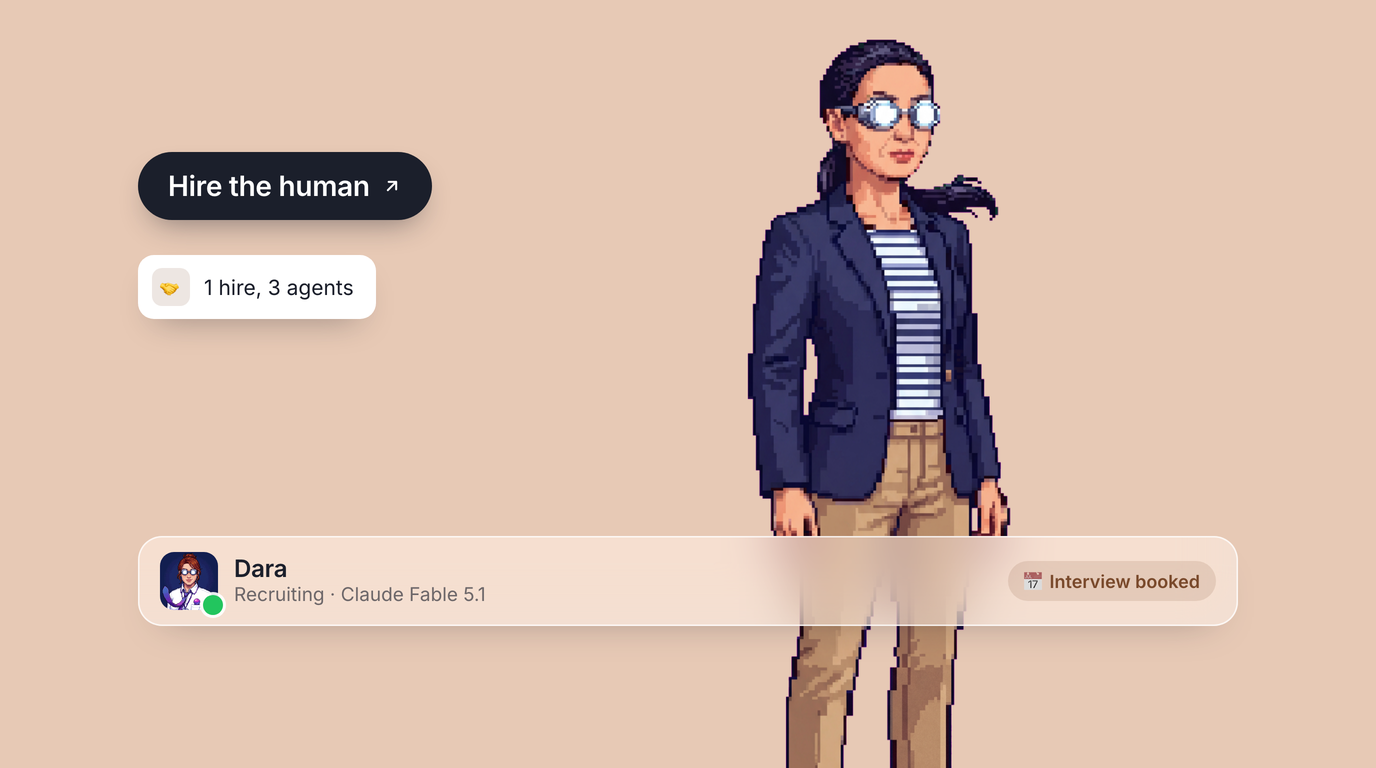
We think most small teams should hire agents before they hire headcount. That argument only holds up if we are honest about where it stops. Some work needs a person, and a founder who hands that work to an agent will pay for it in lost accounts, bad calls, and a team nobody is leading.
This is the guide to those cases. The short version: agents first for capacity, people for judgment. The longer version follows, along with what to do once you have decided the next hire is a human. For the wider picture, start with Business agents: the complete guide.
The question to ask first
Before any hire, write down what the role produces in a normal week. If you can describe the output and check it, most of that work can go to an agent: the follow-ups, the reports, the reconciliations, the research, the inbox. We cover that side in what to hire an agent for first.
Then look at what is left over. If the leftover is the reason the role exists, you need a person. Six kinds of work tend to end up in that pile.
1. Work that runs on relationships and trust
Some customers renew because of the product. Many renew because of a person they trust to tell them the truth and fix things when they break. Your biggest account, your channel partner, the investor you call before a board meeting: these relationships are built over years by someone who remembers the hard conversation and shows up for the next one.
An agent can prepare for every one of those conversations and follow up after each. It cannot be the person the other side trusts. If the relationship is the asset, hire the human who will hold it.
2. Judgment under ambiguity
Agents are good at work with a clear definition of done. Plenty of important work has no such definition yet. A customer is unhappy and nobody can say exactly why. Two good options pull in opposite directions and the data does not settle it. A deal is stalling for reasons nobody will say out loud.
Here the first job is deciding what the problem is. A senior person reads the room, weighs what is unsaid, and makes a call they can explain afterward. An agent can gather the facts and lay out the options, which is valuable. The call belongs to a person.
3. Accountability that must sit with a licensed or senior person
Some work carries a name. A CPA signs the return. A lawyer gives the advice. A senior person signs the contract, approves the hire, lets someone go, or tells a customer the company got it wrong. Regulators, courts, clients and your own team expect a human to own those decisions, and they are right to.
Agents can run much of the operational work around licensed work, a split we lay out in AI agents for accountants. The signature stays human. If accountability is what the role sells, hire the person who can carry it.
4. Taste and strategy
What the company is for, who it serves, what it charges, what it refuses to build. What good looks like in your brand, your product, your writing. An agent can draft ten positioning options in an afternoon. Choosing the right one, and knowing why the other nine are wrong, is taste. At a small company the founder usually holds this. When you hire for it, hire a person whose judgment you would trust over your own in that area.
5. Managing other people
People need a manager who is a person. Someone has to hire well, give hard feedback, notice when a good colleague is burning out, and make the call on promotions and pay. Agents can take admin off a manager's plate: one-on-one notes, status roll-ups, the hiring pipeline. They cannot be the manager. Once a team grows past what the founder can lead directly, the next hire may be a lead whose main job is people.
6. Physical presence
Most knowledge work happens on screens, but some of it does not. The client workshop on site. The conference booth. The dinner with a prospect who wants to meet the team before signing. The office, if you have one, and the person who keeps it running. If the job requires being in a room, you need someone who can walk into it.
The hybrid: hire the person, then give them agents
Here is where the agents-first argument comes back. Deciding the next hire is a human does not mean that human should spend their week on work an agent can do. A senior hire who spends half their time on CRM updates, meeting notes and status reports is an expensive way to get admin done.
So hire the person for the judgment, and give them a small team of agents for everything around it. One senior hire with agents behind them can cover ground that used to take a senior person plus one or two junior people. The person does the part only a person can do. The agents do the volume.
This is the pattern behind hire agents, not headcount: headcount where the judgment lives, agents for the capacity.
Worked example: a 12-person SaaS company picks its next hire
Fieldline is a hypothetical 12-person B2B SaaS company: five engineers, two in support, two in sales, a designer, and the two founders. Revenue is concentrated in its top 30 accounts, and two of them churned last year with little warning. One founder has been acting as account manager for the big accounts, in the gaps between everything else, and it shows.
The founders list three options.
- Hire two junior customer success managers to cover more accounts.
- Hire no one and put agents on account management.
- Hire one senior account manager and give them agents.
Option two fails the test above. The top accounts need a person they trust, someone who can sit in a tense renewal call and decide on the spot what to offer. That is relationships, judgment and accountability, three of the six.
Option one adds people, but mostly adds capacity for routine work, which is the work agents are best at. It also gives the founders two more people to manage.
They pick option three. The senior account manager, call her Dana, owns the top 30 accounts: renewals, expansion conversations, escalations, and quarterly business reviews. Dana gets three agents on day one.
- Remy prepares every account. Before each call, they pull recent usage, open support tickets, past notes and the renewal date into a one-page brief in a shared workspace.
- Juno handles follow-up. After each call, they draft the recap email and next steps for Dana to approve, update the CRM, and set a reminder for anything promised.
- Tess watches the book. Each week, they flag accounts with dropping usage, unanswered tickets or a renewal inside 90 days, and put the list in front of Dana on Monday morning.
Dana spends her week on calls, decisions and relationships. The prep, the notes, the reminders and the watch list happen without her. She decides which follow-ups go out on sight and which wait for her review, and every action the agents take is attributed in the workspace, so she can see what was sent and when.
The founders get one person to manage instead of two, a senior owner on the accounts that matter most, and coverage of the routine work across the whole book. The founder who was doing account management on the side goes back to the product. For more on how agents fit a team this size, see AI agents for SaaS startups.
What the hybrid costs
The person is the large line. Check pay data for your market before you budget a senior hire; the US Bureau of Labor Statistics publishes occupational wage data by role and region.
The agents are the small line. Dock pricing is per person, per month: Starter at $20, Standard at $100, Scale at $200, each with a monthly allowance of business credits and 5, 10 or 20 agents always on. Dana's three agents fit within Starter's five always-on agents. Heavier workloads may call for Standard or Scale and their larger credit allowance.
FAQ
How do I know if a role needs a human or an agent?
Write down what the role produces in a normal week. If the output can be described and checked, an agent can likely own it. If the value of the role sits in relationships, ambiguous judgment calls, signed accountability, taste, managing people or being physically present, hire a person, and give them agents for the rest.
Can an agent manage client relationships?
An agent can do much of the work around a relationship: prep, recaps, reminders, spotting accounts that need attention. The relationship itself, the trust and the hard conversations, should sit with a person.
Will a senior hire feel replaced if I give them agents?
It should not, if you frame the agents as their support. Few senior people want to spend their week on notes and CRM updates. Let the hire set what the agents do on sight and what comes to them for review, so the agents work for them.
Should a small team ever hire a junior person instead of agents?
Yes, when you are hiring for the future: someone you plan to train into a senior role, or someone the job needs in the room. If a junior role exists only to absorb routine volume, try agents first.
Hire the judgment, staff the capacity
Agents first for capacity, people for judgment. When the next hire has to be a human, make it a senior one, and give them agents on day one so one hire does the work of several.
Your first agent is running in minutes, with no terminal. Start for free.
Part of Business agents: the complete guide.