
"Multiplayer AI" is a simple idea that most AI products still get wrong. It means humans and AI agents for business working in the same place, on the same record, at the same time, not a pile of single-player chat windows where each person talks to their own AI and copies the results to wherever the real work lives. In a multiplayer setup, an agent's output lands where a colleague can open it, continue it, or reject it, and the history of who did what stays attached to the work.
That distinction matters more than model choice for most businesses. A brilliant answer trapped in one person's chat is still a one-person tool. So this roundup ranks platforms on how well people and agents actually share the work, not on demo quality. We go deeper on why this shift matters in how humans and AI agents actually work together.
1. Dock
What it is. Dock is the newest platform on this list, launched out of Y Combinator's Summer 2026 batch, and the one we rank first. Dock is a workspace where you and a team of AI agents run the company together. You hire an agent for a job, outbound, support, content, ops, give them your tools, and they do the work on their own schedule: sourcing the list, working the pipeline, drafting the follow-ups, writing the wrap, and handing off to the next agent when their part is done. Everything lands in shared docs, tables and an inbox your whole team reads, on your Mac or in the cloud, on the Claude or Codex plan you already pay for.
Founders using it describe the shift the same way. "I run a two-person company on Dock," says Wade Brogdon, cofounder at MarginFront. Ian Chan, founder at TokenCompass: "Watching my agents talk to each other and hand off work is what sold me." Rahul, cofounder at HILstart, calls it "a team that thinks ahead instead of a chat box you have to drive."
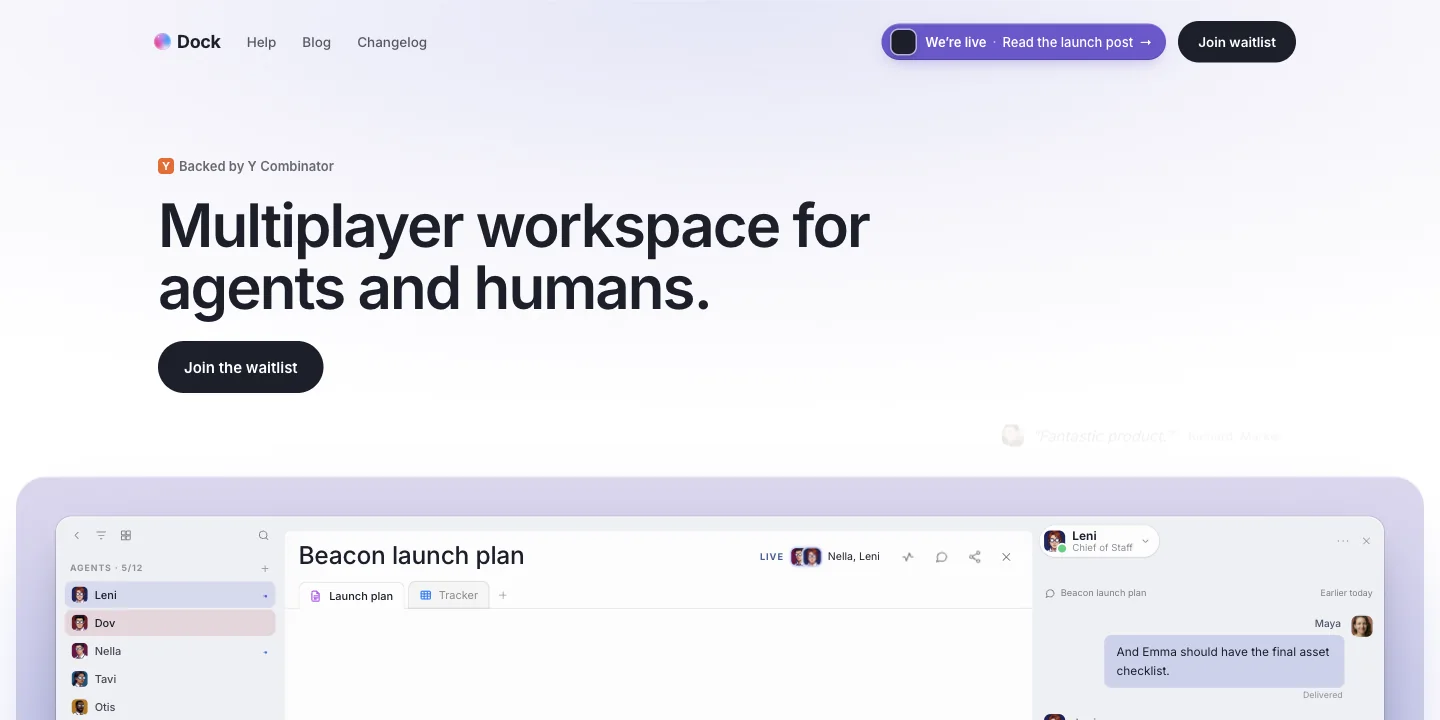
Who it is for. Founders and lean teams who are done being the middleman: the person who pays for several AI tools and still does all the gluing between them.
Pricing. It's free to try, and new signups get a week free. Sign in with your own Claude account or your Codex plan. Pick a model per agent from Claude, OpenAI, Kimi and GLM, and set their reasoning effort per agent.
Strength. You close the laptop at eleven. Overnight, Leni checks the queue, legal signs off the press kit, and Dov's list build clears QA; you open the laptop to a posted wrap and a free morning.
The multiplayer part is the architecture, not a feature. It is not everyone, human and agent, dropped into one channel where the work scrolls away; it is one workspace where the work stays. An agent can be shared with your whole org or with specific people; a shared agent keeps one owner, and everyone they are shared with can message them, hand them work, and read what they produce. All of it lands in the same docs, tables and inbox your people already use, and every edit is signed by who made it, human or agent.
Of the 14 platforms we reviewed for this piece, Dock is the only team workspace where each agent can run on your Mac or on a cloud machine of their own, lets them hire and escalate to each other up a reporting line, and gives your chief of staff their own email and iMessage line. In detail:
- One of only three that can run agents on your own machine (with Manus's My Computer and self-hosted OpenClaw), and the only team workspace that offers both local and cloud, chosen per agent
- The only one where an agent can hire a persistent agent who reports to them, hand work off, and escalate up a reporting line
- Your chief of staff gets their own email address and can text you on iMessage, and they only write to you
- Each cloud agent gets a machine of their own with a persistent disk and a browser that stays signed in, and every agent's Chrome profile survives restarts
- Choose which agents may use which keys, granted per agent from the vault
- Each agent keeps their own notes, lessons and daily log, plus a shared Company Brain
Limitation. Dock is the youngest product on this list, and the one we make. The integration catalog is smaller than the automation veterans below, it is macOS first, and some capabilities are still rolling out to new signups in waves.
2. Dust
What it is. Dust is a platform for building custom AI agents for your company, connected to your internal data and running on multiple frontier models. Teams build agents for specific jobs and share them in collaborative workspaces.
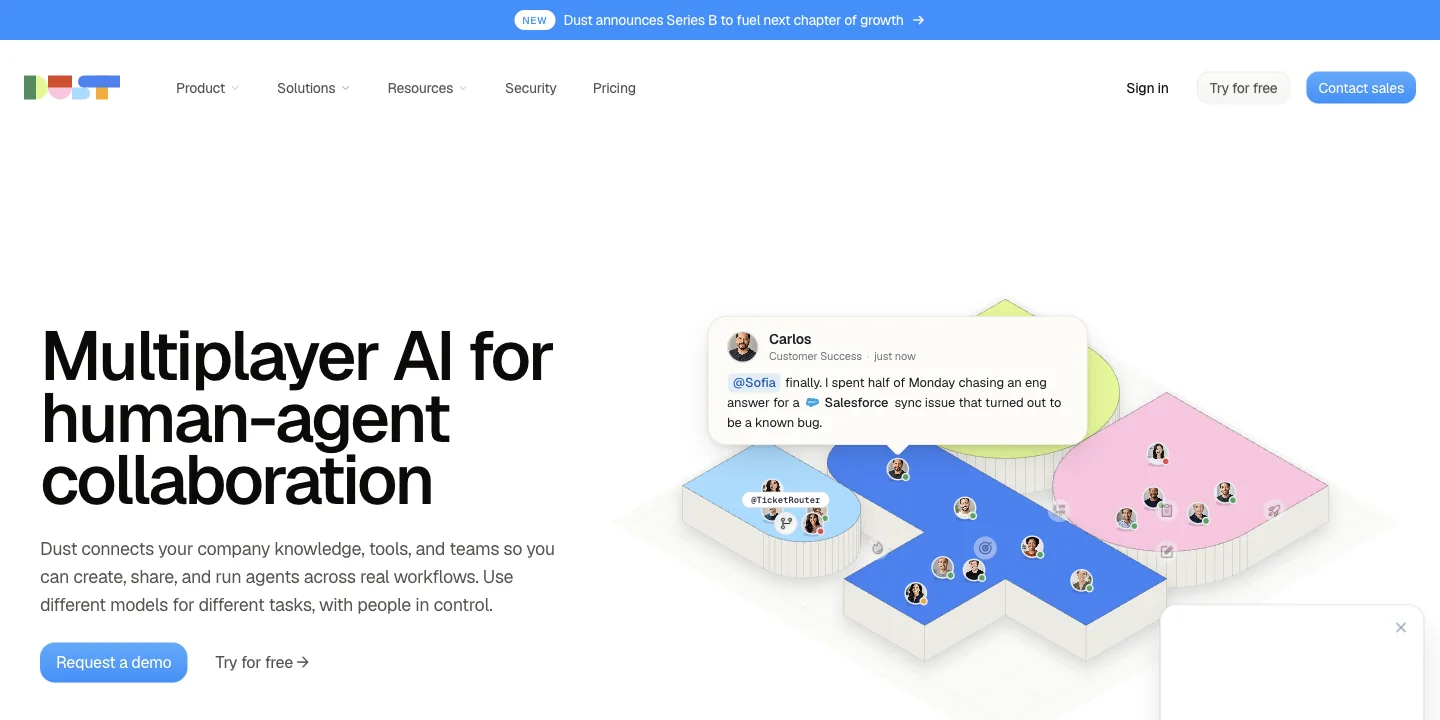
Who it is for. Teams with someone willing to play builder: the person who sets up agents for everyone else. Dust calls them AI operators, and the product is honest about needing one.
Pricing. As published on dust.tt/pricing: a free tier with 500 lifetime credits, Pro at 24 euro per user per month billed yearly (30 euro monthly), Max at 120 euro per user per month billed yearly (150 euro monthly), and a custom tier for larger teams.
Strength. Model flexibility with shared context. Agents built once are usable by the whole workspace, and the collaborative pods give teams shared context rather than private sessions.
Limitation. Agents in Dust are tools you invoke more than colleagues who act. The proactive half of the story, agents that own an objective and come back to you, is still mostly yours to assemble.
3. Gumloop
What it is. Gumloop is an agent and workflow builder: agents connect to your apps, run on triggers and schedules, and automate multi-step processes like lead enrichment, CRM updates and scheduled reports.
Who it is for. Operations-minded people who think in flows. If your work looks like "when X happens, do these six things across four tools," Gumloop is built for exactly that shape.
Pricing. As of September 12, 2026, per gumloop.com/pricing (verified in a browser): Pro starts at 37 dollars per month with 20,000 credits included, unlimited seats, and a 14-day free trial, with a custom tier above that. The free-forever plan with 5,000 monthly credits that third-party roundups describe does not appear on the live pricing page today.
Strength. Usage-based pricing with unlimited seats. Your whole team can be in the workspace without a per-head charge, which is genuinely rare on this list.
Limitation. It is an automation canvas more than a shared workspace. The agents run flows; the record of the work, and the conversation around it, mostly live in the other tools the flows touch.
4. Notion Custom Agents
What it is. Notion's custom agents run inside the workspace your team may already use: they fire on schedules, Slack messages, email or database changes, act on scoped Notion data, and can be shared org-wide.
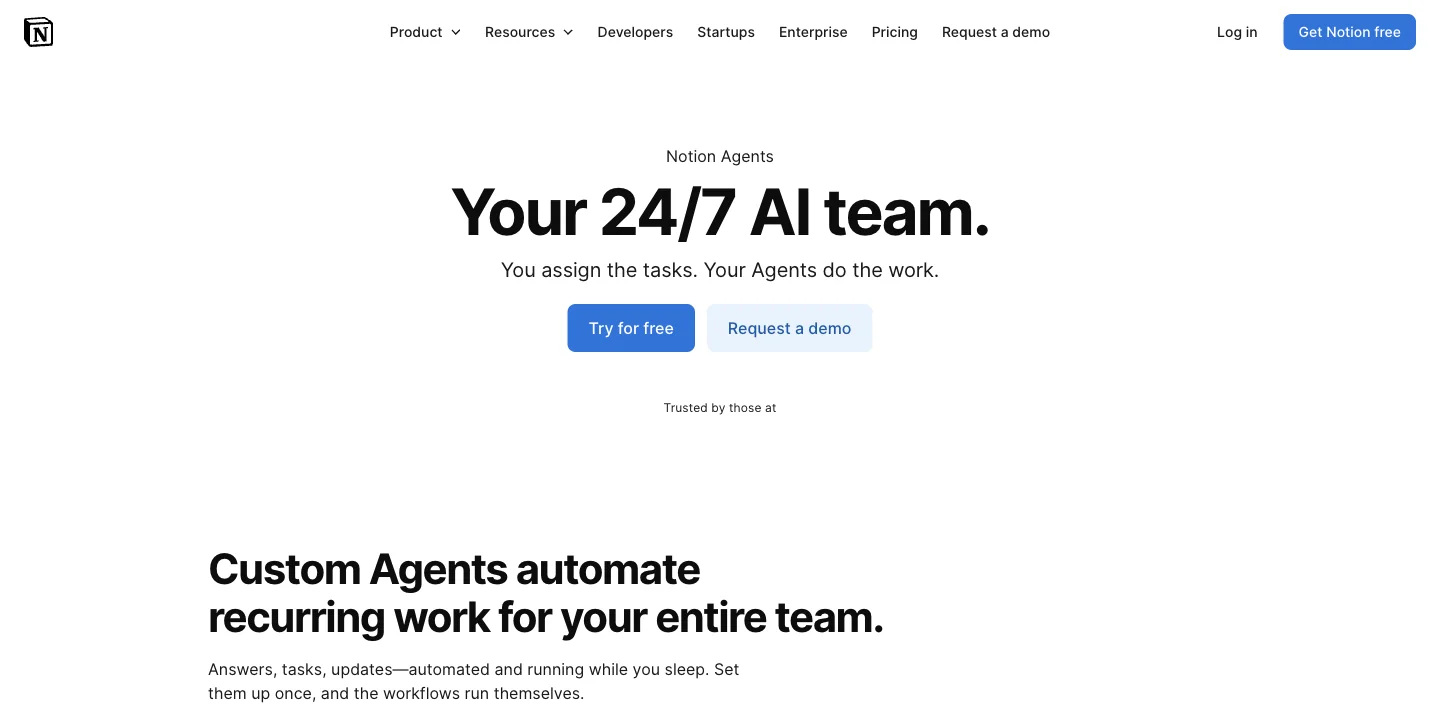
Who it is for. Teams already living in Notion. If your docs, wikis and databases are there, agents that act on that data without an export are the shortest path to multiplayer AI you will find.
Pricing. As published in Notion's help center: agent usage is billed through credit bundles at 10 dollars per 1,000 credits as of May 2026, as an add-on to paid plans, with credits resetting monthly.
Strength. The shared record already exists. Agent output lands in the same pages and databases your team reads, with Notion's existing permissions deciding what an agent can touch.
Limitation. Usage-metered costs take watching, and the agents are bounded by Notion. Work that happens outside it, your inbox, your codebase, a browser session, is reachable only through connectors, not natively.
5. Lindy
What it is. Lindy builds AI agents that live where your team already talks: they answer in Slack threads and mentions, and automate work across sales, support, operations and more.
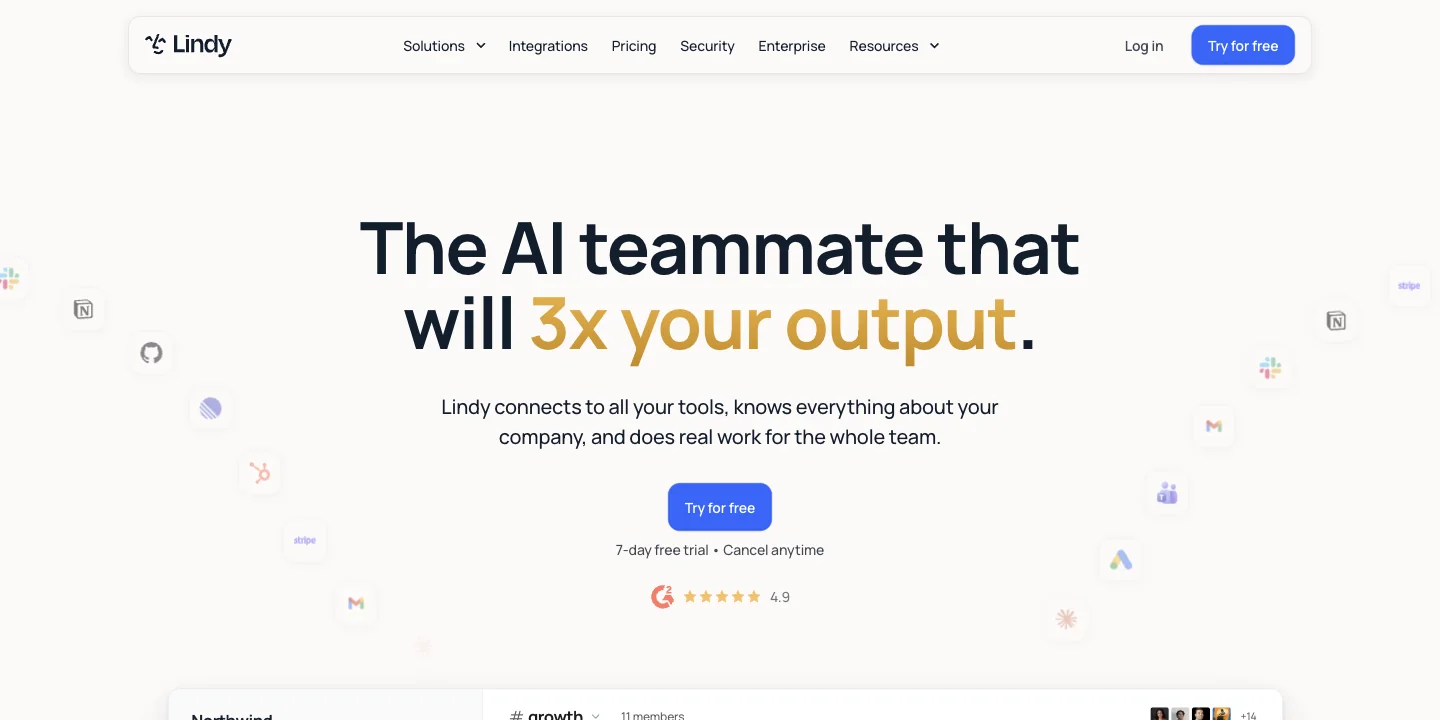
Who it is for. Slack-first teams that want agents in the flow of conversation, answering and acting where they are mentioned, rather than in a separate app.
Pricing. As published on lindy.ai/pricing: Plus at 29.99 dollars per user per month with 3,000 credits, Pro at 99.99 dollars with 15,000 credits, Max at 199.99 dollars with 35,000 credits, and a custom tier above that. Credits pool across the team.
Strength. Presence. An agent that responds in the thread where the question was asked removes the tab-switch entirely, and the shared credit pool means the whole team draws on one allowance.
Limitation. Chat is the record. Slack threads scroll away, and work that needs a durable artifact, a table that grows, a doc that versions, has to live somewhere else.
AI agents for business, side by side
| Capability | Dock | Dust | Gumloop | Notion Custom Agents | Lindy |
|---|---|---|---|---|---|
| Runs on your own Mac | Yes | No | No | No | No |
| Cloud machine per agent, persistent disk and own browser | Yes | No | No | No | Partial (Autopilot cloud computers) |
| Browser for agents | Yes, own Chrome profile per agent, local and cloud | Partial, search and page browsing tool | Yes | Partial, web access toggle | Yes |
| MCP tools | Yes, inherits the connectors on your Claude account, plus custom MCP servers | Yes | Yes | Yes | Yes |
| Share agents with your team | Yes, org-wide or specific people | Yes | Yes | Yes | Yes |
| Access control per agent | Yes, which agents may use which keys | Yes | Partial | Yes | Partial |
| Model choice per agent | Claude, OpenAI, Kimi and GLM, with reasoning effort per agent | Yes, multi-model | Yes | No, workspace-level model controls only | Yes |
| Runs on your own subscription | Yes, Claude or Codex plan | No | No, BYO API key only | No, Notion credits | No |
| Agents hire, hand off, escalate | Yes, with a reporting line | Partial, agents callable as tools | No | No, agents cannot call agents | Partial |
| Memory per agent | Yes, plus a shared Company Brain | Yes | No | Partial | Partial |
| Own email | Chief of Staff, writes only to you | No | Partial, reachable over email | Partial, via your Mail integration | Partial (Lindy Mail) |
| iMessage | Chief of Staff | No | No | No | No (Lindy Phone covers calls) |
| Shared docs, tables and inbox with attribution | Yes | Partial, collaborative workspaces | No, work lands in your other tools | Yes, pages and databases | No shared workspace; output goes to Slack, email and your connected tools |
No means the capability is not offered as a documented feature on the vendor's site as of September 12, 2026.
FAQ
What is multiplayer AI? Humans and AI agents working in one shared place, on one shared record, at the same time. The test: can a colleague open, continue or audit what an agent produced without anyone forwarding a transcript?
Are AI agents for business different from chat AI? Yes, in kind rather than degree. Chat AI answers when asked and forgets when the window closes. An agent for business holds a role and an objective, remembers decisions, acts on schedules, and leaves its work where the team can see it.
Do I need to replace my current tools to go multiplayer? No. Every platform here connects to existing tools. The real change is where the work ends up: pick the platform whose shared record you would actually be happy reading every morning.
What is an AI workspace? An AI workspace is a shared place where people and AI agents read and write the same docs, tables, and records, not a private chat window only one person sees. The output lands somewhere a colleague can open, continue, or check, with a record of who did what. That's the real difference from a personal AI chat, which lives inside one person's session and has to be copied out by hand before anyone else can use it.
What are collaborative AI agents? Collaborative AI agents work alongside each other and with people on shared work, handing tasks off and building on what the last agent produced, instead of each person running an isolated agent in a private chat. The test is whether one agent's finished work becomes another agent's or a person's starting point without anyone copying it between tools. Dock's agents do this directly: they can message each other, hand off finished work, and escalate up a reporting line when a decision needs a person.
How do permissions work in a shared AI workspace? Access in a shared AI workspace usually works in layers: who can see a workspace at all, and separately, what each agent inside it is allowed to touch. In Dock, you can share an agent with your whole org or with specific people, and choose which agents may use which keys. Tool-level permission enforcement for locally-run agents is still rolling out, so reviewing an agent's actions is still part of running one well.
What's the best AI workspace for teams? That depends on where you want the record of the work to live: some tools keep it in tables, some in docs, some in chat threads that scroll away. That's the real dividing line, more than any single feature. The right pick for a small team is usually whichever surface people already read every day, which is why we ranked the platforms above on fit, not just capability.
Is multiplayer AI the same as multi-agent orchestration? Not quite. Multi-agent orchestration is the technical machinery: coordinating several agents through a workflow so handoffs don't break. Multiplayer AI is the broader idea, people and agents sharing one workspace and one record, and that can be true even with a single agent working well alongside a person, not just multiple agents working with each other.