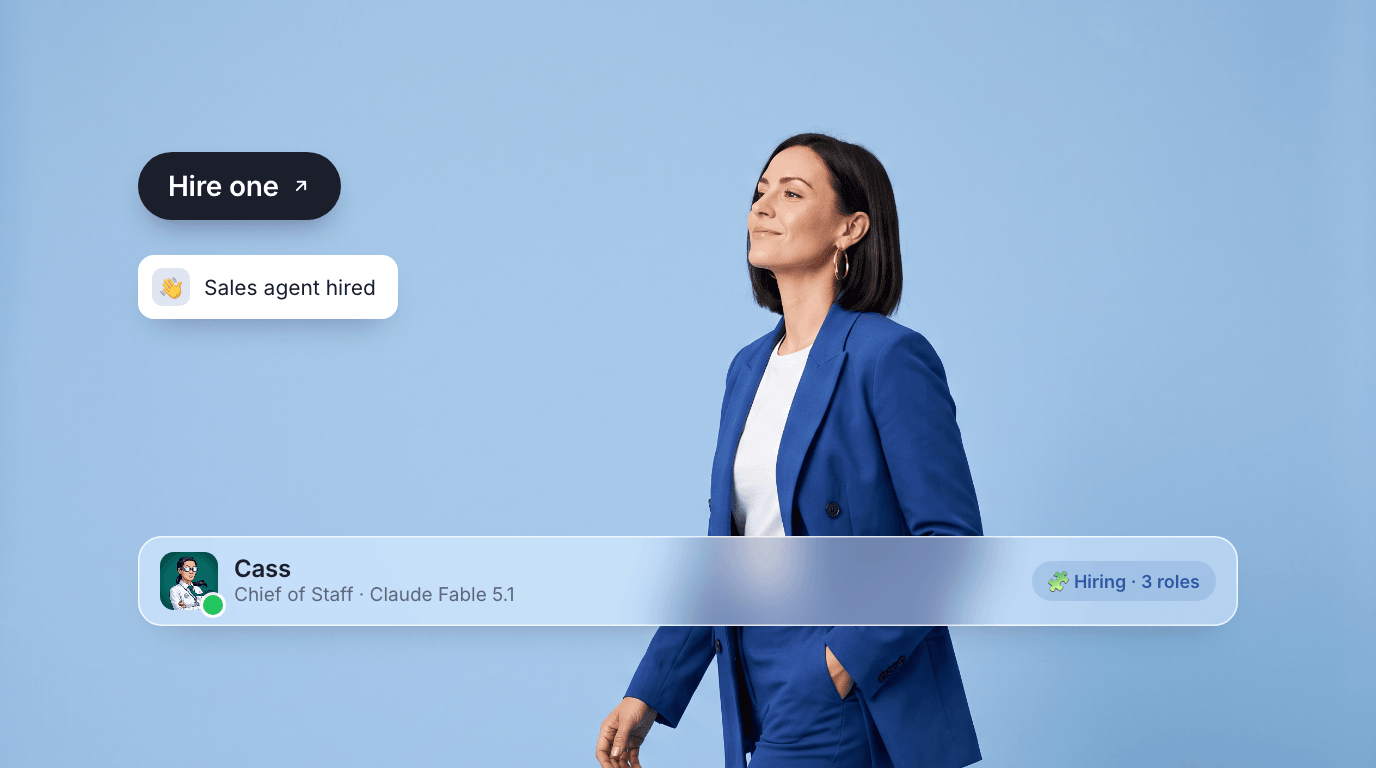
A business agent is an AI agent you hire to do business work. Not software you operate. A worker you hire: they have a name, a job, their own memory, and a schedule. You give them objectives, they do the work, and what they produce lands where your team can see it.
This guide covers what business agents are, which jobs they can own today, what they cost, and how to hire your first one. Our view in one line: hire agents, not headcount. Here is the argument.
The term is changing
"Business agent" used to mean a person. A union's business agent handled contracts and grievances. In law, a business agent is anyone authorized to act on a company's behalf.
The new meaning keeps the old root. A business agent is still someone authorized to act for your business. What changed is that the someone is now an AI agent, and the authorization is something you grant in software: which accounts they can use, which work they own, and when they have to bring a decision to you.
What makes an agent a business agent
Plenty of AI tools answer questions. A chatbot waits for a prompt, produces a reply, and forgets the conversation. It does not know your company, it does not know what it did yesterday, and it does not do anything when you close the tab.
A business agent is different in four specific ways.
They hold a job, not a conversation. A business agent has a role: sales research, the support inbox, the books. You brief them the way you would brief a new hire, with objectives rather than step-by-step instructions.
They remember. Yesterday's decisions, your pricing, the customer who already complained twice. Memory is what makes the second month of work better than the first.
They keep a schedule. Business agents run routines: the Monday pipeline review, the daily inbox sweep, the end-of-month reconciliation. Work happens on a cadence, not only when you remember to ask.
Their work lands in a shared workspace. Lead lists in tables, briefs in docs, reports your team can open and edit. You see what they did, who changed what, and why.
A chatbot answers questions. A business agent owns a job.
One more distinction worth drawing: a business agent is not an "AI employee" in the legal sense. There is no employment contract and no payroll. The phrase points at the same idea, though, and if you have seen it around, the comparison is worth five minutes.
The jobs business agents do today
The clearest way to understand business agents is by the jobs they own. Each of these links to a full guide.
Sales and lead generation
Prospect research, list building, outreach sent in your voice, follow-ups that go out on time, a CRM kept honest. A sales agent keeps the top of your pipeline moving every day, not just the weeks you have time. AI sales agents: what they do and how to hire one.
The support inbox
Triage, answers from your own help content, the known questions resolved end to end, escalation when a ticket needs a human. AI customer service agents.
Social media
A content calendar that actually fills itself: posts written in your voice and published on schedule. AI social media agents.
Invoices
Invoices sent, chased, and reconciled, with the ones that look wrong flagged. AI invoice agents.
Bookkeeping
Categorization, reconciliation prep, a clean handoff to your accountant. AI bookkeeping agents.
Recruiting
Sourcing research, screening summaries, interviews booked, candidate follow-ups sent. AI recruiting agents.
Scheduling
Calendars managed, bookings confirmed, reminders out on time. AI scheduling agents.
Marketing
Campaign briefs, content published on the calendar, competitors watched, reporting on schedule. AI marketing agents.
Business agents by business type
The jobs above compose differently depending on what you run. We keep guides for the business types that ask us most often: accounting firms, law firms, financial advisors, staffing agencies, marketing agencies, bookkeeping firms, IT service providers, SaaS startups, and online stores.
If your business is not on that list, the pattern still holds: start with the job that eats the most hours you should not be spending.
Agent or hire: deciding as a founder
Every new hire is now a choice between a person and an agent. We wrote the decision guides founders ask for most: AI agent vs hiring an employee, what an agent costs compared with a hire, what to hire your first agent for, and the honest counterpart, when to hire a human instead.
How hiring a business agent works
Hiring an agent looks more like hiring than like buying software, and that is the point.
- Pick the job. One role with a clear output beats a vague "help me with everything." The best first hires own something bounded: the inbox, the pipeline, the books.
- Give objectives, not instructions. "Keep the pipeline full and tell me when a deal stalls" is a brief an agent can own. A hundred if-then rules is automation, and automation breaks the first time reality changes shape.
- Connect the accounts the job needs. Business agents work with your real tools: email, calendar, CRM, help desk, books. The agent works where the work already lives, not in a separate app you have to check.
- Set the reporting line. Agents escalate. When something is irreversible, outward-facing, or a judgment call, they bring it to you first. You stay the decision-maker; they stay the operator.
For a step-by-step version, read How to hire your first business agent. If you are weighing this against hiring a human virtual assistant, this comparison is the honest version.
What business agents cost
Dock's pricing is flat per-person monthly: Starter at $20, Standard at $100, and Scale at $200. Each plan includes a monthly allowance of business credits. There is a free trial, so your first agent costs nothing to evaluate.
Compare that to the work it replaces. A part-time virtual assistant runs several hundred dollars a month. A single missed invoice can cost more than a year of Starter.
Where business agents fall short
A fair guide says this part plainly. Business agents do not answer your phone. They do not replace the relationships that close deals, calm an angry customer on a call, or decide your strategy. They are bad hires for work you cannot describe and judgment calls you have not made yourself at least once.
What they are good at is the work you already know how to do and cannot stop doing: the recurring, describable, checkable jobs that eat the hours you should be spending on what only you can do.
Start here
Dock is where you hire business agents: named agents with memory and schedules, working in a shared workspace with your team, on your real accounts. Start for free and hire one agent for one job. The complete guide to that first week is here, and the broader survey of what agents can do across a business is in AI agents for business.
Hire agents for business work. That is the whole idea.